

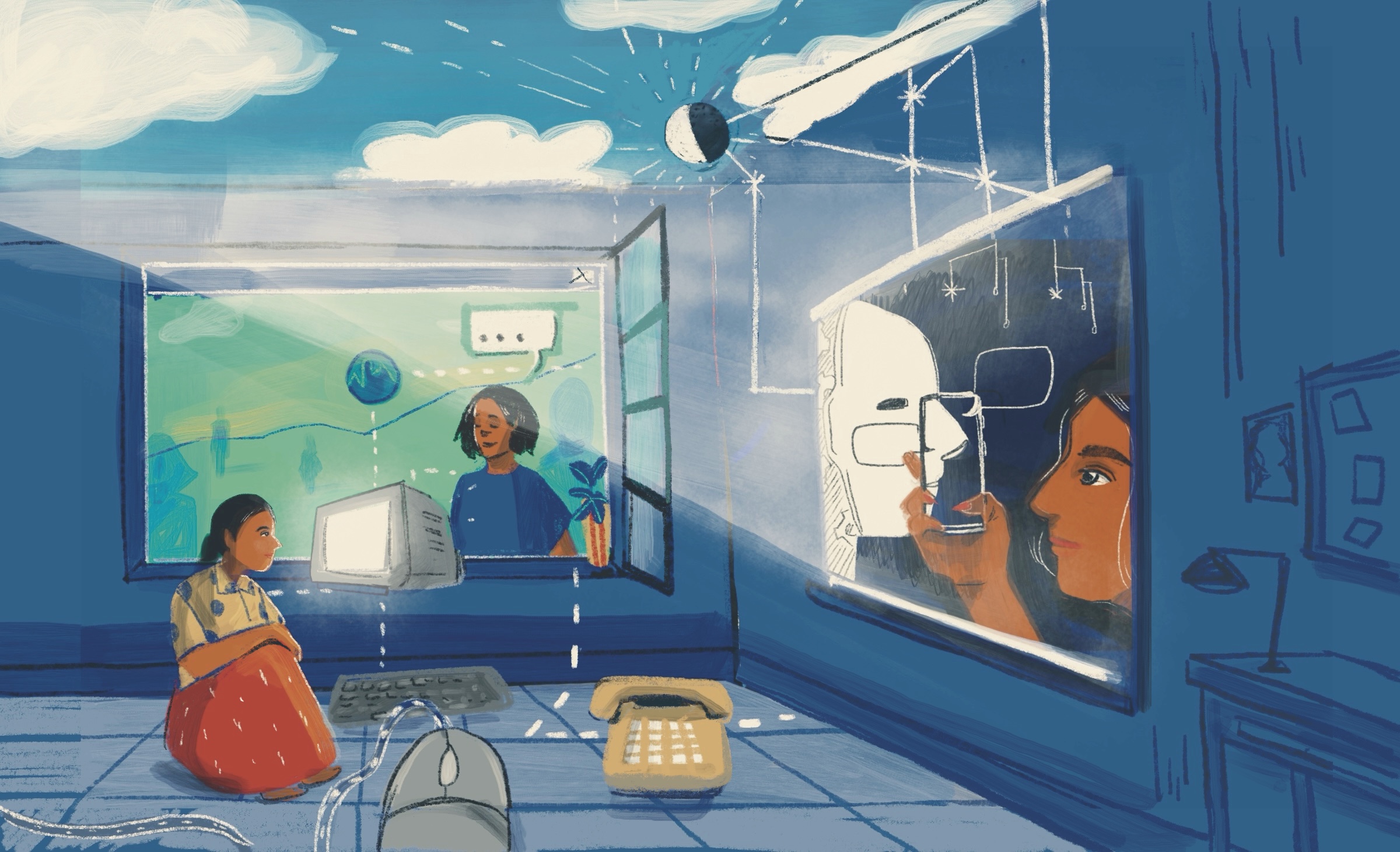
The early internet seemed to offer us so much — including access to seemingly decentralised information and to people across physical borders and boundaries. Since then we have discovered, and been provided with, a variety of new pleasures and ways to communicate. But with the advent of artificial intelligence, we are again left asking: has AI really solved the modern human problems of loneliness and uncertainty, or has it found a dangerous new way to encash vulnerability?
Vauhini Vara’s book Searches: Selfhood in the Digital Age is a personal history refracted through the history of technological capitalism. With decades of tech and business journalism behind her, Vauhini shows us how generative technology, a mere imitation of human articulation, reaches a dead end when it comes to communication. She traces the then and now of digital innovation, and what is being mediated for us emotionally through the companies that design our personal chatbots. You can read an excerpt from Searches: Selfhood in the Digital Age, published in 2025, on our website here.
Shabani Hassanwalia: Your book is a history of the internet as well as a history of yourself. Fascinatingly, it also becomes a history of the reader, especially an early millennial reader who came of age as the desktop computer found its sacred place in homes. Since you historicise your life through the entry of the internet, we wanted to start by asking you: how do you feel about the internet today, especially after writing Searches?
Vauhini: When I started writing this book, looking back on my time in the ‘90s using the internet for the first time, I thought to myself: “Oh, the internet then was a site of opportunity, creativity and communion.”
Now that is less the case. I had imagined an almost binary conception of what it was like then and what it is like now: “How did we get from that to this? It’s so much worse now.” But in doing the journalistic research for the book, what was interesting was finding a dynamic that has always existed.
The internet has always been a site for the negotiation of power between the entities that create the platforms that we use to get online and the users themselves.
In the mid-90s, the tech companies behind these platforms hadn’t yet fully consolidated their power or figured out how to exercise it.
The relative power of the users of the platforms was more visible. It was easier to look at the internet as an opportunity, especially for people who had been marginalised in existing offline spaces.
It’s not that the fundamental dynamic shifted. Instead, over time, it became more evident that the holders of power in any system are those who own the medium that we’re using in order to communicate. They’re dictating the terms of our engagement.
I still insist that we — the users of these platforms — do have power, we do have agency. But we have to get increasingly creative and critical-minded in how we exercise that agency, given how successfully the owners of these platforms have consolidated their power over time.
Shabani: Do you think we romanticised the internet a little bit, back in the day?
Vauhini: I was 12 or 13 at the time when my first interactions with the internet occurred, using AOL [America Online] at a friend’s house. At the time, AOL had undertaken this several-hundred million dollar campaign to send physical discs to people’s houses, saying, “Hey, put this in and we’ll give you a little free internet. And after that, you’re going to have to pay for it for the rest of time.” But that’s not our primary memory of that time. We remember what we did on the internet, who we met, what we discovered.
It’s hard to say whether we were right or wrong in our romanticisation of the experience, then. For me, both are true. The foundations for the internet that we have now were set in [place in] the mid-90s.
How the platform owners change the specifics of the platform, and the way they evolved their behaviour over time, happened in parallel to the way in which we evolved with the internet.
There has always been this dance.
It’s not always a battle between the two either — there is a kind of mutual dependence. Now, with 30 years of hindsight, we can try to chart a narrative of how things progressed from then to now. I’m trying to process what that feels like at an emotional level.
Honestly though, my excitement at hearing a dial-up modem and going into a chat room with my best friend was not so different from my excitement the first time I played around with an AI model, pre-ChatGPT.
I wouldn’t pretend that I’m so jaded or all-knowing that when I encounter a new technology now, I do it with a fully critical mind that can say: “This looks cool, but it’s here to exploit us.” I still, simultaneously, think to myself: “What are the ways in which we could be exploited by these technologies?” and “Isn’t this interesting?”
Shabani: Your book helped us make the connection that there is a historicity to our relationship with technology that works in loops. What were some of the most significant patterns that jumped at you, over the last 25 years of the internet and us?
Vauhini: As a technology reporter, I had always conceived of the relationship between tech companies and their users as a combative one, in which our power was pitted against their power.
And that is true. At the same time, I realised over the course of writing the book that their power — and their rising wealth — was completely bound up in our willingness to use their products.
Some people have read this book and thought I am saying, “Well, on the one hand, technology companies are bad. On the other hand, they’re good.” [laughs] On the one hand, they exploit us, but on the other hand, they help us. I was more interested in uncovering the way in which those two concepts are intertwined. It wasn’t that they hurt us and also they help us. They hurt us because they help us.
If all of us decided tomorrow not to use Amazon and Meta’s products, Google’s products, and OpenAI’s products, those companies would [cease to] exist. We have to account for the fact that there is something that they’re providing us with, [something] that we appreciate. Therefore, we use these products and, therefore, the wealth and power of these companies keeps growing.
Each of these companies promises us something specific. It turns out that their business model is built on extracting that same specific thing from us.
The first company I write about is Google, which promises us information. Google’s business model is, in fact, built on extracting information from its users and from the world.
Similarly, Amazon promises us efficiency: a kind of information, commercial information specifically, that’s going to make our lives more efficient and lower costs for us. But by collecting all that information — about how much things cost and what supply chains look like — Amazon is able to then undercut its competitors, and exploit workers and the environment, to benefit itself. That’s the business model.
Meta promises to connect us to one another, and Meta’s business model is built on benefiting from learning about the connections among us. OpenAI promises, with ChatGPT, to give us language. Its business model extracts language from us, including when we’re using the product itself, in order to improve its models.
With all of these companies over time, you can just look at their mission statement about what they want to provide, and then ask yourself, well, how are we actually providing that to them? And in every case, that dynamic exists.
Shabani: If that’s the business model, what space is there for resistance? Sometimes it feels like firing at a beast with a pellet gun. Is that what it is? Or do you genuinely see possibilities of resistance that could shake the structure a little?
Vauhini: I found myself raising those questions in my book more than I felt myself capable of answering them. That said, my instinct — or my theory — is that, to an extent, these companies’ business models have been built on a totalising, even totalitarian, approach to ideology and to influence.
One way of framing the problem is this: How can people working out of different traditions — ones that are in tension with totalitarianism — ever amass the power that these platforms have? Framed that way, it’s not possible, you know?
But if you say: The approach they’re taking is this totalising one, so is there a way in which resistance can take a different form?
I am interested in asking how success can be defined in terms other than the ones big technology companies use.
[For example] by how many people are part of a movement, or its reach in social media followers or how high its efforts are ranked on search platforms results.
I am intentionally not defining what those terms should be. What if the counter to this totalising way of looking at things is to have a multiplicity of ways in which to think about what we offer in response?
It’s sort of half-formed. But what I wanted to be intentional about not doing in the book, and also in conversations, is saying, “Here’s what we propose, the one correct response would be X.” Because that would be replicating the rhetoric that there is one correct approach.
Shabani: That would mean redefining not just success, but even resistance. It could be anything. It could be a boycott —
Vauhini: Or it could be an art project. Yes, exactly.
Shabani: A really significant part of your book your sister. It’s a really unusual way to the story of technology — through the death of your sister.
I went into my own rabbit hole. I asked GPT: What is the history of grief and mourning coming together with tech? It gave me a listicle.
In 2012, when Facebook had just taken off in India, I made a documentary called Online and Available. Its main argument is that the online and the offline are not separate; [they exist in] a continuum. One of the protagonists was a woman who ran a blog called ‘Indian Homemaker’. She was the mother of a 21-year-old college student in Delhi, a girl who was the first person to die from dengue in India. Until then, no one had known that you could die of this fever.
The process of her mourning happened entirely on this blog site. In fact, when we went to shoot with her, she kept telling us, “You don’t understand the support I’m getting online.” Because there was a lot of judgment from everyone, like: what are you doing, have you lost your mind, why aren’t you spending time with your husband? Why don’t you mourn the traditional way?
She told us, “These [the blogosphere] are my people, and they understand. I talk about my daughter and I share her photographs and they do things with them. They write poetry.” The memorialising was continuous.
GPT-3, of course, told me that throughout the history of tech, we have tried to imbue it with our emotions. When the telegraph was invented, we said the dead were speaking to us across the electric lines. When Thomas Edison invented the phonograph, it was that we were recording the voices of the dead. When the camera was invented in the 1800s, there were images with multiple exposures, and everybody said the figures in them were ghosts. It was a way to keep the ghosts alive.
So, in many ways, we have tried to induce the machines that we have built to do what our memory cannot do, or what we cannot do. Or what we feel we are not able to cope with. Most often, it is death.
In that light, I wanted to talk about what your essay ‘Ghosts’ [and the revised version of it that appears] in this book has done for you. What did the machine in this case help you do, that a human wouldn’t have been able to?
Vauhini: That’s a really thoughtful framing of the question, so, thank you. I hadn’t thought about it in those historical terms myself.
I got access to an early predecessor to ChatGPT called GPT-3. I wondered, once this becomes a product, what will OpenAI promise to us? And the answer that came to mind based on the way GPT-3 worked, which was different from ChatGPT, was:
well, the way the product works is that you give it language and then it promises to produce language that imitates the style and substance of what you’ve written.
This was all still an intellectual exercise. Why would anybody need to use that? My answer to myself was that sometimes there are things we struggle to talk about, especially things that are emotionally difficult. That was the intellectual framing that led to ‘Ghosts’; I thought, well, I have something like that — the death of my sister.
When we were both young, my sister and I were super, super close. It’s something that I still struggle not just to write about but also to talk about. I think part of the reason communication about death, or about the people we’ve lost, is particularly difficult is that when we speak about something or represent it in whatever form, it’s not the thing itself.
Like when I say “book”, the word itself is not a book. We’re fine with that dissonance generally.
But when we’re talking about loss and grief, the gap between saying the thing out loud or writing it, and the thing itself that doesn’t exist, feels more painful.
It becomes deeply clear that the words themselves, the representation itself, is never going to resurrect the person. That’s where my mindset was when I started writing ‘Ghosts’.
But I didn’t think it was [going to be] an essay. I said to myself: “What would happen if I went to this technology tool and put in a sentence about my sister? Maybe it could communicate for me, and to me. That would be nice.” And that’s where this project started.
I’d been experimenting in different ways with GPT-3 [at that point]. I kept trying to get GPT-3 to write about my actual experience of my sister’s death, my grief over the loss. It kept producing imitations that, over time, got closer and closer, but never really successfully channelled what I was experiencing — understandably, because it’s not me. It was not a technology capable of doing that.
It was the fact that it couldn’t that led me to write in response to, but also in opposition to, what this product was producing. It challenged me to confront that there was no technology product for [my need]. I realised I was going to have to do it myself.
Some people read ‘Ghosts’ as this technology product actually communicating something real about grief. This was really interesting, but it wasn’t the level of rhetoric I was especially interested in. I wanted to highlight the way in which this product fell short. For that reason, in the version of the essay that appears in the book, rather than writing most of the text myself and then having ChatGPT or GPT-3 have the last word, I ended the essay in my own words, because I wanted to make that clear.
Shabani: Do you feel that during this mourning process, the LLM did help mediate… something?
Vauhini: Well, there are a couple of things to unpack. I wrote the essay from the position of the speaker or narrator. In other words, I wasn’t saying to GPT-3, “Write me a story about my experience,” in which case GPT-3 would be the narrator and I would be in the position of the reader. I was saying: I want to write this, do it for me.
Traditionally, any piece of text is a communication act between the narrator and the addressee. What makes the text a text is the fact that some communication is taking place through that text, and the meaning is kind of co-constructed by both sides. I think that’s where I would locate the value of a piece of writing.
With a text generated by AI, there’s no meaning generated by the product itself. All the meaning that exists there is the meaning that’s interpreted by the reader.
That kind of meaning is located only in the consciousness of the reader. For example, in ‘Ghosts’, GPT-3 goes on this recursive loop where it says, “I’m a ghost, and I’m in a spaceship, and I’m hurtling through the universe, I’m a ghost, I’m in a spaceship, I’m hurtling through the universe,” over and over and over.
On a technical level, what’s actually happening — and I spoke to someone at OpenAI shortly after writing the essay to explain this — is that having been given such a large chunk of text, the model had gotten stuck in a technical loop. It wasn’t creating that pattern of language for reasons having to do with grief. It was just glitching.
As a reader, I can interpret that in all kinds of different ways. It can replicate the recursive experience of being in grief and not being able to get out of it, but that interpretation comes entirely from [me]. I know for a fact that GPT-3 didn’t create that loop because it replicated grief. It created that loop because it was glitching. But I can read meaning into it, and that’s satisfying to me as a reader.
But it’s not satisfying to me as the author.
Shabani: You speak a lot about language in the book — the whole chapter on learning Spanish, your relationship with Google Translate… I was struck by what you arrived at through your language piece: the continuing homogenisation of language thanks to the digital sphere. Considering we [often] assume digital translations are offering us multiplicity, how did you get there?
Vauhini: I was actually thinking about this when you mentioned asking ChatGPT about the history of technology mediating grief. Wait, where are you located?
Shabani: New Delhi.
Vauhini: In Delhi, I think the product will function a little differently than it does here [in the US]. At the same time, I would be surprised if ChatGPT had offered you examples from an Indian or even an Asian context when you asked about grief. I would imagine that a lot of the history would have come from a European or American context.
You probably appreciated the part in the book where GPT-3 gave me this entirely European male[-centric] history of art. When I asked about women, or non-binary people, or people of colour, it was so flummoxed by the question that it came up with fake people.
That feels very bound up in the point you’re making — that yes, in ways that we’re sometimes not even conscious of, these products or AI language models are not just the most recent iteration of the [software]. They have been homogenising language over time.
An example that I love from the book is where my dad started using ChatGPT to edit his emails. In one email, one of the very few edits ChatGPT made was to change his Indian English construction into American English construction. He had written “then only”, and it changed this to “only then”.
There are so many more people living in India than in the US.
One could argue that if you’re determining ‘correctness’ by number [of speakers], Indian English is a more correct version than the American English construction.
And yet, ChatGPT is implicitly saying to my dad, “If you want to use proper English in your email, you need to use the American English construction.” It’s not only prioritising certain kinds of language, but also convincing us that certain kinds of language should be prioritised.
Shabani: You were saying something through that Spanish chapter, ‘I Am Hungry To Talk’, about how there is always the risk of communication falling through the cracks. And yet, one carries that risk and tries to arrive at something. You said that what you appreciate is not the perfect articulation of communication, but something else. Would you like to talk a little bit about that?
Vauhini: The argument of the tech companies offering these language products that claim to be able to translate language is, “Listen, you don’t even have to try anymore to speak a language other than the one or two languages that are native to you. You can just use this product and it’ll do the work for you.”
What became clear to me, through the process of writing this chapter, is that what is valuable about communication between people is the effort itself. It’s the fact of trying, and of trying in a way that reflects one’s own perspective. If we turn to technology to do that work, it’s not clear the extent to which that that bridges the gap between … people.
Shabani: We’re developing a film that came from this data point that has emerged, of people using GPT for companionship and therapy. Everyone’s talking about it. We did a series of interviews, and the [kinds of] relationships people were forming with GPTs are staggering. I was wondering — has this come up in the work that you are doing, or are going to do? For me, that’s a critical piece of the selfhood story, these deep relationships that we form with machines.
Vauhini: We live in a world in which actual human relationships have become fragmented, largely because of technological capitalism. And now here is a product that offers a “solution” to that problem.
But peel back the onion and try to understand. What is happening underneath that interaction? ChatGPT, or Claude, or Gemini — these products are not people. We can’t have relationships with them the way we have relationships with people. Then who are we having a relationship with?
I just finished Arundhati Roy’s memoir, Mother Mary Comes To Me. Roy created a character on the page to narrate this story, and this character was a version of herself. She created other characters, versions of her mom, her brother, her husbands and so on.
I read that book and I knew I was reading a constructed world. But some communication was taking place. The book was the medium through which she and I were in dialogue.
If that’s the case, the question becomes this:
when I’m talking to ChatGPT and forming a relationship with it, if we can agree that this is also a constructed fiction, who am I really talking to through the product?
And the answer, of course, is OpenAI.
OpenAI also has announced what its goals are: to become hugely financially successful, to have AI running society and doing all the labour in the world, such that we don’t need to work anymore, and we’ll get paid with little checks mailed to us every month from OpenAI itself.
The companies themselves, especially OpenAI, tend to be quite explicit about why they’re doing what they’re doing, you know. So, in the same way that we do this with [authors], we can look at the companies and ask, what is their goal in this communication with us?
I’m not saying that people’s experiences with AI aren’t real. They’re not meaningless, but as with that GPT-3 conversation I had, the meaning is being constructed entirely by the human reader, the user. Is that enough? I don’t know, and maybe that’s not for me to say. But how does it compare to an actual human relationship?
Shabani: I wanted to talk about how you deal with AI in your book, which is quite remarkable. It was like being in an interrogation room where you slowly go from friendliness to implication. Did you know you were going to interrogate AI the way you did when you set out to write the book?
Vauhini: I didn’t know what would happen. I finished the book, with the actual chapters, and then thought: what would happen if I shared it with ChatGPT? I thought to myself that if something interesting happened, maybe I’ll include it, but if not then I wouldn’t. I actually did this a number of different times, to see if it turned out similarly, and it did turn out relatively similarly each time.
I was thinking about the traditional elements of craft, because I was asking myself: if this is part of the book, then I have to think about what the plot arc of this conversation is. I was hoping that readers realised the chatbot was using very rhetorically charged language. I’m interested in the reader noticing that and asking themselves, is the author going to notice this? And then have the satisfaction of me responding.
What would happen in this exchange reflected the ideas that the whole book was about. It was kind of perfect.
Vauhini has been a reporter and editor for The Atlantic, The New Yorker, and The New York Times Magazine. She has authored The Immortal King Rao and This is Salvaged. You can find her book Searches: Selfhood in the Digital Age here.
-
Shabani Hassanwalia is the Editor of The Third Eye.