
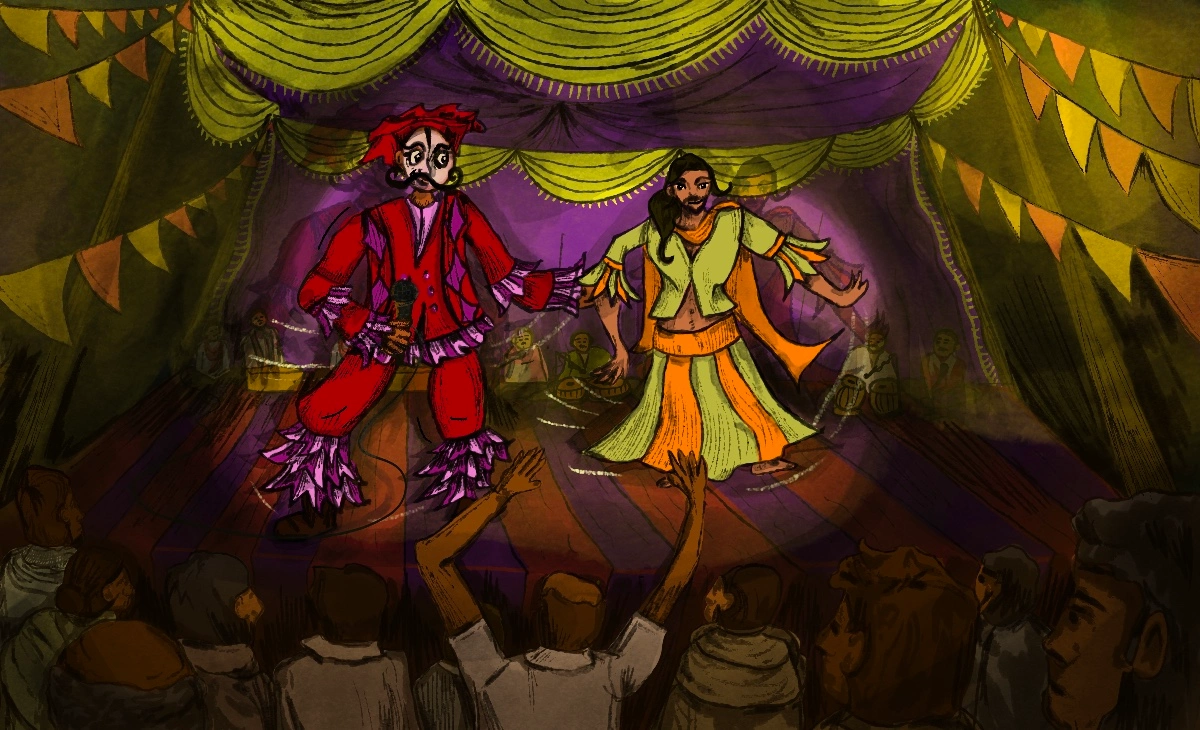
The figure of the ‘stand-up comedian’, a lone performer who directly delivers jokes to the audience mostly without props, is very new to South Asia. But the ‘jester’ or the ‘fool’ is a scandalous — and thriving — figure in popular folk theatre, an art form that continues to captivate the majority of the region. In this essay, Dr. Brahma Prakash presents the jester’s bodily excesses and verbal distortions against the pronouncements of the Natyashastra. He shows how comical pleasure has always been dangerous, not only to the political ruling class, but also to modest gatekeepers of culture.
1.
A comedian has been an important stock character in the traditions of folk theatre in India, with different names in local and regional languages.
The comedian’s character and movements disturb gendered expectations assigned to the body, with enactments that disrupt ideal male roles (a comedian in folk theatre in India is usually male) and do not fit into ‘appropriate frames’. Comedians represent a dangerous mix for various reasons, portraying themselves as an almost trickster figure whose comedy thrives on thwarting expectations. Within the regime of the standard aesthetic perception, they embody low forms of pleasure.
(An interview with Banka Paswan. Here he recollects his performance as ‘Joker’ character which he played on stage as Mohan Choti, two decades back. Video Credits – YouTube/@basantbihar7559)
Instead of creating a binary, a joker creates a playful relationship between pleasure and danger, perhaps exceeding the limits of both. This essay tries to problematise the questions of pleasure that are usually idealised and standardised in a broader gender discourse.
I discuss the problem of comical pleasure in three different but interrelated aesthetic and performance contexts. While the ancient Indian dramaturgical text Bharata’s Natyashastra discusses it in relation to hasya (humour) rasa (pleasure), regulating comical pleasure has been one of the primary concerns of modern bourgeois theatre. Both the Natyashastra and modern theatre tend to produce idealised pleasure (within their own time and contexts) and see comical pleasure with suspicion, or as too much. Against this background, the comedians of the folk theatre offer us something more interesting, despite having problematic approaches to several issues.
They laugh through their bodies and parody our pleasure.
What is interesting is the way caste, gender and hierarchies are enmeshed in the questions of laughter and pleasure. The Natyashastra tells us that the way we laugh and participate in pleasure shows our class and status. One does not laugh innocently; rather, one laughs with one’s social status.
II. The Pleasure of the “Lower Orders”
On the floor of Parliament in 2018, Renuka Chowdhury’s laughter was compared to that of Surpanakha, a character in the Ramayana whose laugh is considered loud, uncontrollable and so aggressive that it does not maintain decorum. It is said that it was this laugh that led to her disfiguration. Many Indian texts have discussed the standards of comedy and laughter based on the social classes, and it is especially the laughter of female and lowbrow characters that is viewed as a threat.
The Natyashastra, while discussing hasya rasa, talks about humour and laughter primarily in relation to deformities. It offers us an allegorical reading in which social and aesthetic considerations come together. If the sringara (erotic) and veera (heroic) are idealised emotions, hasya is seen as a failure of the idealisation — or it is the failures of the ideal that incite humour and the comical. Once the erotic and heroic become the standards, the rest are seen as failure. If Bharata sees it as the failure of sringara, other commentators see that it can be the deformation of any standard rasa — heroic, karuna (sorrow/ compassion), or others.
विपरितालङ्कारैर्विकृताचराभिधानवेषैश्च ।
विकृतैरर्थविशेषैर्हसतीति रसः स्मृतो हास्यः ॥ ४९॥
[viparitālaṅkārairvikṛtācarābhidhānaveṣaiśca |
vikṛtairarthaviśeṣairhasatīti rasaḥ smṛto hāsyaḥ ||]1
Do not get anxious after seeing this shloka (verse) in Sanskrit. The above verse describes how hasya (laughter) arises from absurd ornaments, distorted actions, speech, dress and peculiar situations. Translator and commentator Adya Rangacharya has translated the verse as “with [the] wrong kind of ornaments, with queer behaviour, with distorted (incoherent) speech and with strange costumes and disfigured gestures, when one laughs it is hasya rasa”.2
A text obsessed with classification and categorisation, the Natyashastra also talks about the hierarchy of jokes and laughter, in which comical laughter is considered the lowest. According to the text, a comedian makes people laugh through disgusting and deformed behaviours. Thus, it places vikriti (deformation) as fundamental to the enactment of hasya rasa. Reading through Mikhail Bakhtin’s formulation of carnivalesque, one can think of these deformations as destabilising and disruptive acts that bring in the grotesque and laughter, with their subversive and transformative potentials.3
However, the Natyashastra makes a qualification about who can be the subjects of satire, comics and laughter. It says that hasya rasa is portrayed mostly by female characters and the lowbrow. They become subjects of comical rasas or the butt of jokes. In another context, it curses the actors who start lampooning sages and behaving ‘comically’ after receiving the knowledge of natya. The sages curse them to be treated like shudras — those who entertain and serve.
What one realises is how intricately the Natyashastra brings social and aesthetic qualification together, by what I would like to term ‘aesthetic casteism’ — in which caste becomes the marker of beauty, ugliness and aesthetics.
For example, in the chapter on prahasna (farce) — one-act plays in which the comic sentiment dominates — the Natyashastra discusses two types: shuddha (pure) farce and sankirna (narrow) farce. Pure farce places high-status characters and vulgar characters in an encounter, leading to the ridicule of gurus, ascetics, Buddhist monks, learned Brahmins et cetera. Under the narrow and low farce, the Natyashastra places the comics and laughter of courtesans, menial servants, eunuchs, rogues and so on, who appear in immodest dress and make obscene gestures (Natyashastra 18.103; Rangacharya 154).
The Natyashastra divides hasya into six categories: smita, hasita, vihasita, upahasita, apahasita and atihasita. These categories indicate the degree to which one should laugh, joke and transgress limits. While smita and hasita are recognised as the gentle smiles and slight laughter of the high class, vihasita and upahasita are for the middle class with slight and open laughter, while apahasita and atihasita are for the lower orders and are recognised by obscene and boisterous laughter.4 Atihasita can be read as excess.
The classification suggests that while high-class people participate in controlled laughter and can regulate their laughter, others fail to do so. This produces gendered, social and caste-based notions of laughter.
It also relates to the question of pleasure: who can express pleasure and who cannot. For example, a person playing the joker of the folk theatre can easily transgress limits, but the same person — who usually comes from low social status — could not dare to make that transgression in his everyday life. In a society where pleasure and desire also bring a set of expectations in the sense of desirable beauty and desirable bodies, here again, a joker questions the very notion of a pleasurable body, a desirable body and pleasurable emotions, by posing deformation.
(Actors performing as ‘Joker’ on stage)
Video Credits – YouTube/@pradeepprajapatifoodfanmzp7371 and @mazzamaro01)
What we gather from common understanding is that not all pleasures are dangerous, but there are bodies and forms of pleasure that incite danger; the pleasure arising from the joker and buffoon of folk performance being one.
However, their acts are read as apolitical or un-agential. It is understood to be a false pleasure, in the line of false consciousness, because fools cannot understand the meaning of pleasure even though they can enjoy it. In other words, theirs is the pleasure that one feels but does not think about or explain.
Philosopher Giorgio Agamben has discussed this problem in relation to taste, saying, “taste enjoys beauty without being able to explain it”.5 He sees it as one of the fundamental problems of the division of knowledge, in which some forms of pleasure are declared as the doctrine of pleasure (in relation to ethics) and others are relegated to the low and bodily.6 These pleasures are seen as instinctive, impulsive, irrational and reactionary.
Stock comic characters like buffoons, fools and jokers of folk theatre and cultural performances in India not only perform ‘dangerous pleasure’ by participating in the ‘base pleasure’ and ‘comical pleasure’, but also perform a critique of an idealised and regulated notion of erotic and pleasure.7 In other words, what emerges as dangerous in a comic performance also opens a potentiality to think about the power of base pleasure in its subversion and problematics. I reflect on these questions through the figure of the comedian of various popular folk theatre and performance traditions, including Bidesia, Naqal, Nautanki and others. The point here is to present a structure to show how some forms of pleasure become dangerous, including the pleasure coming from such performances.
III. The Comic Pleasure of a Joker
A clown or a joker, known by different names (buffoon, clown, comedian, bhand, trickster) is one of the most hilarious and thriving figures of folk theatre in India. They are called Labaar (liar) in Bidesia, Bikta (literally, the disfigured) in Bidapat Naach of Bihar, Harami (unwanted or illegitimate) in some forms of Nautanki, Naqali (the fake or the mimic) and Bighla in Swang and Naqal traditions of Haryana and Punjab, Bhanr, Sangdar and Chor in Bengali theatre, and comedians in Isai Natakam (also known as Special Drama) of Tamil Nadu and so on. In Sanskrit theatre, they were treated as the bastard sons of Bharata.
A comedian of folk theatre, in an ideal sense, is a disruptive character; difficult to contain. They tend to corrupt social norms, make fun of gurus and pandits, mix the daily with divine and the erotic with death, and so on. Most often they cross-dress or play quick-witted and gender-fluid roles, sometimes to affirm the binary and sometimes to break it down. In the few studies on jokers and buffoon characters, the focus has largely been on their language and speech acts, not so much on the body and movements.
How do those movements and gestures convey base pleasure? In Punjabi folk theatre, Ranga, the character who represents authority and intellect, maintains a serious, superior and authoritative tone and intelligence, while Bighla pretends naivete, stupidity and carnal desire. Punjabi playwright and theatre critic Swaraj Bir Singh asks why the body of Bighla is naked and Ranga is dressed up. Why is Bighla slapped again and again by the Ranga? Claire Pamment, in relation to Punjabi theatre in Pakistan, mentions one enactment:
Bighla: Somebody got the arm and no one could understand what the arm was. Lots of journalists from outside the country were invited to identify it.
Ranga: Then what?
Bighla: Then I went and recognised the arm.
Ranga: But what is that arm?
Bighla: It is the same arm that has been stuck in our arses for 30 years.8
Here, the simple act of base pleasure punctures the spectacle of the authority. We could say that the naked body of Bighla is a social commentary on an unequal society, but this body also represents a person made of body (only body) in all its materiality (as opposed to the ephemeral intellect).
Katja Vaghi rightly argues that “academic research studying humour often neglects the body, mostly focusing on language and how jokes, gags and other puns work” (2024: 52).
But the body still remains at the centre of jokes and comedy. While bawdy jokes carry the bodies, many times words and the body can also go in opposite directions, to show caricature.
It may also happen that words or speech acts are full of embodied language and the body is creating speech acts through gestures. Unlike puppets, whose bodies are made of joints, a joker’s movement is made of subversions. They move to unmake their own movements; they gesture power to bring it down. Even if they have to reinforce the hierarchy, it appears as if they are saying, ‘I am a joker but you are not; I am allowed to perform this subversion because I am a joker, but you are not.’ The comical act does not guarantee a radical subversion, but in the very act of subversion, the hierarchy is enacted. Yet, at the same time, when a joker subverts the norms, they show the hole in our sense of pleasure and moralised aesthetic discourse.
Claire Pamment, in her work on bhands (buffoons) of Pakistani performances, talks about the larger politics of elite theatre in which the bhand can be located as a lowbrow performer. She discusses the bhand mode in three different ways: the oppositional inherent in performance; second, the dual functions of being able to assert and debunk normative social structures; and third, playful reinvention. She has again placed this bhand mode in relation to the subversion and the degradation of high morals. The bhand improvises across genders, social types and religions and remains unfixed, both in relation to the enactment of gender and the performance of pleasure.
Scenario!
A joker of Bidesia comes dancing onto the stage. His dance movement is often full of gyrating sexual movement, more focused on the lower parts of the body. He wears colourful clothes, a cap on his head and a face painted contrasting black and white. A sword is fastened around his waist. He pays respect to the orchestra team sitting on the stage, but when they acknowledge and preen the gesture, he takes a round of the stage, showing them his danda, a sexual gesture of ‘f*** off’. He comes to the stage and pays his gratitude to singers and musicians.
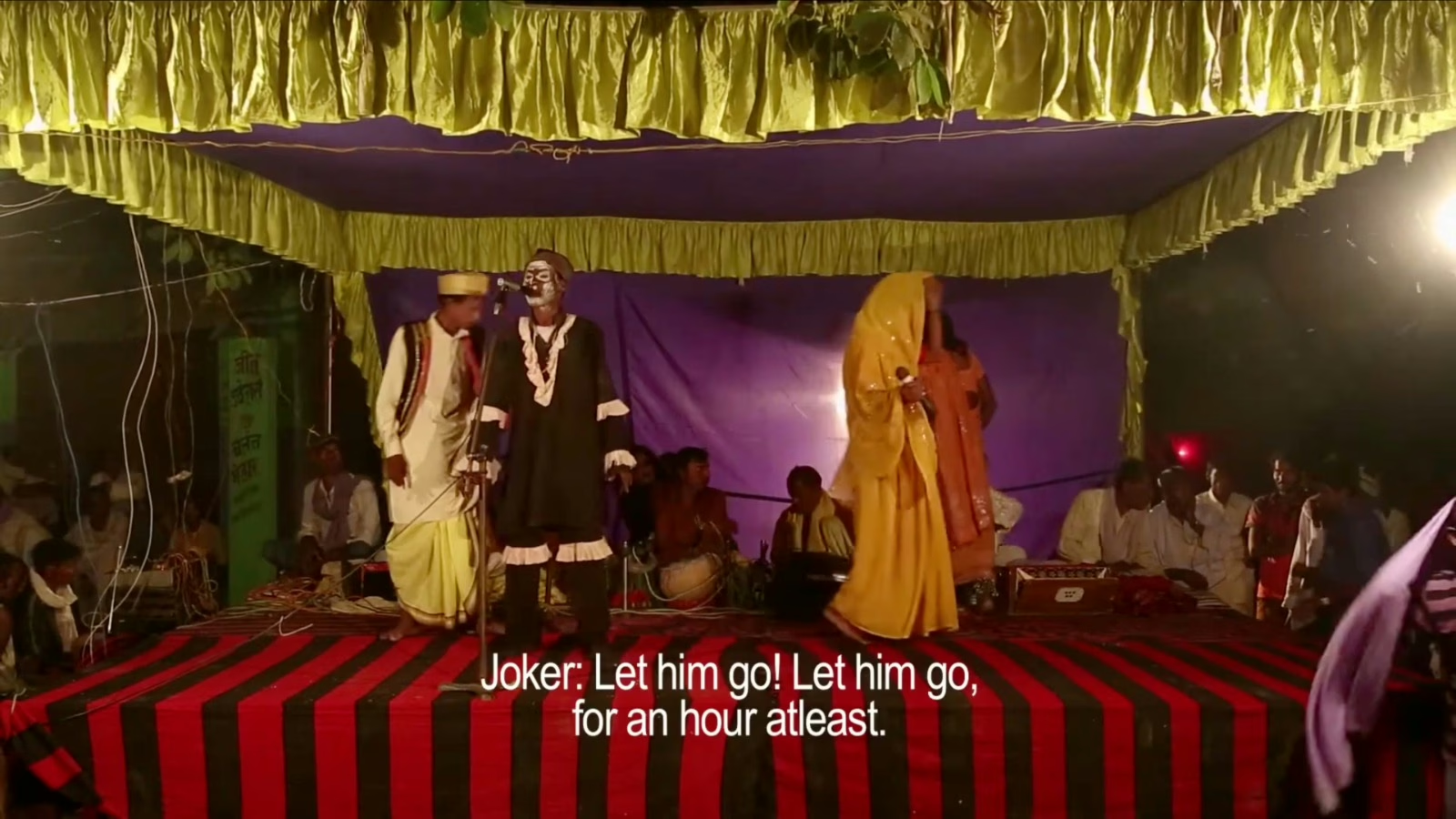
In a scene when the ustad of the Bidesia party leaves the stage after introducing the characters and appealing to the audience to maintain calm during the performance, the joker of Bidesia slowly appears behind him. He too appeals to the audience to be friendly, but he does this in his own style, in a way that is immediate and visceral. He occupies the front stage, takes the microphone and makes this announcement:
‘Don’t worry if you have come to watch our Bidesia performance. You will enjoy it. Be peaceful. Don’t make unnecessary noise or I will demean the name of your village among other villages. Enjoy it (with an obscene gesture). It will be a good f****** experience for you, because you know our performance is always f****** (says in the manner of a riddle. The audience laughs and shouts). You as the audience may ask, why is it so? Ask… ask (pauses)’.
‘Why is it so?’ (some teenagers, while laughing, ask the joker).
‘Listen… listen … maybe tomorrow our party will travel to other places to perform, and people may ask there, ‘How was the performance and the audience there?’ If you people don’t treat us well, then, of course, we will be angry and may say, ‘Damn! Don’t take their name! They were simply ungrateful f****** audiences.’ But if you treat us well and be peaceful during our performance, will give an applause even if you don’t like it, then (a dramatic pause) we will say, ‘They were great, they understand our art. Brother! …aaha…uhhu … eheh. Wonderful they were … simply f******!’ Thus, I say, ‘Our performance is always f******.’
Amidst the laughter, a member of the audience comments, ‘What a f****** joker… bloody… he will give us a stomach ache [after laughing so much]’. Among the enthralled audiences, I could not stop myself from saying, ‘What a f****** performance!’ The so-called fourth wall of theatre, erected between the performer and the audience, is shattered in moments like this. A visceral exchange takes place when a Bidesia joker and its audience hurl verbal and gestural comments at each other.
IV. Comical against the Classical
Can the comic become a critique of classical dance and body-making? Let us look closely at what creates the dangerous-pleasure zone they operate within. Each of their parodies centres on bodies, even if the target is the tradition that is processed through the body.
Ideal pleasure is located in the ideal notion of the body. As most folk epics are full of the portrayal of ideal love and pleasure, comedy stages become the proper, domesticated and ‘romantic’ site of regulated pleasure. Here, a comedian enters and makes fun of such pleasure.
The idealisation of beauty and pleasure has been very much a part of contemporary body discourses, as well as traditional epic performances. Against this background, a comedian of folk theatre brings incongruence.
They do not fit into the frame — they keep falling out of the frame of an idealised body and idealised pleasure. Henri Bergson would underline that the person we laugh at is “the comic [who] expresses, above all a special lack of adaptability to society”.9
These comical characters are brilliantly inescapable when it comes to adoptability of norms. Such jokes and pleasures do not suggest some alternative ideology of pleasure, but they do suggest embodied practices — a choreo-political move that is not yet defined and perhaps remains outside of the framing discourses. They are always unfit or inappropriate, like the tramp. In his autobiography, Charlie Chaplin explains the birth of the Tramp costume as follows:
I had no idea what make-up to put on […] However, on the way to the wardrobe, I thought I would dress in baggy pants, big shoes, a cane, and a derby hat. I wanted everything a contradiction: the pants baggy, the coat tight, the hat small and the shoes large. I was undecided whether to look old or young, but remembering Sennett had expected me to be a much older man, I added a small moustache, which, I reasoned, would add age without hiding my expression. I had no idea of the character. But the moment I was dressed, the clothes and the make-up made me feel the person he was. I began to know him, and by the time I walked on stage, he was fully born.10
More than speeches, they act through their bodies and gestures. Jokers are inappropriate characters who, by the technique of inappropriateness, become the centre of jokes and comedy.
They make inappropriate movements, wear inappropriate costume and dress, speak an inappropriate language and play an inappropriate character. They tend to place the text out of context and take the context out of the text in the very act of contextualisation.11
In Bidesia theatre, they embody inappropriateness at the boundary of tradition and the modern — playing a minister from 900 AD and still wearing a hat from the twenty-first century. Even when the joker makes jokes about himself, it is he who controls those jokes. At the same time, he is the uncontrollable one over whom no authority can prevail. In the narrative of Bidesia, he is the master of jokes, satire and obscenity.
Think about a famous onstage song, enacted by jokers in many Naach traditions of Bihar and Uttar Pradesh: A joker sings ‘ei mahakali’, depicting the terrifying beauty of Kali, and in the next moment, he shatters the goddess’ image by calling her budhiya Kali (haggard Kali). The dualistic frame of pleasure and danger becomes an apt frame to analyse the roles of a clown.
I have pointed out, in my previous work, how classical dance and music as well as modern theatre to an extent, try to maintain the purity of characters and forms, while folk performances of the subaltern communities tend to mix many elements, both as part of performance strategy as well as aesthetics.12 Figures like the joker of folk theatre deploy the aesthetics of defilement. They mobilise comic elements at the level of carnival with excessive presence. Drawing from Stallybrass and White, we can argue that they “flaunt the material body as a pleasurable grotesquerie — protuberant, fat, disproportionate, open at its orifices.”13 Unlike the idealised notion of pleasure, the jokers perform “messy, excessive and unfinished informalities of the body and social life”.14
Though it is difficult to say whether gender is denaturalised or reinforced in the performance of comedians, these figures do open up new dimensions that bourgeois sensibility has erased from our eyes. A joker brings up the materiality of disgust, and it is here one sees pleasure and danger coming together.
The joker’s bodily acts are reminders of some elements that have already been sidelined or erased. In one Bidesia scene, a joker wears a colourful ghaghra with a shirt on the upper part of the body. While enacting the pleasure of sex, he also scratches his itchy belly. The enactment of pleasure looks low and vulgar, but the joker perhaps shows us something.
Some of our best jokes carry sexual and vulgar undertones, with a sense of dirt. In other words, we can say that the best jokes are bodily and earthly; the relationship between the joker and sex acts is not uncanny.
It is not surprising, then, that jokers have a whole repertoire of dirty languages and movements. Jokes are also a polluting act in the regime of excessive puritanism.
Though the regional distinctions of the jokes cannot be completely collapsed, they also share some important characteristics such as the use of the lower parts of the body, the remarkable use of gestures to say the unsayable and entering and breaking what is considered taboo.
Comedy can transcend the body, but it also brings the body back to the earthly level. How do we read the movement and gestures of jokers that are constantly navigating a dualistic frame?
Three positions emerge here. In the first case, mainstream scholarship sees pleasure and danger in a binary position. In the second, there are scholarly attempts to break the binary between these two categories. However, I suggest that a joker would like to work through the third category: creating a playful or joking relationship between two incongruous categories, a performative incongruity.
The joker moves constantly between the sacred and profane. Many times, they move so much that the movements lose their own importance and devalue the performance. A comedian speaks a mantra in perfectly obscene language. They turn mantras into cuss words. They can turn any parts of their speaking bodies into sexual gestures and symbols. Not only do they make parodies of high characters, but also the very notion of love and pleasure.
V. Conclusion
What does a comical figure like a joker do to the idea of pleasure? Both in practice and discourse, there is an attempt to obliterate them: the joker’s pleasure is not considered serious enough and the materiality of the body and corporeality of gesture is not included in analysis or study. While newer discourses and practices of sexuality try to accommodate the subversive side of the comic, and disgust and carnivalesque as part of nostalgia, there has been an apprehension of risk, or transgressing certain boundaries. In Stallybrass and White’s words, “Disgust always bears the imprint of desire. These low domains, apparently expelled as Other, return as the object of nostalgia, longing and fascination.”15 But their return is no guarantee of the danger or the risk they generate. By engendering comical pleasure, a joker of folk theatre brings “a vulgar, shameless materialism of the body — belly, buttocks, anus, genitals”,16 the materiality of pleasure that comes along with danger.
This essay expands on a section on the joker figure in the author’s book Cultural Labour: Conceptualizing the ‘Folk Performance’ in India (2019), published by Oxford University Press.
- See Bharatamuni, Natyashastra, Chapter 6, Shloka 49.
- Rangacharya, 1966, p.58.
- See Bakhtin 1984.
- Venkat, 2023, p. 129.
- Agamben, Taste, p.8
- Ibid.,
- Scholars have argued how such a clear division between the intellectual and the bodily is not possible. Philosophers like Julian Baggini has questioned such division. See Baggini 2018. https://aeon.co/ideas/is-there-any-real-distinction-between-high-and-low-pleasures
- See Pamment, 2017, p. 124.
- Bergson, 41.
- Chaplin, 144.
- See Prakash, Cultural Labour
- Prakash, 2019, p. 151.
- Stallybrass and White,1986, p. 183.
- Same.
- Stallybrass and White,1986, p. 191.
- Eagleton, 1981, 150.
References
Agamben, Giorgio. Taste, trans. Cooper Francis. London: Seagull, 2024.
Rangacharya, Adya. The Natyashastra, English Translation with Critical Notes. Bombay, Popular Prakashan, 1966,
Badiou, Alain, and Nicolas Truong. In Praise of Love. Profile Books, 2012.
Bakhtin, Mikhail. Rabelais and His World, trans. Helene Iswolsky. Bloomington: University of Indiana Press, 1984.
Banerjee, Sumanta. The Parlour and the Streets: Elite and Popular Culture in Nineteenth Century Calcutta. Kolkata: Seagull Books, 1998.
Bergson, Henri, Essay on the Meaning of the Comic. Macmillan and Company, 1911.
Bharatamuni, Natyashastra of Bharatmuni, commentary by Babulal Shukla Shastri, Varanasi: Chaukhmba,2015.
Chaplin, Charles. My Autobiography. New York: Simon and Schuster, 1964.
Elias, Norbert. The Civilizing Process: Sociogenetic and Psychogenetic Investigations. Revised ed. Oxford: Blackwell Publishers, 2000.
Eagleton, Terry. Walter Benjamin, Or, Towards a Revolutionary Criticism. New York and London: Verso, 1981.
Jürs-Munby, Karen. ‘Hanswurst and Herr Ich: Subjection and Abjection in Enlightenment Censorship of the Comic Figure.’ New Theatre Quarterly 23, no. 2 (2007): 124-135.
Pamment, Claire. Comic Performance in Pakistan: the Bhand. London: Palgrave Macmillan, 2017.
Prakash, Brahma. Cultural Labour: Conceptualizing the ‘Folk Performance’ in India. Oxford University Press, 2019.
Stallybrass, P. and White, A. The Politics and Poetics of Transgression, London: Methuen, 1986.
Seizer, Susan. Stigmas of the Tamil stage: An Ethnography of Special Drama Artists in South India. Duke University Press, 2005.
Vaghi, Katja. ‘No Laughing Matter: On the Importance of the Body in Plato’s Humour.’ Études de lettres 324 (2024): 51-70.
Venkat, Vishaka. ‘The Aesthetics of Hāsya and Raudra in Nāṭyaśāstra: Anger as the Flip Side of the Comic Sentiment.” Comedy Studies 14, no. 1 (2023): 120-132.
-
Brahma Prakash is a writer and cultural theorist, and teaches theatre and performance studies at Jawaharlal Nehru University, New Delhi. He is the author of Cultural Labour: Conceptualizing the ‘Folk Performance’ in India (Oxford University Press, 2019) and Body on the Barricades: Life, Art and Resistance in Contemporary India (LeftWord, 2023). Spectacle State: How Hindutva Shapes Feeling and Culture (HarperCollings, forthcoming in July 2026). He has been published in Performance Research, South Asian History and Culture, Economic and Political Weekly, Scroll, Outlook India and others. His opinions have appeared on Al Jazeera, The New Arab, DW News and other popular podcasts in Hindi and English.