
In true feminist fashion, Somrita Urni Ganguly takes the story of Cinderella and shifts the gaze from the canonical curfew-breaking protagonist to her ‘evil’ step-sister. As a result, a fairy tale about true love and fate becomes one about solidarity and liberation.
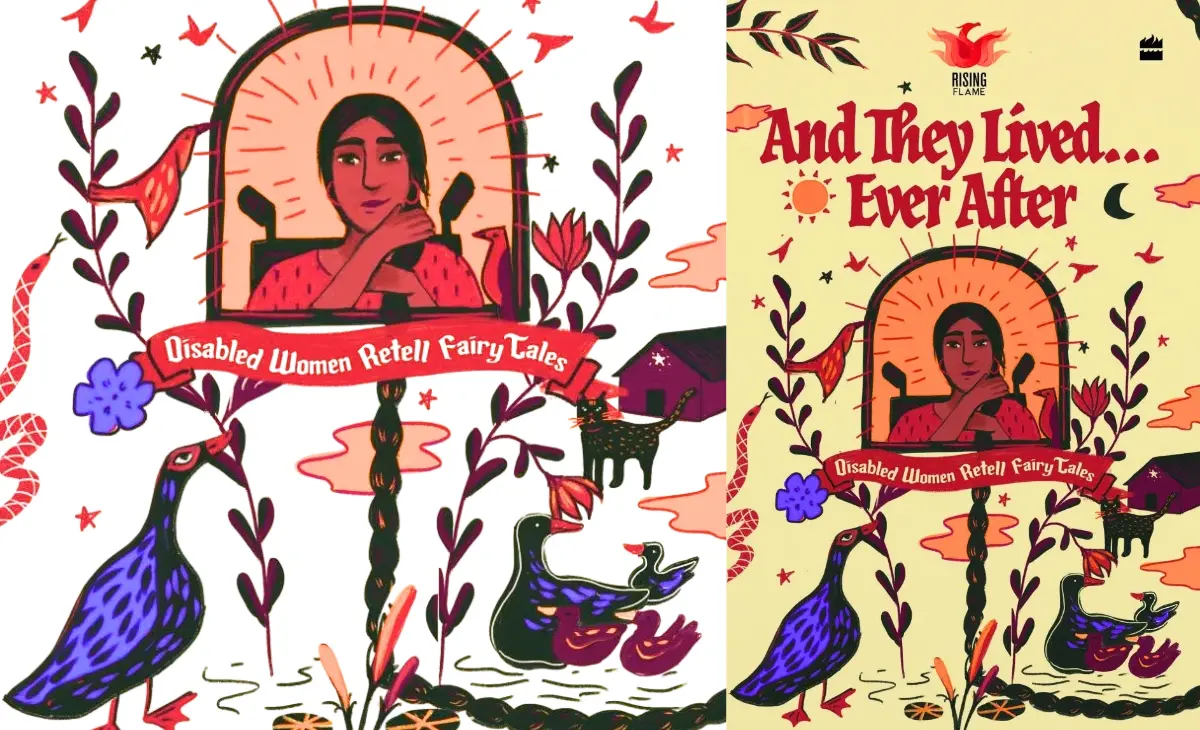
This story was first published in the anthology And They Lived… Ever After (2024), which began with an online writing workshop organised by Rising Flame, a not-for-profit that works for the rights of persons with disabilities, especially women and youth. In it, authors from India and Sri Lanka, who represent a range of regional contexts and disabilities —including visual, hearing and locomotor disabilities, as well as autism, psychosocial disabilities and attention-deficit hyperactivity disorder — re-tell and re-imagine the fantastical world from their unique positions.
1.
Why was the prince the only person who could save her?
Sitting on Ma’s lap, breathing in the fragrance of the salt-smelling moon and chopped onions frying in spluttering mustard oil, I asked Ma a question that had been bothering me for some time. I saw her shadow on the wall in front of us. The monsoon winds had arrived ripe in our little coastal city. Ma was combing my hair. Her voice punctuated the insistent sound of waves crashing against the shore.
She said to me, ‘Mamoni, the world will tell you all sorts of things, but remember there’s nothing wrong in choosing to be alone. Build a life for yourself, build a career, build a castle. Live in that castle alone, if you wish.
The world will feed you dangerous ideas of romance and marriage and princes on white horses. Love yourself before you decide it’s necessary to participate in the rat race of love.’
‘Rat race, Ma? Black rats? White rats?’
‘Rats come in all colours, my dear. Black, brown, white, beige. They are all rats. All equally important. Like people. We come in all colours, sizes and shapes too.’
‘All shapes? Squares as well?’
‘Squares, ovals, triangles, straight lines, pears, peaches, apples, hourglasses, circles. With two legs. With one-and-a-half legs —’
‘Like you, Ma? With one full leg and another, um, almost full?’
‘Indeed. We can have ten toes. Six toes. Eleven fingers. One eye. Two eyes. No eyes. It doesn’t matt —’
‘One eye? But aren’t we supposed to have two?’
‘We aren’t supposed to have two, Mamoni. We can — but we might not. Even Kolkata Biryani does not come with one prescribed recipe. You can make it any which way you like, if you remember to put the aloo in it. We are humans. We come in all forms too. As long as you have the aloo, you are okay.’
‘Do I really come with a boiled, flavoured potato, like a handi of biryani? Why have I not seen it, Ma?’
‘The aloo is the soul of Kolkata Biryani. You have yours too. Flavoured with sensitivity and understanding, curiosity and courage. Don’t lose that light, that aloo, no matter what the stories tell you.’
‘And can this aloo come in all forms? Creamy-mashed? Deep-fried? Parboiled?’
‘Aloos can be whatever they want to be. And we need to respect them for who they are. Have you read the story of Cinderella’s sister?’
‘You mean Ella’s ugly stepsister from the fairy tale?’
‘What does it mean to be ugly, my dear? Was she brown like you and me? Were her eyes not blue enough to be compared to the heart of the ocean? Was her hair too kinky and black and wild?’
‘My hair is black and wild, Ma! But you tell me I’m beautiful!’
‘Because you are! Blue eyes, rosy cheeks, fair hair and size-zero figures are the only standards of beauty, Mamoni. But maybe no one told Cinderella’s sister that.’
2.
‘Cinderella’s sister lived with her mother, her stepfather, a younger sister and Cinderella in a little cottage on the fringes of a fair kingdom,’ Ma told me. ‘The cottage was big enough to house all of them, but not their soaring ambitions or sad histories. Memories of the past and incandescent dreams of the future were always at loggerheads in their household, cracking the walls of their cottage and their hearts into many fragments.
‘Incantotodreams, Ma?’
‘Incandescent. I-N-C-A-N-D-E-S-C-E-N-T. Something that shines bright, Mamoni. With a burning intensity. Like the mother’s burning need to save her two daughters. She wanted a life for them in which there were no tears or sadness, hunger or thirst. To her, a man with a fortune seemed to be the only solution to all her problems. And so, she began to raise her own daughters for high society, while she pushed away her stepdaughter, Cinderella, with a vengeance. She wanted no competition at all for her own children. Mummies and Daddies are capable of making mistakes too.
‘You too, Ma?’ I asked, as she tried to shift her weight from her left leg to the right.
‘Yes, me too. And your Baba too. Just because we are older, we aren’t necessarily wiser. And just because we were raised in a certain way, we don’t have to remain that way.
Remember, all that is legal is not always ethical, Mamoni. And it is never too late to try and break free from cycles of hate. Unfortunately, Cinderella’s stepmother could not.
‘As a white woman who had married a poor brown man, much to the chagrin of her society, she had had a hard life. The faraway continent she lived in had not been ready for the union of a white lady and an immigrant, an indentured labourer from the land of snakes and snake charmers. They had told her, “Love is not love if not between equals.”
‘So, when her husband died, she was left alone in a harsh world with two young girls to look after. She knew what it meant to be a single woman, unloved and unprotected. She wanted a better life for her daughters so they would not have to walk in and out of backdoors, trying to gain favours with the men in their town.
‘When she met Cinderella’s father, who was mourning the death of his wife, she found in him a kindred spirit. Yet, who knew that the grieving man, who loved his wife so dearly, would be ready to remarry before winter had melted into spring? But the man, indeed, was ready. He wanted someone to wipe his tears and warm his bed. And the poor woman with her little daughters was ready to call his hearth her home. After all, he was a white man with money and a dead wife. She had found in him an equal. Love, she assumed, would follow.
‘The family moved into a little cottage on the fringes of the kingdom, built beside a gurgling, dimpled river. However, the stepmother could never bring herself to like her new husband’s young daughter, Cinderella. She made Cinderella do all the household chores. It was her strange way of punishing the girl for the unfair treatment life had meted out to her when she was a lonely widow with two precious mouths to feed.
‘The mother was very exacting with her own daughters as well. Her love and aspirations for them, especially for her firstborn, took strange dimensions.
She wanted her eldest daughter to be ready to woo a charming man when the time came. So, Cinderella’s sister had to go through gruelling hours of dance lessons every day until calluses cracked under the soles of her feet.
She learnt French, English and Bangla. She memorised verses from the holy books, and embroidered little handkerchiefs and silk pillowcases. In the winters, she knitted socks for her family; in the summers, she baked banana bread. She never played in the sun, and she couldn’t go hiking with the boys. Her mother gave her special make-up tutorials to hide away any blemishes on her brown skin, and allowed her only two tiny meals a day to ensure that her fingers shrank enough to slip into any ring a rich man might offer her someday.
‘So, Cinderella’s sister grew up angry and bullied all her life, a brown girl among a sea of white faces with blue eyes. No matter how much she scrubbed, she couldn’t get the melanin [out of] her skin, or that beating voice of insecurity out of her heart. As her anger turned into bitter bile, she learned to bury herself under layers of skin-whitening cream and bleach and foundation and concealers and powder. And voilà! Soon, the world forgot who she truly was. When they saw her pass by, they whispered: “She has a fair face but her heart is dark as the night.”’
3.
‘One day, the ruler of the land where Cinderella’s sister lived decided to throw a fancy ball for his son, a fair young man born into gold and silver and raised to be an emperor. He drank from fountains of chocolate and slept on a bed of soft feathers. The king invited all the beautiful young women of the land to the ball so his son could choose a bride from among the rows of lovely ladies in their flowing gowns and crippling corsets. The parents of these girls were ready to offer their daughters to the ruler and his son, like a sacrifice of tender lambs made to ancient gods.
‘Cinderella’s stepmother was well prepared to present her other daughter: a delicate girl whom she had carefully crafted like a prized project for a day so special.’
‘A couple of days before the ball, Cinderella’s sister picked out a rich cream-coloured gown for herself. It had long lace sleeves, a full tulle skirt, a velvet bodice, and a satin belt around the narrow waist. She was thrilled at the prospect of attending the festivities at the palace. She looked at her gown every now and then, afraid it would disappear if she didn’t watch it closely. Unable to contain her excitement, Cinderella’s sister slipped out of her coarse cotton dress the night before the ball, put on her gown and stepped out onto the starlit porch. The velvet sat soft on her body under the cold sky. Her eyes were like dark balls of fire, catching the silver of the moonlight. She smiled, hugged herself, and twirled barefoot on the wooden deck. Cinderella’s sister imagined herself in the king’s ballroom, dancing, dancing like burning flames among a sea of people. Her skin was flushed with joy. She felt truly happy and looked forward to the breaking dawn, perhaps for the first time in her life.’
‘Did she like the young prince, Ma?’
‘She had never met the prince, my love! So no, I don’t think she liked the prince. But she loved the idea of dancing! She had read of enchanted gardens and gilded gates opening into endless corridors. She had heard of chandeliers that glittered like diamonds in the georgette sky. She had never seen anyone from another town or country before. She had never travelled to another kingdom.
I think she simply wanted to go to the palace and meet people and have a good time. She was also probably hoping to eat some melt-in-the-mouth, soft, buttery Turkishdelight coated in sugar dust, or some exotic oysters. Oh yes, Cinderella’s sister was excited to go to the king’s palace.
‘On the day of the ball, her mother forced her to eat three big bowls of deep-fried rice, two large buttered slices of rye bread, thick cubes of goat-milk cheese, a crackling shoulder of sheep, and a giant mutton cutlet. She wanted her daughter to feel very full. That way, she would only be able to nibble on a little marshmallow at the ball. What would the prince think of her if she ate a large piece of chocolate cake in front of him? Wanton girl! The mother shuddered—that would not do!
‘Cinderella’s sister felt positively sick by the time she forced herself into her corset and chemise and bolster and stockings and petticoat and heavy gown.
‘“Keep your head lowered reverently at all times,” her mother warned her, afraid of the fire in her daughter’s eyes. “And no laughing out loud,” she said, slapping the girl’s cheeks repeatedly to add some colour to her face.
‘After her stepmother and stepsisters left for the ball, Cinderella was alone in the kitchen with piles of dishes to wash, clothes to iron, and a dirty floor to scrub. She was covered in soot, as usual, wearing her frayed dress and a torn apron. Why can’t Daddy help me? Cinderella wondered. The betrayal of her stepsisters and stepmother hurt less than her daddy’s silence. Cinderella cried and cried and cried, talking to the birds and singing to the dormice and doing the laundry.’
‘Ma, is that when Ella decided to go to the tree she had planted by her mother’s grave?’
‘Yes, my dear. Some say the tree helped her. Others say a fairy godmother appeared. Either way, I think Cinderella had some help from her own mother, though she lay cold in the ground, long dead.
Remember: the people we love never really leave us, even in death.
‘Cinderella decided to put on her mother’s taffeta gown, the only one she had been able to save from her stern stepmother. It smelled of old paper, and was a pale shade of Capri blue, gold and silver. She slipped into a pair of gorgeous slippers, the only gift from her father in many years, one that he must have forgotten about. Tying her long blonde hair into a bun, she pinched her pale cheeks for some colour, and rubbed a slice of beetroot to tint her lips red. The dress enhanced the cool blue shade of her eyes, and sat demurely on her white skin.’
‘And then did the pumpkincarriage come to take her to the ball, Ma? The pumpkincarriage is my favourite part of the story!’
‘It’s more likely Cinderella got a lift from a kind stranger, my dear. And then, off she went to the king’s palace! She did her best to stay away from her family, and channelled her energies toward the dance floor.’
‘Did Ella like the prince, Ma?’
‘She had never met the prince! So no, I don’t think she liked the prince. But she loved the idea of dancing with him! She had always watched her stepsister dance and dance and dance in their backyard until her feet bled and her face glistened with sweat. She had heard her sister read aloud, in old English and medieval French, stories of enchanted gardens and gilded gates opening into endless corridors. She had heard from the birds of chandeliers that glittered like diamonds in the georgette sky. She had never seen anyone from another town or country before. She had never travelled to another kingdom. I think she simply wanted to go to the palace and meet people and have a good time, away from the soot and the cinder and the loneliness of the kitchen. She was probably hoping to eat some melt-in-the-mouth, soft, buttery, Turkishdelight coated in sugar dust, or some exotic oysters. Oh yes, Cinderella, like her sister, was excited to be at the king’s court!’
4.
‘Did the girls get to eat Turkishdelight, Ma?’ I asked eagerly.
‘The night turned out very differently for the two young women, Mamoni,’ Ma replied. ‘Cinderella’s sister was constantly aware of her mother’s sharp, watchful gaze, and the nagging pain in her belly from too much meat. She walked among the people, taking little hesitant steps, smiling timidly, afraid to falter, afraid to let her family down, afraid to be herself. She understood, for the first time in her life, the overwhelming tyranny of her mother’s love.’
‘The what, Ma?’
‘The madness of her mother’s love, Mamoni. Cinderella’s sister spent most of the evening in a corner, watching the prince dance several dances with a girl dressed in a pale Capri blue, gold and silver dress. The girl in the prince’s arms laughed too loud, cracked funny jokes, and seemed to be having the time of her life. Cinderella’s sister, on the other hand, was yearning to break free.
The corset was too tight, her mother too strict, the shoes she wore a size too small, the gown a little too large. She wanted to be back on the wooden porch of their little cottage by the dimpled brook, barefoot on a moonlit night.
The king’s ballroom was a far cry from the happy visions she had dreamt of the day before. She looked at the girl in the prince’s arms and sighed.’
‘Ma, was that girl Ella?’
‘She was. And Cinderella felt truly happy and free that evening, Mamoni. There was nothing at stake for her. There was nothing to lose. There was no one holding her back. She danced with the prince, and she danced with the other noblemen. She found herself back in the arms of the prince several times during the night, gliding around the room. There was little time for conversation, the music was loud, the chatter and the clinking sounds of glasses and cutlery drowned out their voices. The prince was transfixed by her slender, swanlike neck, it seemed. He hardly looked at her face. When his eyes strayed lower, Cinderella’s fair skin reddened. She was embarrassed at how ill-bred the king’s dear son was. He didn’t care to ask for her name, and she didn’t particularly want to divulge any information either. Cinderella was one with the birds that night, flying, soaring, dizzy with delight. All she cared about was the next dance. And the next. And the next…
‘Until the clock struck twelve, and Cinderella knew she had outlived her luck, she had tempted fate. How would she ever return to her little cottage by the bubbling river? If she could reclaim the night, she would. If she could reclaim those streets, she would. But young girls on dark roads are an invitation to goblin-men and pishachas that lurk in charnel houses. These beasts and formless men feed on the flesh of young women, creeping up on them stealthily from behind.
Cinderella’s mother, and her mother’s mother, and her mother’s mother’s mother had warned her against the dangers of being a girl walking down the road alone at night. No other sight, they had said, was quite as terrifying and challenging and tempting to the world.
There was not a single road at night for a girl to walk on, safe and free.
‘Cinderella ran out of the palace, the skirt of her gown lifted up to her knee. What if the prince caught sight of her unstockinged calves? Cinderella did not care, she had to flee. A delicate shoe slipped off one of her feet, but Cinderella had no time to stop. Taking off the other slipper, she flew towards home. No matter how ruthless her stepmother was, at home, Cinderella was at least safe from the cruel desires of the creatures of the dark.
5.
‘The next morning was somewhat strange for the women in that little cottage on the fringes of the kingdom,’ Ma said. ‘Cinderella’s sister sat nursing blisters on her feet while her mother frowned and fretted. “Who was the girl the prince kept dancing with last night? Do you think you left a mark on him at all? What did he say to you when you danced that one time with him? Oh, why aren’t things going according to plan? What are we to do now?”
‘Give me some space, mother. You’re stifling me. Go away, please. Shut up…
‘There was so much Cinderella’s sister wanted to say to the older woman, but she couldn’t. Swallowing her words, stifling her tears, she let her mother fuss about the king’s ball.
‘Cinderella remained in the kitchen until late in the afternoon, alternating between bursts of wild energy and hours of daydreaming. At any rate, she made sure to stay away from her stepmother and stepsisters.
‘Meanwhile, in the palace, the prince thought about the girl with the swanlike neck and the dainty feet. The next day, he sent out word through his father to the entire kingdom: “No one else shall my bride be, except the girl who from my arms ran free.”
‘The king’s men went to every house in the kingdom carrying the pretty shoe that Cinderella had accidentally left behind. By the time they reached the cottage next to the stream, they had given up hope. Calling the man of the house out to the door, they explained the rule: “The prince will marry the woman whose foot fits in this shoe. We have searched high and low. We have been to the farthest corners of this kingdom. Speak! Do you have any young maidens in this little house of yours?”
‘Cinderella’s stepmother overheard the king’s men and went to her beloved daughter, pinning her hopes on that single shoe.
‘“But it wasn’t my shoe, Mother,” the young girl protested. She was terrified of her mother’s machinations!
‘Yet, a little voice in her heart whispered, what if this shoe is your key to open the door that has locked you in? What if this shoe sets you free?
She closed her eyes, confused, bracing herself for what was to come. Her mother picked up a meat cleaver, shaved some skin off her daughter’s ankle and cut off her big toe.
‘Writhing in pain, Cinderella’s sister hopped out of the door, feet wrapped in layers of stockings. She slipped into the shoe and the men rejoiced! Word was sent to the prince, who came on a white horse to take home his hesitant bride.
‘Cinderella’s sister, riding with the prince, thought to herself, what kind of a man is he? Does he not remember the face of the woman he danced with? Did he not care to ask for her name? Why must I be betrothed to this man who is so callous and cold? How could I let my mother do this to me? All I wanted was to have a good time at the king’s ball!’
‘As the prince and Cinderella’s sister entered a labyrinthine forest, the birds sang from the trees:
Tick tock tow, tick tock two!
There is blood in the li’l shoe.
The shoe is too tight,
This bride is not right!
‘Soon, the king’s men came rushing to the prince, riding on their horses, gasping for breath. They had overheard a heated exchange between the man who lived in the cottage and his wife, after the prince had left. Having thus discovered the subterfuge, they told the prince that he had picked the wrong bride. Nobody but the prince was surprised by the revelation. He went back to the cottage, Cinderella’s sister in tow. The young woman fainted in the doorway. She had lost too much blood, an infection gradually spreading through her left foot wrapped in layers of stockings.
‘The shoe was offered to Cinderella next. It fit her perfectly and she rode off into the horizon with the prince after much ado. And the rest, as they say, is history.’
6.
My mother was looking out of the window, staring at the waves breaking on the shore. Where was the promise of happily-ever-afters in her version of the story? She was quiet for so long, lost in deep thought, that I had to nudge her and ask, ‘Why do you sound so upset when you say that, Ma?’
‘Because, my darling, Cinderella, like her stepsister, only wanted to have a good time at the king’s ball! The prince was not part of their bargain.
And for the first time, Cinderella’s sister understood what Cinderella might have truly wanted in life; because she too had prayed for the same thing night after night: freedom.
‘And they wanted no prince, Ma?’
‘No prince at all! They simply wanted to be able to eat Turkishdelight, unsupervised.’
‘But how do you know all this, Ma?’
Ma looked at her left foot, partially amputated. I don’t think I quite understood what her silence meant. My eyes went to Ma’s legs. She always had a little trouble walking, but she still went with me to the ice-cream parlour whenever I wanted some black currant lollies. After a while I asked Ma, ‘Can we rewrite Cinderella’s story?
‘We can. We must, Mamoni.’
‘Let’s start at the very beginning then. What was Cinderella’s sister’s name, Ma?’
‘Most women in history, my love, are anonymous. Let’s give her a name. What would you like to call her?’
***
This is an abridged version of the story ‘Cinderella’s Sister’, first published in And They Lived… Ever After by Rising Flame and HarperCollins (2024).
-
Dr. Somrita Ganguly is a professor, award-winning writer and TEDx speaker. She was a Fulbright Doctoral Research Fellow at Brown University, and has served as a judge for the PEN America Translation Prize and the Kamala Das Poetry Awards. She is an Expert Reader for the English PEN Translation Grant, the National Endowment for the Arts Translation Grant offered by the U.S. federal government and the National Translation Award (US). Nights at the Calcutta Café, the latest anthology of poems she co-edited with Prof. Peter Schulman of Old Dominion University, was published by Finishing Line Press, Kentucky.