
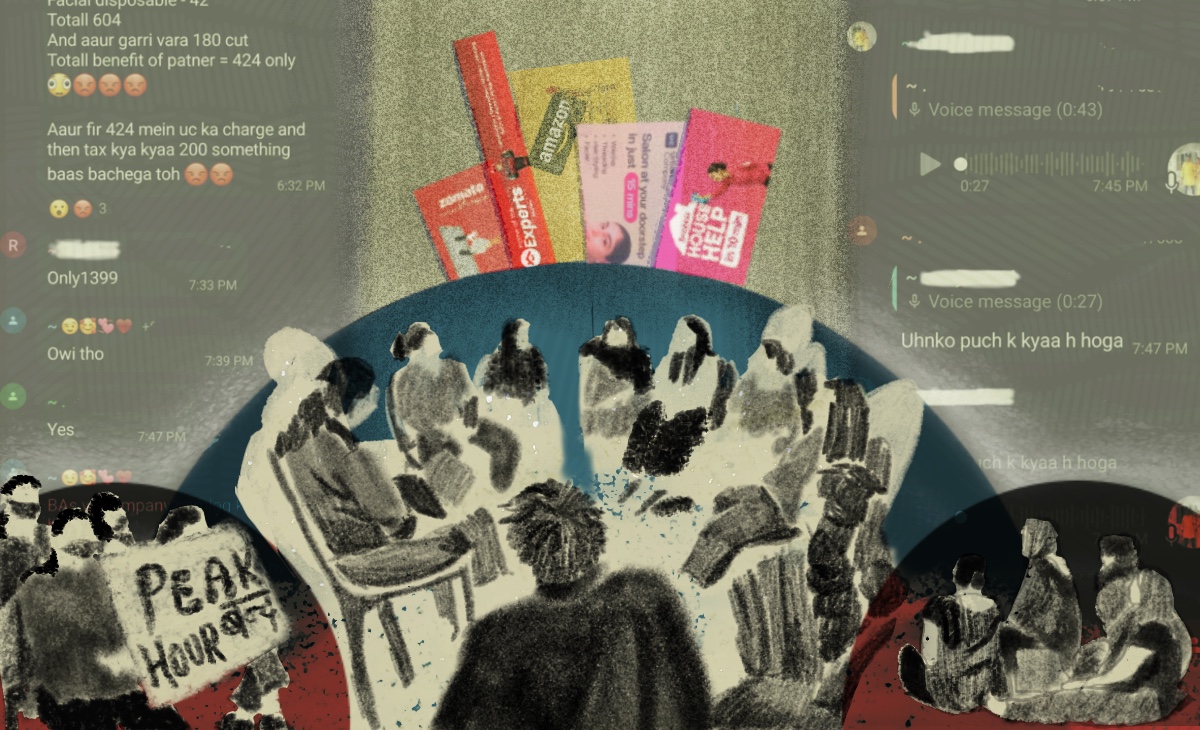
Platform work started becoming popular in India around 2010, but it took more than a decade for a single state to pass an act providing legal protection to platform workers. This journey to be recognised as a group of ‘workers’ rather than individual ‘partners’ is proof of how platform workers have collectively bargained with the human beings behind the algorithms (or the puppeteers being the screen), despite an atomised working environment and the threat of arbitrary deactivation of IDs.
When these platform workers also happen to be women, the threats to safety intensify and the burden of unpaid labour piles up. How then do they manage to collectivise, let alone bargain with an algorithm? Labour researcher Anousha and lawyer Bhargav interview women platform worker-leaders who share the pleasures and dangers of collective power in the platform economy.
Speaking on Google Meet while giving a client a facial at their home in Delhi one evening, Rehana1 tells us that she learned to use the video conferencing software so that she could hold deliberative online meetings with fellow women beauticians on Urban Company and bring more women into their shared digital space.
“Saari meetings ke baad mera phone number groups pe share kiya jaata hai,” she explains (After every meeting, my phone number is shared in [Whatsapp] groups). Rehana and her colleagues use online and offline meetings to strategise for collective action over the issues they face at work. This includes, for example, a 200-worker protest at Urban Company headquarters in Gurgaon in December 2025.
The Terrain for Women in Platform Work
Rehana is one of an estimated 1.2 crore gig and platform workers in India right now, as per NITI Aayog. By 2029–30, there will be 2.35 crore such workers.
Reports from NITI Aayog, the Boston Consulting Group and others suggest that this new digital platform economy is, and will continue to, opening up opportunities for women workers as the flexibility of platform work could allow them to fulfil unpaid care responsibilities at home while also working for a wage.
Platform companies advertise using the same logic. “We are paving the way for a future where women have greater access to opportunities, enhanced financial security, and the freedom to move, grow, and thrive on their own terms,” Urban Company states on LinkedIn. Similarly, a blog post on Zomato boasts of five “business benefits of having more women working in warehouses and dark stores”.
However, the ground reality, as women platform workers have broadcast over social media, press and protests, is not so rosy.
“It is a diversion, it’s a trap… In the beginning, when these companies were starting, they got us all to redirect the course of our lives [and start these jobs]. They said we could work at any time and make a lot of money. ‘You can make Rs. 1 lakh,’ ‘You can be with your kids’… But really, it is not like that,” explains Saranya, a Bengaluru-based beautician who has been on Urban Company for five years.
Saranya also serves as the women’s president of a local union. From her flat in South Bengaluru, Saranya describes being forced to mark herself ‘available’ in the evenings as well as for 13 hours every weekend; having to accept auto-assignments, which means reaching a job within 15 minutes; offering endless deductions for new services; and attending trainings, which Urban Company unilaterally imposes as requirements.
Governed by multinational capital and managed by invasive surveillance and opaque algorithms, the digital platform terrain is constantly evolving to evade responsibility and regulation2.
Women platform workers who feel the brunt of this — many are new to both formal working arrangements and digital technologies — are responding creatively and collectively.
We spoke to women workers across Bengaluru and Delhi whom we know through collectives and unions. Their testimonies paint a picture of grassroots groups engaging in collective decision-making as well as of their active participation in and education about government systems. Even when these groups are informal, they are bringing thousands of women into collective and often political space, where they can influence legislation and private enterprise, and support one another with alternatives when all other systems fail them.
Civic and Political Participation
During the summer of 2021, hundreds of Zomato workers in Bengaluru went on strike. Ganga, who has worked as a delivery worker for six years, remembers this well because she helped organise it, and she recounts it to us over the phone. By that time, she had built strong relationships with many other workers, especially other women, having often helped them understand how to use the app and how to ‘win’ against the algorithm. At one point, Zomato’s staff were calling her to help with the onboarding of new women workers.
The strike was a result of Zomato announcing that workers would be stripped of a fixed salary and instead moved to piece-rate work: that is, they would be paid per delivery — per gig. That was the first time Ganga had heard the word ‘gig’. She and many of her co-workers, whom she calls her annas or older brothers, planned a day-long strike. After the strike, Ganga’s account ID on the app, along with those of 50 other workers, was deactivated, a common strategy employed by platform companies in retaliation against collective action.
One of the primary complaints of platform workers across sectors is that this deactivation robs them of their livelihood without warning or recourse. Ganga and her coworkers responded by contacting a local union, whom one of them had met during a flyer campaign at a delivery hub but had never followed up with. The union helped the group get a meeting at the Government of Karnataka’s Labour Department, at which Zomato management was also present. At the end of this meeting, Zomato agreed to re-activate the workers’ IDs.
“After that, they would call me, begging me to come to work,” says Ganga. “Even now, they pick up immediately when I call. But I didn’t work for a while — that was my ego, my self-respect. I told them: ‘Eppo venumna block pannuvinga, need irrukumbothu beg pannuvinga, naa oru naayi a, enna?’ (You block us whenever you want, and then when you need me, you beg. What am I, a dog?)” Ganga bristled against the double standard:
Zomato was relying on her to help with training, onboarding and supporting women workers, but when she used those same skills and relationships to bring workers together for better working conditions, Zomato wanted Ganga gone.
Saranya speaks about a similar experience during a protest in 2023, which led her to Karnataka’s Labour Department, the Karnataka State Commission for Women and even television channels, all of which was new to her. It began three years ago when Urban Company started a new beauty service for which workers had to carry a very heavy bed on their back to every customer’s home, as well as pay Rs. 13,000 for the bed and training. Already, when she joined the company, Saranya had paid Rs. 45,000 for beautician training, a standard amount to join Urban Company regardless of previous training and experience.
The bed was the breaking point: workers were travelling through Bengaluru traffic, often without their own vehicle, and were forced to be ready at any moment due to the company’s new auto-assign job feature, another component of the work that had become a common complaint, shared especially by platform domestic and home-service workers. Saranya and the friends she had met at her training had had enough: “We decided to strike.” She started a small WhatsApp group of six, which grew to 350 women workers in the span of a single day.
During the 2023 protest, over 300 women gathered at the Urban Company office, many of them with their new, cumbersome beds in tow which they threw back at the office, making their demands known through sloganeering.
Some of the women called news channels, which resulted in the protest being televised. Urban Company immediately ended the new service, thus making the women feel confident about their ability to collectively create change.
The WhatsApp group continued to grow as they discussed what to do next. Someone suggested they go to the Labour Commissioner’s office, where they met an official who helped them schedule a meeting with the Karnataka State Commission for Women. Saranya learned a lot through this process: “I didn’t know how to organise at first. I didn’t know how to set up a meeting, or even what the point of a meeting was. I didn’t know how to mobilise people, but I learned as I did it, and as I watched other people.”
Meera, a former Amazon worker based in Delhi, has spent the last few years collectivising with women platform workers. She sees her role as facilitating connections between grassroots workers’ collectives and the institutions that are meant to listen to them. Meera has accompanied women drivers, working via platforms like Ola and Uber, to meetings with company management and to file complaints, and has also supported groups in setting up meetings with government officials.
“Mera contribution law banane mein raha hai,” she says (My contribution has been in getting laws passed.) “For the Gig Workers Social Security Law that was passed in Rajasthan, we [all the workers] met with the ministers of the Rajasthan government.” Meera feels that a strong central government law is essential to protecting platform workers’ rights. And advocating for laws is a channel that she pushes workers to use when mass actions are met with ID blocks: “There have been strikes, but until a proper law is in place, nothing will change.”
It helps that over the years, Meera has developed relationships with groups that can get her into institutional spaces. “I know all the communist and Left parties [here]. I am not a member, but I attend their meetings.”
Without knowledge of their rights and how to work the system so they can demand them, workers cannot exercise their power, Meera argues, which is why popular education, awareness-building and support in government advocacy have become her preferred strategies.
A major obstacle is the lack of employment recognition: “Neither the company nor the government recognises workers as employees. But since we’ve been raising our voices, they have begun to, in small ways.”
Building Collective Alternatives
One of the main issues that women platform workers raise is the lack of access to basic health and safety protections, including washroom access, emergency helplines with humans rather than AI bots on the other end and real harassment protections and recourse.
A complaint of harassment from a customer leads to immediate ID blocking. Afterwards, workers across sectors share, it is only the customers who are contacted by the company, in calls laced with concern. “But if we complain,” Saranya says, “We have to listen to an AI voice for half an hour, and then they don’t do anything at all.”
Women workers point out that the lack of public care infrastructure and the platform companies’ obstinate centering of customers furthers these issues. Models promising 10-minute delivery and services (exemplified by marketing such as “Dishes piling up? let Pronto take over the mess! #HouseHelpIn10Minutes”) means that workers have to wait on street corners and outside of locked parks to be able to meet their deadlines. Neither the company nor the city provides them with proper rest spaces, leading to health issues.
. In cutting costs and abandoning earlier models of ‘hubs’ where workers could wait, companies also facilitate even less space for workers in an already atomised working environment to assemble and mobilise.
When formal channels and institutions refuse to respond and companies offload their responsibilities to the labour that powers them, women step in to care and advocate for each other. In fact, without the support system of women co-workers, Divya, a domestic platform worker who has been with Snabbit for seven months now, says her work would be impossible.
Sitting outside of a park in Bengaluru in the glaring summer heat, Divya shares with us how important the group of women workers whom she sits with is. “We get each other food and water. We tell each other how customers behave, and how to deal with them.” Without labour protections, her work is very hard. “Look,” she says, pointing around her. “We have to sit and wait like this every day. It is so hot and we have no washrooms we can use. People look at us like we are unclean.”
Being yelled at by customers is a commonplace occurrence for Divya, and though she has never been sexually harassed, many of her colleagues, especially the younger ones, have harrowing stories. Formal channels for complaints, including the POSH Act, exist on paper but remain unimplemented and unenforced in the platform economy. Where these systems fail, it creates both the necessity and potential for women workers to sit together in the heat and in the rain, to swap stories and to tell each other whom to look out for, whether they be company or customer, and to fight alongside each other when issues of harassment or exploitation arise.
“There are many single mothers and widows in our group. When they face financial difficulties, we lend them money. Everyone in the group supports each other,” explains Siya, a driver who works on Uber and Ola and has over 20 years of experience and is also the vice president of a national union federation. “There was an incident when a girl [driver] video-called the group and told us the customer was harassing her. We told her that since he was drunk, she should drive straight to the police station. There, the police handled the situation.”
Saranya explains that when a customer harasses a worker, they immediately share a screenshot of that customer’s profile in their group so that others know not to accept bookings from them.
This draws on a longer tradition of women’s collectives shielding each other from violence and harassment: through economic power as SEWA has shown us, and through information-sharing circles from town gossip to Facebook groups such as ‘Woman to Woman’.
Delivery workers, Ganga shares, often support each other during traffic accidents. She recounts an incident during which she and her co-workers banded together to make sure that the correct documents were deposited at the hospital where their friend had been admitted. The friend was then able to claim accident insurance from Zomato, a task notoriously made near-impossible by bureaucratic red tape.
Collectivising Challenges and Creative Solutions
Workers feel the constant surveillance.
Company executives enter their group chats and later threaten them with soundbites of the voice messages they sent to other workers; GPS tracking is constantly on, whether they are logged on to work or not. When they see that many workers are turning off their apps on one particular day, companies get wise to impending strikes and try to break them. Saranya recounts receiving messages before a strike telling workers they could earn extra money if they turned the app back on. “But it’s actually a lie — they never give you [the extra money].”
This is when Meera pushes her preferred strategy: educating workers about their rights and using government advocacy to demand accountability. In 2024, when delivery workers went on strike in Delhi and had their IDs deactivated, multiple union leaders came together to push the Labour Minister to force the companies to reinstate workers’ IDs: “Only when [the Labour Minister] demanded it did they finally reactivate our IDs.”
Some of these challenges are specific to the time poverty and social restrictions that women, in particular, face. Divya leaves for work at 6 AM and only gets home by 9 PM, after which she has to make herself dinner, clean up, and get ready for the next day. Siya recounts having to argue with her family members when she began driving, over whether driving as a profession was right for a woman. Often, the husband stops a woman from giving her time to collectives or even to support other individual women, Ganga reports. “What will you get out of it?” he might ask.
These challenges are compounded for migrant workers, who have fewer support structures around them in case of deactivation and loss of income.
Saranya echoes what she thinks migrant workers feel, having come to the city just for work: “Why should they risk losing [their work]?” Many migrant workers, particularly in highly feminised sectors such as home service or domestic work, have moved specifically for these jobs from places where neither this kind of work nor the accompanying salary was a possibility. Without many other options or the safety net of family and extended community, Saranya estimates that the risk of participating in collective action may not be worth the possibility of reward.
To respond to these issues, women workers have come up with many creative strategies. For instance, the meetings Rehana runs with her group are conducted online so that women can take them at home and at night, when housework has been finished. Saranya and Siya echo this approach.
All of the women stress the importance of speaking with workers one-on-one in building trust and making sure they feel safe in the space they are in, and of cultivating friendships alongside their relationship as co-workers who advocate for one another. Divya specifically draws attention to the impact of physically sitting together every day.
At the same time, social media and more anonymous online interactions are also crucial to their work. Rehana has an Instagram account with over 7,000 followers at the time of our interview, solely focused on speaking to women platform beauticians about demanding their rights. Social media platforms allow women to interact and develop awareness anonymously, even amidst a pervasive fear that collective action by workers will lead to retaliation.
In Bengaluru, where so much of the platform workforce is made up of migrant workers, and where hostilities between ‘local’ and ‘non-local’ workers are frequent, Saranya shares how important it has been to split leadership duties.
Continuing Care and Collectives
Regardless of the challenges, the women shared a determination and deep desire to continue their efforts. “Since my childhood, I’ve seen just how important it is to have the support of other people. I’m always thinking about how I can do it,” says Rehana.
“For a woman to work in this field, we need to have a lot of inner strength. I myself have struggled a lot. I have been very alone. So I decided then that I would always help everyone,” Ganga adds.
“I know this will not be an immediate win,” Saranya says, her conviction evident. “[What] the Karnataka government and the company [do] is not in our hands. So, it will be a slow process [to have our rights recognised and respected]. If I quit now, it will mean that they have won. The entirety of this three-year journey will go t0 waste. I have a strong belief that until all of our demands are met, I will keep fighting.”
As this slow process of regulating the platform economy unfolds, women workers’ collective space and power are growing alongside it. Of course, the path forward requires much greater accountability and obligations placed on platform companies to deliver dignity in the work they create.
But in the gaping health and safety holes left by the acceleration of the platform industry, women are developing community-powered alternatives.
- All names have been anonymised.
- Nayak BS, Walton N (2024), “The future of platforms, big data and new forms of capital accumulation”. Information Technology & People, Vol. 37 No. 2 pp. 662–676.
-
Anousha works with platform workers and their organisations, where she undertakes research and coordination.
Bhargav is a lawyer and labour researcher. He has worked with trade unions and collectives of informal workers in the capacity of researcher.