
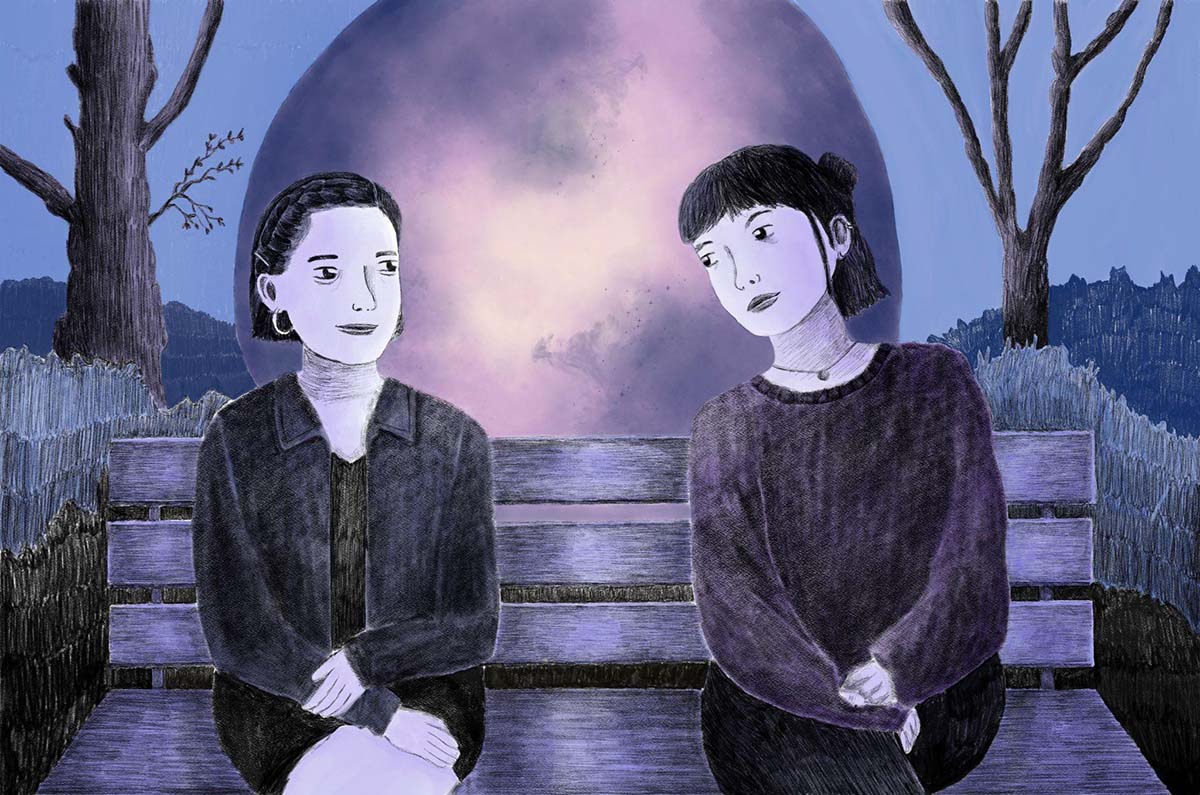
Faith and Courage sit next to each other in a cafe. Courage is thinking about her crush on Faith: Should she confess? But what if saying something jeopardises their friendship? What if the crush is obvious?
Maybe a woman loving another woman isn’t obvious. Before Courage can decide how to initiate, Faith turns to face her and asks, “Should we write to each other?”
“Write to each other? About what?”
“About women loving women… in literature, in film, in art. Anywhere around us, really.”
Courage’s face turns red. Did Faith read her mind?
Dear Courage,
Imagine my thrill when I picked up a book that poses as a murder mystery, only to find that it is actually about a passionate love affair between two women navigating the scene of the crime. Sarah Waters’ novel Paying Guests, published in 2014, is set against the backdrop of post-World War I London, where everything has gone for a toss, from the economy, to social behaviour, to morality. Waters adds one more transgression — two women in love — and a moment of violence that changes everything.
The protagonist Frances, who has taken in a married couple as paying guests, is besotted not with the husband who has a mysterious, charming air but rather with his wife Lilian. Frances is a single woman who lives with her widowed mother on the estate, taking in lodgers to pay off her father’s debts, mourning over her brothers’ deaths. She has let go of her dream to make a life with her former girlfriend. But can one help falling in love? At the heart of this novel is the tricky business of hiding one’s feelings. The hiding is what leads to the crime. The fear of punishment is always lurking, not only for the crime accidentally committed but also for the love they feel for each other.
Their glances and touches despite it all, passionate kisses in the kitchen, tracing each other’s bodies in the candlelight, the complex feelings of jealousy and the uncertainty of their future together — they gave me goosebumps. I kept dreaming of them living together, having escaped the rigmarole. I kept turning the pages for the flesh and blood of their story — when they dress each other up, or plan a picnic together, or wait for the husband to leave home in order to gaze at each other, or when Francis helps Lilian to clean the blood after her abortion.
Their desire for each other, even with bloodied hands, moved me.
Do you feel as excited when you come across stories of women loving women (WLW)? I wonder why my heart beats so fast even when I am aware of the real life consequences of this love. It’s as if I want to be consumed by that particular feeling of love. Do you feel that, too?
Exhilarated,
Faith
***
Dear Faith,
Isn’t it fascinating that there are so many narratives of two women falling in love in queer circumstances? ‘Queer’ not only because that is what the women are, but because it is anything but normal, like two paying guests caught up in a murder. I wonder if these strange situations, these unlikely affairs, make it easier to bring about what is otherwise left unsaid.
Another unlikely affair this reminds me of is between a royal woman who escapes from her painting in a museum and a security guard in a song that I’ve been obsessing over. It’s called ‘Ankles’ by Lucy Dacus, and I discovered it through the music video. I first saw a clip of a stern-looking woman dressed in a security guard’s uniform, stealing glances at the princess sitting across from her. The princess looks like she has stepped straight out of a Renaissance painting. An entire section of the music video is only the glances exchanged between the guard, the princess, and the women in the paintings that surround them. It thrums with quiet desire, but the lyrics that go over it are anything but quiet: “Pull me by the ankles to the edge of the bed, and take me like you do in your dreams.” They are in complete contrast to the civility that the set is trying to maintain, and I’m hooked. The song at once gives space to how unspoken this desire can be, but also the pure joy of unleashing it (rather shamelessly).
In an interview, Lucy Dacus describes the song as a daydream. “When you are into someone, and you probably shouldn’t be, you have to use your imagination.” She wrote it when she was sad, but when she played back what she’d written, she realised how happy it was.
You mentioned fear and punishment, Faith, but maybe it is in imagination that one can find happiness.
I’ve always wondered why you decided to call me Courage. I grew up a shy child and never thought I was courageous. Like the security guard in the video, I have often escaped into daydreams, but also thought of those very dreams as fragile and born out of weakness.
Perhaps there is courage in allowing yourself a fantasy — to start with stealing glances and then dream of so much more — and perhaps, it is this courage that can counter our equally weak and fragile fears.
How do you give form to something you long to devour? How do you turn up with Faith?
Shamelessly, but joyously,
Courage
***
Dear Courage,
I have been humming the song you sent me, tip-toeing along with the security guard and the royal woman through the galleries of my speculation. I am thinking about fantasy today, which you call shameless joy. It is your love for speculative fiction that has me thinking about characters that can exist boundlessly. I have immense faith in this world-building, not only as speculations but as something that takes the form of a new language within me. The form that I want to devour exists in this reimagination and reinvention of what we think we know, no?
In her collection Feminist Fables, Suniti Namjoshi constantly reinvents how we tell stories by reimagining characters from fairy tales, fables and myths. You enter via a story you heard growing up, but the characters have aged and are with you in a different room than you expected. The animals, birds, princesses, symbols and caricatures become not-so-familiar when they refuse to be what they are supposed to be. You meet a blue donkey eating pink carrots, a one-eyed female monkey with a desire to go on an adventure, and a lesbian cow living in a self-sustaining lesbian community.
Namjoshi conjures up Bhadravati, along with her self-sustaining community of other lesbian cows, in her novella The Conversations of Cow. The protagonist Suniti falls in love with the shape-shifting Bhadravati aka Baddy or Bud or B, the playful cow taking on various personas to challenge the author’s ways of loving. In an interlude, Suniti asks Bhadravati what one would find if they were to cut Suniti open. Bhadravati makes fun of her, saying there will be cockroaches, carcasses, and forests and rivers. Bhadravati asks Suniti the same question. To it Suniti responds, “Blood and guts, a living creature.” That night, they become lovers.
This is why we have ‘Courage’ and ‘Faith’, to write of love and give it language, to be traveling companions on this journey and to speculate.
Do you think you and I can write a fable like Suniti and her lesbian lover cow, who swears while wearing a turquoise Banarasi shawl? Or are we already writing one?
Speculating and reimagining,
Faith
***
Dear Faith,
I read the copy of The Conversations of a Cow you sent me, and I found it so comforting that a fable existing in two realms — of the speculative and transgressive and of children’s literature — could contain a language for love between women.
I’ve always been drawn to these forms — fairytales, children’s stories, cartoons. They often treat feelings and emotions with a playfulness that we grow to be so embarrassed by in adulthood. For these fables to contain a love that at one point I held some shame about feels like a parent telling the child-me at bedtime, “It’s all right, you have always belonged.”
It’s how I felt when I first met Marceline and Princess Bubblegum, or PB, from the animated fantasy TV series Adventure Time. The show explores the love between these two women with full hearts; real, gnarly anatomical hearts. Adventure Time gets into the complexity of the human-ness of two women who taught themselves, and each other, how to love. Like the geek I am, I once watched a video essay about the two characters on the YouTube channel Lessons Of. The essay said something like, “Love alone for them wasn’t enough… Not because they didn’t care, but because they didn’t know how to care for themselves.” Marceline, a vampire queen who learned in childhood that the people you love leave, built walls to keep others out; Princess Bubblegum, maker of a kingdom populated by candy people who could never hurt her, learned to build walls that keep others in. In their adventures together, they see each other’s best and worst selves.
As they learn to trust one another and the world again, they realise they are, as Marcy writes in a song to PB, the pink in each other’s cheeks.
My heart swells as I talk about them; more than comforting words said by an imaginary parent that I wish for, they tell me something real. That it’s okay to be afraid to love, but it’s beautiful when you try.
Lately, you’ve begun to appear in my dreams. We travel through portals and sometimes land in a memory you’ve told me about, sometimes in a secret that I haven’t told you. Sometimes we land in a new world altogether, one both of us are strangers to. I do think us travelling across these scary and not-so-scary places together is already a tale-in-becoming.
From The Conversations of a Cow, this line has stayed with me: “If you cut me open, what would you find?”
As exciting as it is being your travelling companion, Faith, I wonder if the real adventure is when we stop over to rest under the trees and cut something open together. Will the insides be gritty, or hard to fathom?
Cutting open,
Courage
***
Dear Courage,
Today, I carried with me the image of you and me jumping through portals together and being the pink in each other’s cheeks like PB and Marceline. It gave me chills.
When I was growing up, I didn’t have anyone I could share feelings like these with. I thought I had to figure things out on my own, and so these sensations of the body stayed private. When they showed themselves, they brought doubt, like they brought you guilt or shame.
I grew up thinking I was the odd one out — until I got to dance with you.
Where do you see women lovers dancing in public? What could their bodies look like? I absolutely love to watch queer tango dancer Marina Ventarron’s dance videos, where you can see two women sensuously dancing in front of a cafe, near a book store, in the street…
It is so unusual, this sequence of images of women doing tango in the metro. I needed to see this public-ness in order to arrive at the dance I wanted to do. My friend Jazz shared an animated dance video by Vladimir Mavounia-Kouka with me, in which two women dance to the song ‘Radio Romance’ by Mashrou’ Leila, a Lebanese indie rock band known for their satirical lyrics around politics, religion and sexuality.
When a woman loves another woman, their relationship can be easily flattened by calling them best friends.
It is, of course, that too. But what of the body? I often wonder why it took me so long to kiss a woman. There is no one answer, but one sure answer lies in the fact that I did not see women kissing women in movies, books or comics when I was growing up. But now, my hunger has led me to erotic literature.
Niki Smith’s Crossplay is a graphic novel that tells the story of friends and acquaintances at the anime convention Megacon. It is vivid and intimate in its images of queer bodies making love. Amongst many parallel stories, one is that of Priya and EMI. As Priya, a photographer at the event, expresses her desire for her friend EMI, they follow each other’s bodies as if they were dancing. Their mouths so full, bodies so close, hands caressing like it is the end of the world. That’s how I want to love; my entire body singing this chorus from ‘Radio Romance’:
When you’re on my body
And when your hands touch me
And suddenly the world is giving me back
The one that was taken from me
My god
Love is bursting in my chest
The tango dancer, Marina, once said, “I wasn’t bad at dancing. I was just dancing with the wrong gender.” Let’s invite our bodies to dance, Courage. We don’t have to learn the steps. You lead; I follow. I lead and you follow. Our bodies, in public.
From the dance portal,
Faith
***
Dear Faith,
I’ve been dancing within the constraints (but also the freedom) of my room, to the gifts you sent in your last correspondence.
I want us to take up a whole dance floor, a whole city, and think of all the moments where our touch felt so much bigger than the world that we steal time and space from.
Today, I write to you with Twenty-One Love Poems by Adrienne Rich. The poems in the collection change places: in bed, out in the city, on a beach, in a dream. Through these varied landscapes Rich writes about love between two women that moves, expands, contracts and travels. There are many lines that I want to read to you from it, and maybe I will.
Here’s ‘Poem XVII’, which, on my first reading, made me laugh; not because it was humorous, but because in it there is a scoff, a calling out to the world itself.
Tristan und Isolde is scarcely the story,
women at least should know the difference
between love and death. No poison cup,
no penance. Merely a notion that the tape-recorder
should have caught some ghost of us: that tape-recorder
not merely played but should have listened to us,
and could instruct those after us:
this we were, this is how we tried to love,
and these are the forces they had ranged against us,
and these are the forces we had ranged within us
within us and against us, against us and within us.
In ‘Poem I’, Rich writes two lines: “No one has imagined us. We want to live like trees.”
I keep coming back to this act of writing together, like Nikki Giovanni returns to Toni Morrison saying, “Love is a bench”. A bench is something that is just there, she says. Steady, holding your back. And that is what love is; it’s got your back. Who knew, sitting on a bench, and taking in the landscapes in and around us, could be so sensual.
Away, but sitting beside you,
Courage
***
Dear Courage,
“Whatever happens, this is,” is the last line of ‘The Floating Poem, Unnumbered’ in Twenty-One Love Poems. I want to acknowledge what ‘this is’ refers to — it is love. Writing to you is loving you.
If I wasn’t writing to you, where would I have fallen in love with you?
Do you remember the news story of two girls eloping, who were finally traced by the police? Or the two girls who died by suicide, together, but the investigation ended there? Maya Sharma picks them up, and tells us other stories of working-class women in Loving Women: Being Lesbian in Underprivileged India. The women in the book stitch clothes, work in factories, do domestic work, make a living by doing glasswork and love other women. Guddi leaves her husband after three months of marriage to come back home and live closer to Aasu. Sabo, a separated wife with two kids, travels to her village every now and then to meet Razia, a widowed mother. When the writer asks Sabo and Razia where they find space to love, they teasingly reveal that they sometimes bathe together, and that is where they make love.
The inevitability of love struck me when I read the story ‘Dohri Jun’ by Vijaydan Detha, a Rajasthani writer who draws heavily from Rajasthani folklore. The story is translated into English by Mridul Bhasin as ‘New Life’. In it, two merchants in rural Rajasthan promise their unborn children to each other in marriage. When both families have daughters, one child is secretly raised as a boy and they are married regardless.
The two women fall in love. They decide to enter a new life as Beeja and Teeja, leaving their homes after confronting the villagers and finding love on the mountain with the clouds, the rain and the lightning serving as witnesses to their love. In the comic version by Blue Jackal publications, Dohri Zindagi, translated by Kabeer Kailash and illustrated by Shefalee Jain, Beeja and Teeja are portrayed as one with nature. In one instance, the two women have the bodies of fish, another time those of swans, and in one illustration where they are having sex, they become spiders weaving their own home.
Oh, Courage. I want to ask Beeja, Teeja, Sabo, Razia, Guddi, Aasu and so many others to sit in this circle with us. It is not easy for anyone. Not for them. Not for us. But if we listen and tell each other we love women, we will learn to be witnesses, carriers and protectors of our dreams, desires and love. Because no matter what, the love will keep happening.
Singing and witnessing,
Faith
***
Dear Faith,
My favourite part of ‘Dohri Zindagi’ is when the bride dresses up her regretful groom as a woman and tells her, “आज से तेरा नाम बीजा, और मेरा नाम तीजा। यह हमारी ख़ुशनसीबी है कि हमें ऐसा अचीता संयोग हाथ लगा। अब मेरे सामने पछतावे का ज़िक्र भी मत करना।” (From this day onwards, you’ll be Beeja and I’ll be Teeja. How serendipitous this turned out to be! Don’t speak to me of regret any longer.) This is not only a promise to be happy together but also a rebellion against a society that expects women to suffer, to be victims of their story. Teeja tells us we don’t owe anyone our sorrow. Let’s be true to ourselves, and let’s go find some f*&#ng joy.
A few days ago I went foraging, and googled something that I’m certain many of us queers have before: WLW films with happy endings.
I was surprised that the film that surfaced at the top was still the one that I watched years ago — Imagine Me and You. It’s the story of Rachel and Luce, who first meet on Rachel’s wedding day and gradually realise they have fallen for each other.
The film is often critiqued as being too simplistic or too sweet (the same critiques most rom-coms get), but it was one of the few sapphic films I could watch snuggled in a blanket with hot chocolate, without fearing the onset of something bad. It took me so much time to find films that mirror the cosiness and meet-cutes of straight rom-coms. Even though I found some gems here and there, I was so disappointed by how scarce they were, and in even smaller numbers than films about men loving men.
We are a country of stories. We all grew up with so much song, dance and cinema, especially about love. Like most of us, I carried a love song in my head wherever I went. But for more than half my life, I did not hear the song, or see the image that I hold so dear to me now — of two women loving each other. I wonder why I feel so angry, or why I so desperately wanted an image to power my love song, when the truth is that with you by my side and in my heart, I don’t really need it. I know we have an abundance of song and dance. Where we are, no scarcity exists. But, perhaps, I want the world to celebrate my love with me.
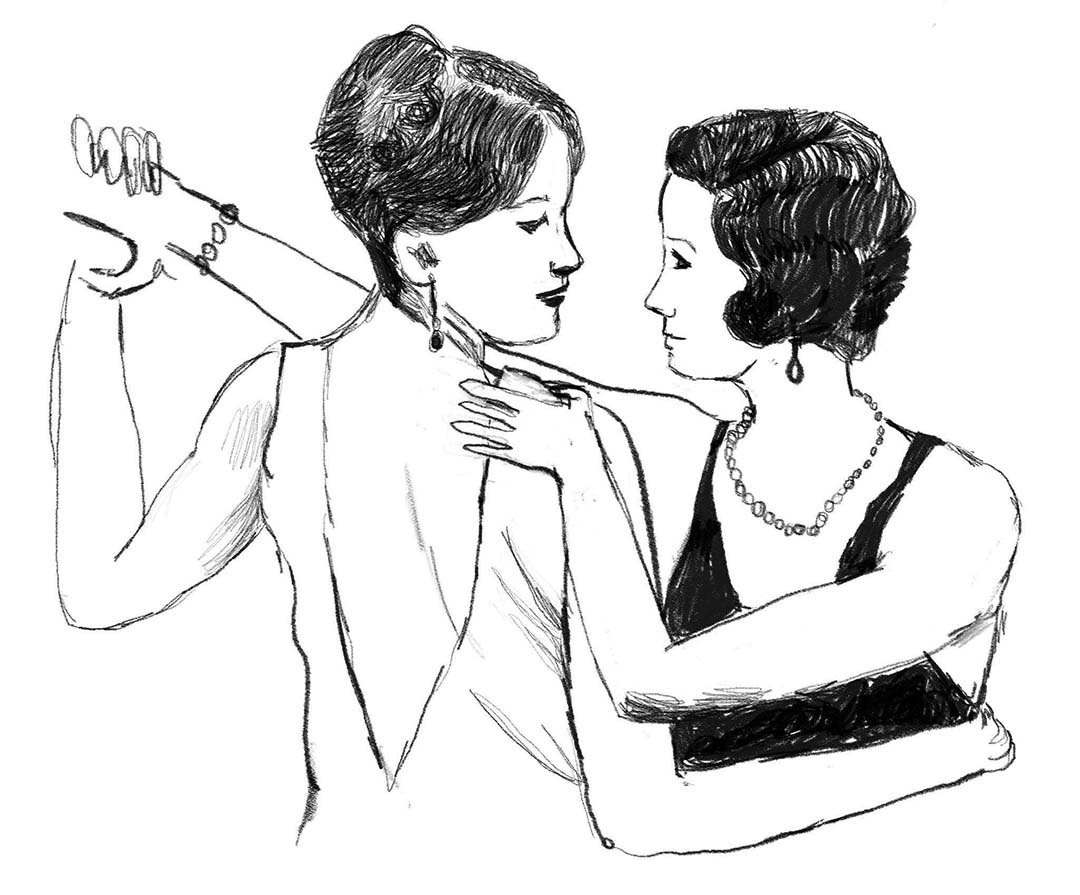
My dear one, it is such a joy to want more, to seek more, to create more with you. To counter all the questions we’ve received on the ‘hows’ and ‘whys’ of us, I leave here a little drawing that I hope gives you the coziness that being tucked in with a hot chocolate gives me.
To our meet-cute,
Courage
***
Dear Courage,
I want to put this illustration on my wall and wake up to it every day. I want to invite the world into my room for tea or coffee, and have them see this image you have made as if it were our family photograph.
Recently, I walked into a child’s room that had a picture of an elephant with the words ‘Exist Loudly’ embroidered on it hanging over a wall. My immediate response was that I wish I had grown up with this sentiment. What stopped me from existing loudly? When I spiral into these thoughts, my mother often makes an appearance.
I return to my mother, again and again, for approval of who I am and the values I carry. In doing so, I feel I don’t want to just be seen by my mother, but also to see her.
A daughter seeing her mother is what most of Jacqueline Wilson’s novels are all about. In her novel Love Frankie, you watch Frankie taking care of her mother who suffers from multiple sclerosis (MS) and come to see what makes Frankie so adult-like. Wilson’s girl characters are filled with empathy and kindness, and I often find myself in them. Thirteen-year-old Frankie, who has learned to be there for her mother, doesn’t know how to make sense of falling in love with her classmate Sally. When she tells her mother that she loves a girl, her mother says that she doesn’t want her daughter to be heartbroken. I loved that the ‘coming out’ moment did not land on the parent’s acceptance or rejection, but rather on a parent’s worry over seeing their child’s heart broken.
As I get older, I’ve realised that the child comes to worry about their parent’s heart breaking too. But why do they both fear for each other’s hearts? It exposes a system that both mother and daughter are a part of, which makes us exist in silence instead of loudly.
I think of Jeanette Winterson and her semi-autobiographical coming-of-age novel, Oranges Are Not The Only Fruit. She writes, “There are many forms of love and affection, some people can spend their whole lives together without knowing each other’s names. Naming is a difficult and time-consuming process; it concerns essences, and it means power. But on the wild nights who can call you home? Only the one who knows your name.”
I have always wanted to heal with my mother, not away from her.
When I found myself falling for you, I said to myself, “If no one else understands, at least my mother will.” It still has to play itself out for me to find out, but a part of me wants to believe that she will see me, because I have tried to see and understand her through myself. As I gather experiences, I find myself wondering if I am living a version of her life, one she couldn’t live herself. If she knew she could love a woman, would she have?
Thank you for making me taste wild berries with you. I am in this garden with you, growing in desire each day.
Fruitfully yours,
Faith.
***
Dear Faith,
You wrote to me about mothers, Frankie’s, Jeanette Winterson’s and yours. Maybe it is primal or in line with many attachment theories, but this way of looking at one’s mother to understand something within is something I have arrived at too late in life.
For many years, I did not want to think about my mother much. I found her too quiet, too dutiful. I was too afraid that I would become like her, and too certain that I was nothing like her. Like many of us, I wanted to escape a fate like hers so badly that I looked at her life through my own righteousness and judgement.
Only when I saw that her quiet was not empty, that she creates things and worlds in that quiet in surprising ways, did I realise how much I take after my mother.
In Yael van der Wouden’s book, The Safekeep, Isabel lives alone in her late mother’s familial home and follows a life of strict order. She, like her mother before her, counts the cutlery in the kitchen before bed, makes sure the house and the garden are always well kept and trusts no unfamiliar presence, wary they might disturb her ways. Isabel’s solitary life is disrupted when her brother drops off his girlfriend Eva at their family home, so she has a place to stay. The events in the book take place in the Netherlands, fifteen years after World War II, and are almost entirely set inside and around this house that carries the history of the war for its two protagonists.
Throughout the book, there is tension in how both women inhabit this home — Eva, as the book tells us, “with a loud restlessness” and Isabel always on the defensive, her counting of the cutlery becoming even more obsessive. It is as if two separate worlds exist. First, there is the world of the house, which is apparent to them in its rooms, walls, and histories. Then there is the world in which they forget concreteness and who they are supposed to be, instead suspending themselves in each other’s company and allowing their bodies to come close to each other (and even dance!)
There is friction between these two worlds. The world of the house, with its facts and laws, riddles them with shame. But as they begin to accept one another more fully in the second world, the relationship itself starts shaping who they can be, instead of the house dictating it for them. In a moment of intimacy, Eva asks Isabel, “Who are you? Have you always been like this? Have you just been waiting to happen?”
We all carry our houses within us, just as our mothers carry theirs. But it is in knowing that brick and mortar can also be such fickle things, that there have always been hidden rooms (or worlds) of play for our mothers, that I hold on to a hope that their responses may surprise us.
Until then, my Faith, it is this second world between us that keeps giving me courage. It is in the tiniest moment of waking up next to you, of feeling your soft (and fruity) cheek against mine, that the walls, the rooms, the list of things in our inventory cease to exist.
From our suspended house (I like to imagine it amidst the clouds),
Courage
***
P. S. Faith and Courage lie facing each other on the living-room sofa.
Months ago, they were two friends in a cafe, awkward, struggling to imagine this moment. Now they call each other silly names, laugh, and worry less. They’ve decided to stay in and watch But I’m a Cheerleader tonight, a satirical romantic comedy set at a conversion therapy camp where the protagonist, instead of having her lesbianism ‘cured’, falls for a fellow camper. WLW stories now come to them a bit more easily. Courage jokes that they’ll have to keep writing to each other forever, and the listicle will never end. Faith tells her, “Maybe we should all make lists to remind ourselves what matters, what needs to be seen and heard and what needs to be done.”
-
Gurleen is a filmmaker and editor interested in examining the various structures and narratives found in the everyday. She studied creative documentary filmmaking from Sri Aurobindo Centre for Arts and Communication, where she made her first film Somewhere Near and Far (Best Short Documentary, IDSFFK). She is a Video Producer at The Third Eye, where she recently made her docu-fiction film IRL (In Real Life), which explores intimacy and identity in an online virtual world. She is also a mentor and Associate Editor with The Third Eye’s Learning Lab, a pedagogical platform where she teaches and facilitates image-based and visual narrative forms.
Madhuri revels in word-play and the worlds they open. Madhuri is a writer and producer, and works as Associate Editor at The Third Eye, where she produces podcasts and teaches writing and sound at the Learning Lab. She has a keen ear for stories that hold both lived experience and imagination, and is currently working on a non-fiction book on single women, based on the audio series Ekal In The City on Nirantar Radio (Laadli Media Award, 2023). When she is not recording or taking interviews, she is writing on her substack @jollydancingheart or telling a story on her YouTube channel Kahaniyon Ka Adda.