
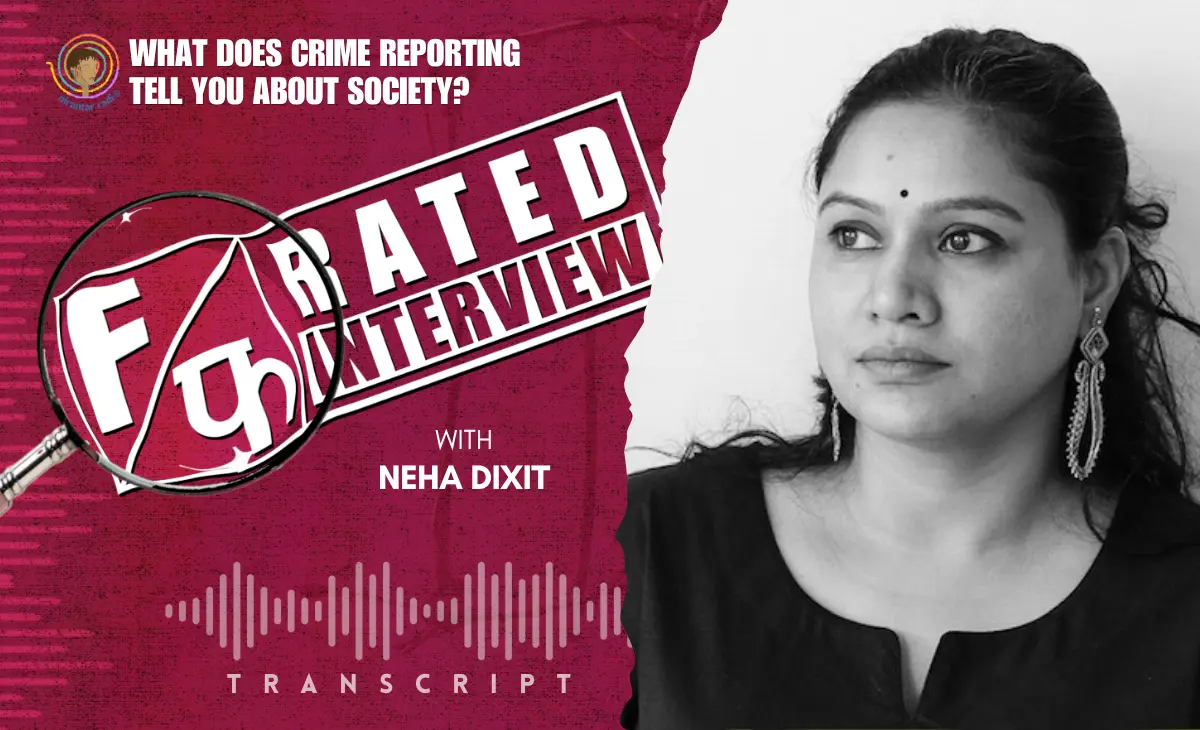
Neha Dixit is a freelance journalist who, in her own words, has investigated topics of social justice, gender and politics for the past 16 years. After Neha’s undercover investigations, audacious encounters, and many formats of work, how does she now understand crime? Narrating experiences that range from sting operations to press releases, she demystifies investigative journalism and reveals how it’s not one mysterious tip-off, but rather mundane, consistent legwork that breaks the biggest stories.
This is a translated and edited transcript of the fourth instalment in our podcast F-Rated Interviews, titled ‘What Does Crime Reporting Tell You About Society?’. Listen to the full episode in Hindi. Translation to English by Astha Sharma.
Neha: In 2010, I was doing a story while working for a television channel. At the time, a judgment in the Punjab and Haryana High Court stated that the police are usually involved in honour killings. I had covered cases of honour killings before that too, but for this particular story, I was on the investigation team. It was a sting operation, although I don’t do those anymore. I was posing as a girl who had eloped with a boy, and my colleagues had gone to various police stations in Greater Noida, Rohtak, et cetera, posing as my family. Every policeman they spoke to repeated [some version of], “The girl has made a big mistake; you should kill her, amputate her body, and dump her in a ditch. File a missing persons report in another police station to cover it up, and then we will find the guy and claim that he was in possession of four kilograms of RDX.”
At the Rohtak station, a reporter posing as my brother informed the police that the family had received news of the boy and girl having arrived at a temple nearby. The policemen came to the temple and took us to the police station. The reporter posing as my boyfriend was beaten up inside the station, and the station in-charge actually pointed a gun at me and said, “Go with your family or I will kill you.”
I was actually quite amused when he said this. Eventually, the two of us were handed over to our editor — who was posing as my mother — so that we may be ‘honour killed’. The police also took Rs. 6,000 as a bribe.
What I’m saying is, all these things are involved. Society’s stereotypes and discrimination are also at work. Who’s to say who is a criminal and who isn’t, unless you thoroughly investigate?
The policeman told my editor, “Auntyji, [people like you] send [girls] to a convent to study, give them mobile phones and don’t check their bags; that’s why [things like] this happen.” The truth was that we were privileged enough to be staging this situation, but so many real cases have occurred, like the Manoj–Babli case in Kaithal, Haryana. There are many honour killing cases where the police are involved.
TTE: There is a very romantic picture of investigative journalism in popular media. In your experience, what does it mean to do an ‘investigation’?
Neha: In my opinion, the hype around investigative reporting is just that — hype. Connecting the dots while on the ground, that’s what investigative reporting is — which a lot of reporters do, actually. It’s just that they don’t get the stamp of investigative reporting. I’ll give you a very simple example. Maybe you remember this: in the year 2019, a reporter named Pawan Jaiswal did a story in Mirzapur about only salt and roti being given to children at a particular school, for their midday meal. The UP government charged him with criminal conspiracy; many other things happened afterwards. Is that not investigative reporting? The fact is that despite so much money being spent on midday meals, there are malnourished children who are unable to attend school. The midday meal was introduced in our country for a reason — and these children are being given salt and roti. The consequences of this affect not only their health but also their education. A reporter sheds light on this in Mirzapur, and through this we understand why, despite midday meals, the health of children is not improving — this too is investigative reporting. Anyone working on a specific issue for a long time, who can then connect all the links, is writing an investigative report. Unless you do the legwork, you won’t allow yourself the space to read, research and meet people in various corners and in various ways.
TTE: Could you unpack ‘legwork’ in the context of investigative reporting?
Neha: There’s a very famous quote about it. I don’t remember who said it, but it goes like this: “For a reporter, their feet are more important than their mind is.” Basically, there can be a lot on your mind, but if your feet don’t take you to that place, then nothing is possible. The legwork that you speak of is something I talk to everyone about, because it’s my own as well as a lot of other people’s experience. If you want to do journalism within a newsroom or news organisation, it’s a given that for the first one or two years you must do the legwork. Copy–paste work, editing, making pages for magazines or newspapers, cleaning up the news copy that comes from the PTI or Reuters and publishing it — all of this is legwork. I say this because of those who dream of being reporters, thinking that they will go to Syria immediately, or do a story on the Taliban, or uncover a large scam. All of that takes some time.
Legwork is also useful because it helps you understand the system. You see how you might navigate the system later; it gives you a sense of how you could perhaps pitch and conceptualise a story, and how to make a strategy to report a story.
Let’s assume you want to do a story on human trafficking. You understand the system — that it needs to have a news peg and should be connected to the news cycle, or that you don’t necessarily need to talk to an activist or a policeman. In the popular perception, trafficking is understood to only be commercial sex exploitation, but there are many other parts to it. You might speak to an activist or a policeman, and that’s all right, but maybe there could be a lawyer who is fighting cases against trafficking. If you meet this lawyer, you also stumble upon these cases, and that could lead you to hear from someone firsthand. So that’s why you have to be brave enough to do the legwork for one or two years; then you can do whatever you want to do.
TTE: From what you’ve said so far, I get the sense that you have an understanding of a criminal that goes beyond ‘This is a bad person, they must be exposed’ — your language has not been of that kind. How does this perspective actualise for a reporter; what is this lens?
Neha: On one hand, there’s a conventional way that news is reported. These days, television news has sensationalised crime reporting to a large extent, by recreating scenes, and so on. That is a very male way of reporting crime. ‘This is a criminal, this is what the police did’ — a clear divide is shown. I remember that when I was growing up, Shams Tahir Khan, a crime reporter who has been with Aaj Tak for many years now, was so popular. There weren’t as many news channels at the time; this was around 2003–2004. He was so popular that when a train would pass by [a town] in northern India, if it was discovered that he was travelling in it, people would show up at the station to catch a glimpse of him. That started a way of reporting.
In my opinion, there must be an intersectional approach to crime reporting, because it’s not about crime alone. Crime intersects with gender, health, politics, social justice, economy, culture, everything.
So, one must not see it in black and white. For example, if a woman is involved in a crime, you’ll see headlines such as ‘wife and her lover murder husband’, or ‘girl elopes…’ In such language there is gender at play, because there is an expectation that women cannot commit crime; they have to uphold the sati-savitri, noble image of women, who couldn’t do such a thing. Women aren’t seen as human. Hence that kind of sensational language is used.
Any reporter who has covered a crime story can tell you the kind of caste profiling that the police do. In my own experience, I have seen that when they are asked about caste-related crimes, they speak a very casteist language; they [even] catch people from a particular community and say that it is in their nature to steal. And then you’ll see the glorification of the police in films like Dabangg and Singham, which glamourise ‘encounter cops’. This is part of why, as a society, we are conditioned to see criminals in black and white.
The other thing happening in India is that we have stopped questioning the police’s version of events. When a crime report is published, the yardstick by which it is to be judged is to compare the volume of police statements to the volume of on-ground reporting.
Nowadays, crime reporters are publishing police statements as the report itself, which is a problem. I’ll give you an example that’s quite tragic, but also comical. In 2009, maybe on January 24 or 25, there was an encounter in Noida in which two people were killed. The police said, “Two terrorists had come to kill a high-profile person in the January 26 (Republic Day) celebrations, and we gunned them down.” Many reporters received calls in the morning to cover it. When we reached the location in the morning, we found the dead bodies, a Maruti car, a few bags of grenades, and 20 or 25 guns. We started talking and wondered who would think of going about with so many arms right before Republic Day. It was a bit strange. By the time the press conference happened, all but two or three of the guns and four or five of the grenades were still around — everything else was missing. If you, as a reporter, don’t question that and accept [the police’s story] that these were terrorists who were in Delhi to kill people before Republic Day — don’t cover crime. Cover something else.
What I’m saying is, you cannot blindly accept the establishment’s version of events. You must always question it. That’s why, in crime reporting, it’s important that you look at everything, follow intersections, and parse the communal angle or the caste stereotyping in what the police say to you.
TTE: What is it like, going into the scene as a reporter? What is the ‘doing’ of your reporting?
Neha: Over the last 16 years of reporting, speaking to the officer at the top has been far from my priority. What matters is that I see the people who have come to lodge a complaint, or those who wish to lodge a complaint but are not able to; if there is a room in the police station where all the clerical work happens, then what’s happening there; what’s happening in the record room; if there is a lock-up in the police station, who is inside and how are they kept. From all this, I have got a sense of my approach towards people. Once the reporter gets a handle on that, it becomes easier to ask questions of the many people involved, to prepare the background and to gather information.
For example, in 2018, I did an investigation for The Wire. Every six months, the Uttar Pradesh government would hold a press conference in which it shared statistics about encounters as their achievements. After about a year of this, 1,200 people had been killed in that manner. For me, it was crucial to understand: who are these people being killed like this? Their names were not revealed in these press conferences. It took some time to find out who they were — mostly by collating news through small newspapers that carried these reports in western Uttar Pradesh.
I went to a village and found the house of the man in question — [this man] who the police said was out to loot some [Rs.] 50 lakh, and so shot him — and saw the roof caving in, his ageing father seated nearby as the villagers told me that the man had been arrested previously and tortured to such an extent that it had affected his mental state, and that he used to while his time away sitting under a tree in the village. This was the man the police picked up and declared was planning to commit a robbery.
This was the template in all the cases: men between the ages of 17 and 40 — mostly Muslim, Scheduled Caste or OBC — had set out to rob or kill and shot at the police when stopped, after which the police shot them in self-defence.
When I went to their houses, I found that all of them were working-class. Someone sold samosas, some sold fruits, some sold chow mein. They were accused of stealing Rs. 50 lakh, or a ring worth Rs. 8,000, and so they were subject to these encounters. Only after visiting their homes did I understand that the police’s proudly claiming this to be an achievement — that they had shot down criminals — was actually a ploy to increase statistics.
Though the police never allowed post-mortem examinations, members of the victims’ families had taken pictures of their deceased loved ones with their own phones. In those pictures, [I saw] skulls cracked, eyes taken out, broken legs, people who had clearly been shot point-blank, revealing that these weren’t chance encounters but pre-planned killings.
I’m giving you this example because in many films you’re shown — to my utter irritation — reporters that rush to the scene. And in the corner, a source passes them information via folded-up bits of paper. In my 16 years of reporting, nothing of this sort has happened.
No one has ever slipped me [a clue in] a piece of paper. Everything was right in front of my eyes; it was just about reaching that place and seeing it for myself.
So in that sense, unless you go and observe, you won’t find anything. If anyone feels that they’re going to uncover something while mysteriously prying into your computer — yes, that is also reporting [but it is not always enough] — the good reporting that is in the public domain comes from reaching the scene and doing deep observation [from there].
TTE: You emphatically foreground observation — what it means to see and then to parse what you see. Others see you as well, with a certain lens. What are these lenses that you are viewed through and how do you navigate being observed?
Neha: This is a very important question. When I teach, I make my students practise this as well. In a new space, while you are observing, people observe you as well. You need to have practice to be able to deal with that discomfort, of being seen. There are many strategies to follow. For instance, as a reporter, you have to extract and bring information back from wherever you are. In that situation, the most basic thing is the way you’re dressed. I am the last person to moralise; but as a strategy, I have learnt this after stumbling many times.
Our society is so foolishly patriarchal that simply wearing a dupatta as a woman makes others see you as someone ‘decent’, and speak to you politely.
Earlier, I used to feel, as a feminist, why should I engage in this? But then, I started playing it up in a lot of places, like amidst Khap panchayat leaders. I remember going to interview a Khap panchayat regarding an honour killing; the leaders were involved in the killing, and they told me, “If there was a girl like you in our community, who roamed around with a male cameraperson, we would have cut her up and hung her on a tree.” I was fresh out of college, and wondered how they dared to say such a thing. I argued with them quite intensely, after which they refused to give me an interview. What of the fight I had picked in the newsroom in Delhi, to go to Haryana because I wanted to report? How would I go back without a story?
Often, I strategically lean into that role of a simple-minded, ‘decent’ woman with people like this. In their mind, that’s how a woman should be and they find great joy in mansplaining. I realised that they ended up telling me more than they would tell a man in my position. So now I get all that information, frame it as a story, and put it out in the public domain. What I’m trying to say is: be smart. Your personal beliefs have to reflect in the story, but while you’re on the ground, know what is most important: you need information. Don’t lie, don’t deceive, don’t be unethical, but you have to vary your tone when seeking out information.
TTE: Through this work, and being observed, what has been your understanding of patriarchy? And what link is a woman in this — whether as a reporter, a witness, or as anyone?
Neha: I’ve always had an understanding of patriarchy; the words came later. We have always dealt with it and continue to do so. What I have learnt, though, is that it is very easy to play with patriarchy, and I have started to do it. To feel that you’re great and everyone should listen to you: that’s what patriarchy is, right? To not be questioned? If I look at my major stories — like on the RSS, the Khap panchayat, or the police — I didn’t have to do much. If you sit in front of them, they voluntarily spew their nonsense. And they get such joy from doing it. As a reporter, you are thrilled that it’s coming out, and you’ll get to expose it. What one needs to learn is to keep one’s patience, in the face of having so much garbage enter your consciousness.
There is another way too. I went to Hapur with the lawyer Vrinda Grover when she was fighting a case of mob lynching, and it was extremely difficult to get inside that court as a woman, because women don’t really enter public spaces in Hapur. So how could we face those men? Vrinda told me that pretending to be simple-minded and ‘decent’ was one way; that you say, “Please sir, teach me all you know, I know nothing.” Another way is to behave like that privileged English-speaking madam whom nobody can question. Depending on the situation, you can use either. It’s very easy to play with [the patriarchy].
TTE: We know that within the patriarchal system, women reporters are often denied access. Are there spaces where you are granted access, specifically as a woman reporter? Does occupying this position offer you a different kind of access?
Neha: When I reported on the riots in Muzaffarnagar in 2013, I went to many relief camps to gather information. This meant I had to stay the night in the village, in someone or the other’s house. What would happen is this: night would fall, the men would finish their dinner and leave the house, and I would be left inside it. I found it very strange that the male reporters were talking about all sorts of things without me; I too wanted to be part of those conversations. I had no interest in knowing which aunty’s hip hurt because she had lifted a bucket or something. So, in the beginning, I was very bothered by this [behaviour]. Then, I realised that the other reporters don’t have the access I have — to inside the house. This lines up with my feminist thinking now, which I wasn’t as familiar with up until then. In the media, we speak of the ‘source’, the person who gives you the news or whom you quote. For instance, if a sexual violence case has been reported, traditionally reporters will get one statement from a male policeman, one from the woman’s brother or father, and the men from the neighbourhood too give statements — and the report is done.
Women’s voices never surface as sources. I realised that this would be my strength.
The dissatisfaction that I have with the media — this is my way of putting it out. It is different for men. They are out at night, they’ve drunk their tea, smoked their cigarettes, and have also gathered information — which is not being given to me — but they know nothing about the indoors.
To give you another example, if I do a story on a police encounter, all the people I speak to are usually women. I have covered many terror cases. Who fights them? When the men have been locked up, it’s the women who run the home and also fight the case. They have more information.
I am often stereotyped [because of it]. I have covered all kinds of cases — on politics, on health, on the economy, on the environment and so on — but because my sources are women, whenever I am introduced, it goes something like, “This is Neha Dixit. She writes about women’s issues.” I always correct them. Then they ask me, “Oh, so do you write about men’s issues then?”
I remember doing a story on the number of typhoid and cholera cases rising rapidly in Delhi. On checking the numbers, we found that the incidence of women falling ill was very high. When we do stories on gender, the assumptions are that they will be about maternal mortality and sexual violence. Can we not see health in the way that women also contract typhoid or cholera? Why is the number of women patients so high? It’s because a lot of household work, which women do, involves coming into direct contact with water. We’re not able to break these glass partitions. No issue is singular.
TTE: A more personal question, now. In this 16-year journey, what have you learnt about yourself?
Neha: I learnt all of this through reporting. Gradually, questions were posed to our reporting as well. Like caste, for instance. I often used to think: why is my report being critiqued [just] because I am Savarna? Eventually I understood that I needed to accept that I am, and that I am afforded a lot of access that others aren’t because of it. I learnt this through reporting, and a lot of people have also taught me. Through their scoldings, cursing or love, I have learnt a lot. As a reporter, there is a huge advantage if you use this — that you are given the chance to go on-ground and understand for yourself. That’s where I have learnt. This is the work I know, this is the work I can do, and this work is what has taught me.
About me (laughs), I learnt that I cannot do anything other than this. That’s the most important thing you need to know about yourself: what I’m capable of and what is not possible. Additionally, it became clear that we are very conditioned, and when we go on-ground, we are given the chance to be de-conditioned about the things we think we know.
I tell my students not to decide beforehand what the story is. A lot of people who wish to engage with the world on an intellectual or ideological level presume what is happening.
[For example,] presuming someone to be a sexist old man, who’s going to swear and behave in a certain way. We learn that yes, he may be sexist, but look at the hierarchy of privilege. He too may be oppressed in some way due to his caste or his religion. His sexism is wrong, and there are other things happening as well.
Unlearning these [presumptions] is quite essential. I learnt it is important not to have a rigid understanding of something before experiencing it. It is important to go there first, and then understand. I say all this, but it takes great effort to tell yourself, “I don’t know what’s happening.” Earlier, I used to be a bit rigid in my feminist thinking; I still stand by it, but the way I understand it has changed.
TTE: You’ve done a podcast, you also teach — so you think through things chapter-wise and curriculum-wise — you are also writing a book, you’ve written long-form articles, you’ve worked in a newsroom. When you engage with so many forms, does the crime scene mutate for you?
Neha: It was very nice to be able to explore these different forms, to be able to tell one story in many ways. A lot of things have changed in these sixteen years. People’s attention spans have shortened, and many people don’t read [the news]; they prefer reels or stories on Instagram. The biggest break for me, apart from writing, which was different, was working on two graphic non-fiction books — one with Orijit Sen and another with Priya Kuriyan — that were graphically illustrated long-form reports. One was on trafficking, and the other was on the Muzaffarnagar riots. I understood that people who don’t read often look at things through this graphic/comic form, and that there is a need to deliver reports in this manner too. You mentioned long-form — the story I told you about the policemen and the weapons that went missing must have been a short report, 800 words for a magazine. If I have to write it as a book, then it’s a very fun process. I like to research and understand who these two people were, where they came from, what actually happened in that place, who these policemen were, and why no one questioned them. To discover details about people, places, and systems — and then pick at the interconnections — is a very interesting form. I say that people have short attention spans these days, but people also spend 12 hours at a stretch finishing a web series or binge-watching. So I also see that contradiction: that actually people do invest their attention where they wish to. Working with different forms, you realise these things.
I have written mostly in English, and I come from a Hindi-speaking background. My mother is not very fluent in English, so when she listened to my podcast — it was in Hindi and easy to understand — that’s when she understood what it is that I do. From this, I also found out what I should not do.
TTE: You work with young or aspiring reporters as a mentor. What is something you would say to a young girl who wants to become a reporter, which the classroom space didn’t offer you a chance to share?
Neha: “Do it.” My advice is, “Go and do it.” Usually, the kind of people I meet — I am not talking about any specific institution, but more generally — have a lot of mental blocks. They think, “Oh god, how do I do this?” The one thing I say to everyone, and want to say over and over, is this:
The perception that you can’t do journalism without contacts and networks is nonsense. The early reporters who came from very privileged spaces, whose parents had phone directories that they could use — they spread this idea.
But you need not come from any specific place; it makes no difference if you don’t even have one contact. Those will come [with time]. Never think, “No one around me is in journalism”; “I don’t have any acquaintances”; “I do not like socialising”. There is no need [for any of this]; just pick a story and start reporting on it. Your contacts and networks will grow naturally. By the time you do the next story, and then another and another, you will have 10 contacts. Work like that; there is no need to stop and no need to worry, “How am I going to do this?” If you have an idea in your head and start working on it, that’s the beginning. The day you start working, no one will stop you. You would have tasted blood; you won’t be able to stop. It’s all about starting.
TTE: You’ve given us so many nuggets throughout the interview that unpack our inquiry of looking at crime through a feminist lens. To bind all this together for our listeners: what is this feminist lens in your work?
Neha: Talking about labour, for instance: conventionally, the image that appears is that of a man carrying a load on his head. That is not the complete truth in the present day. I also want to know: what are the realities of trans people in labour? If I’m writing about COVID, then I also want to know what trans people went through during that time. You cannot simply cover the pandemic in a singular way. When we talk about conflict, we can’t see it in just one way; if you’re looking at Palestine right now: in what ways are the different genders affected? If there is a natural disaster, it is not simply about the environment, but about how it affects different people very differently. It’s quite important to understand that.
When mining happened in Chhattisgarh and Jharkhand, the men left their land and went outside. Who was protecting the land in those Adivasi areas then? The women, right? So then writing about mining is also writing about gender: these Adivasi women aren’t only protecting their land, but are also involved in conserving the environment. It is essential to repeatedly remind oneself that there is a need to look at all issues through a gender lens, and that helps in correcting one’s own vision. If I am covering the budget, that doesn’t mean that I go to a woman only to ask her, “What does this change for you in the kitchen?” A woman can give her opinion on the railway budget as well; a trans woman can also give us her opinion on the defence budget — it’s not fair to include her only on panels about trans rights. For me, the feminist lens is one in which the voices of and about people across genders and sexualities can enter the public domain.
Neha Dixit is an Indian freelance journalist covering politics, gender, and social justice. She has been awarded over a dozen awards including the Chameli Devi Jain Award (2016) as well as CPJ International Press Freedom Award (2019). She also serves as visiting faculty for Media Studies at Ashoka University.
-
Madhuri Adwani produces, records and edits narratives and sound pieces on Nirantar Radio. She also mentors and facilitates workshops as part of The Learning Lab where her core enquiry is ‘how do we write and tell our narratives’.
Juhi is a writer and a researcher who writes long form pieces, provides editorial support, and produces podcast episodes and audio pieces for The Third Eye’s podcast channel Nirantar Radio.