

I present a biography of the video filmmaking industry in Mumbai (India), the censorship it bypassed, the moral panic it created, the spaces it made for sex, pleasure and pornography to emerge — and its ultimate marginalisation into oblivion.
This is the story of the risqué-ridden 1980s, and the emergence of VHS technology in India.
I will track the journey of the video film through a case study of a specific video production house, Hiba Films, which I discovered during the research of my book, Video Culture in India: The Analog Era. I look at Hiba Films as an institutional structure that emerged broadly in response to the arrival of video and specifically in relation to the rise of the video nasty and straight-to-video genre across the world.1
Hiba was the audio-visual sister of India’s best-selling tabloid film magazine Stardust, which promoted the films that Hiba produced. The production house concentrated on the creation of female stars to attract the magazine’s primarily female audience.
This is the story of an adjacent entertainment industry and of a new infrastructure and style located in the heart of Bombay. Video emerged as a medium that attempted to define itself in opposition to celluloid through (among other things) its propagation of close-up shots. Smaller television screens needed bigger faces for viewers to engage with, and the video medium brought high emotion close, and into our homes.
Thus, video became a medium of intimacy — as opposed to cinema, which was a medium of spectacle.
Fear and Panic in the Video Parlour
The first thing that struck me during my research was the shrill moral panic and paranoia triggered by video’s arrival in India during the 1980s.
During my work at the National Film Archives of India (NFAI), I discovered emerging anxieties about piracy of celluloid cinema at the time. I also discovered a rising fear that pornographic and violent material would become easier to make because video was a cheaper and more accessible medium to produce, thus dodging censorship. However, alongside this paranoia, another narrative emerged.
I discovered letters to the editors in the journal Screen, written by readers from small towns, who described how video had exposed them to a wide variety of films that were often not released where they lived.
Informal circuits were crucial in building the narrative of analogue video in India. These informal circuits consisted of spaces of distribution such as video libraries, video theatres and video parlours. These spaces caused much anxiety and came to be associated with pornographic content; the law was, therefore, used as an instrument of containment. There were numerous reports of police raids at video parlours to shut down illegal screenings of pornographic films, where teenage boys were in the audience. The menace of video was seen as the cause of “a cancerous spread of adult films”.2
In this atmosphere of thrill, censorship and prohibition, one of the most common stories I heard in the field was to do with video’s materiality and the shared pleasure it birthed.
The oft-cited example was the popularity of the film Basic Instinct (dir. Paul Verhoeven, 1992), particularly the famous interrogation scene. My respondents told me how the part of the scene where Sharon Stone uncrosses her legs became blurred, a result of the rented tape being fast-forwarded and rewound multiple times by various renters.
The image was an (im)material marker of the pleasures of watching film on videotape.

But as I went through dusty archives, I wondered — with all the video parlours and VHS rental spaces, what were the women doing? Where were the women during this heyday of videotapes and pleasure?
This story is not just about an adjacent entertainment industry, but also takes a gendered look at the new architecture of video films made in the 1980s, starring women and made for the women who had the time and leisure to peruse film magazines, own a television set and the opportunity to watch these videos at home.
Television Killed the Movie Star
Analogue video came to India in 1982 with the Asian Games, televised by the national broadcaster, Doordarshan. It was seen as a way to project the image of a modern India to an international audience in the post-Emergency era.
The Union Minister for Information and Broadcasting at the time, Vasant Sathe, advocating for the introduction of colour television, stated: “Black and white is dead technology. Dead like a dodo… If I had my way I [would] go in for VCR (video cassettes) right away. Cassettes can be produced in thousands and they are cheap. Every village and school can screen its own video cassettes.” It was this event that triggered the growth of television in India.
Colour television was introduced and an unparalleled technological restructuring began. It is crucial to note that video was introduced by the State for the purpose of development communication, which they hoped would lead to a process of modernisation.
The advent of video created a revolution of sorts, as audiences withdrew from theatres and moved to the private spaces of their living rooms. Television ownership increased and the audio and video cassette market rapidly expanded, setting forth a pirate economy in spaces like video libraries. Video parlours and video theatres sprang up, and restaurants, buses and shops began installing video equipment.3
The ‘Video Film’
Sitting in a dusty government archive, I leafed through pages so delicate that they were on the verge of falling apart. As I poured through censor reports, the Ministry of Information and Broadcasting’s annual reports and journals, the phrase ‘video film’ kept appearing.
The titles that appeared under this term were a curious mix of familiar mainstream titles such as Himmatwala (dir. K. Raghavendra Rao, 1983, trans. Brave Man), Mr. India (dir. Shekhar Kapoor, 1987) and Karz (dir. Subhash Ghai, 1980, trans. Debt), and unfamiliar ones like Shingora (dir. Anil Tejani, 1986) and Khatarnak Irade (dir. Uday Shankar Paani, 1987, trans. Dangerous Intentions).
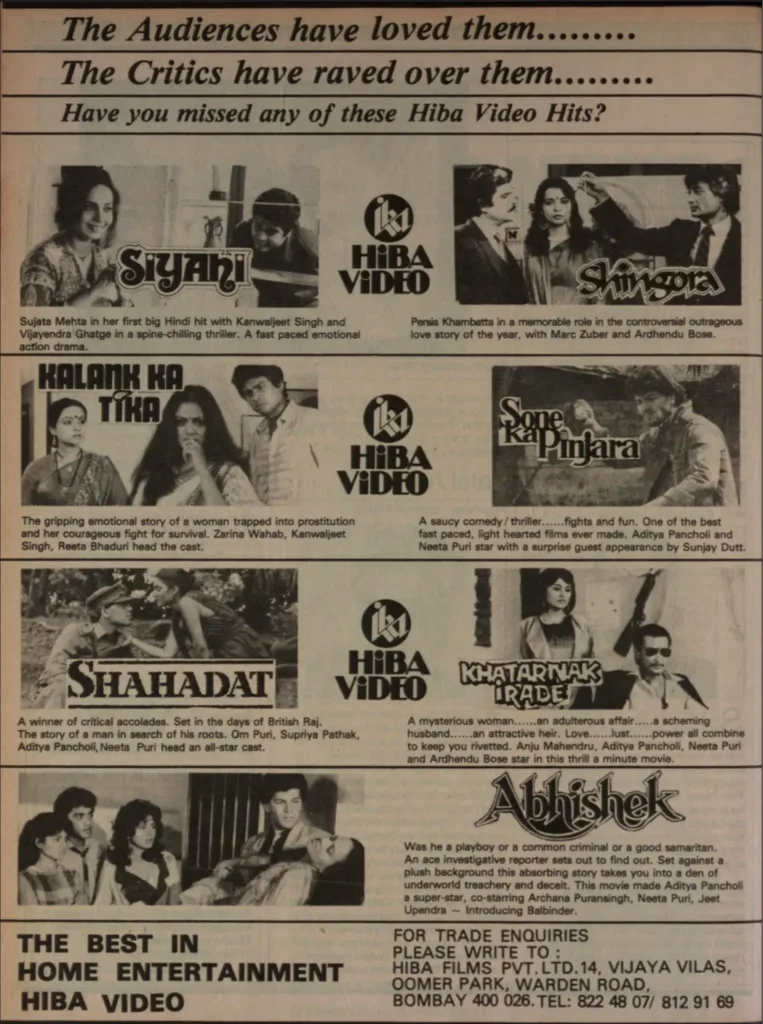
As a child of the 1990s, I started asking people around me who had memories of the 1980s whether they were aware of this ‘video film’ phenomenon. Inevitably, I was met with blank stares. A lead came through one day when a friend with an encyclopaedic memory remembered a line from a video film featuring actors Anju Mahendru and Aditya Pancholi. The line was, ‘Main tumhe dinner se breakfast tak ke liye le jaaonga’ (I’ll take you out for dinner and even breakfast). This clue led to a fresh perusal of the archives, and I finally struck gold.
I came across titles, star casts, directors, production companies and reviews of films that were not released on celluloid, but labelled ‘video films’. Hunting for surviving copies of these titles was another task.
Frustrated by this lack of progress, on a whim, I started searching for these titles on YouTube, where I had more success. Of the 50 titles on my original list, I was able to find seven on YouTube. They were found on channels such as Biscoot Filmy Talkies, which on further inspection, had playlists exclusively for B- and C-grade movies.
The first time the term ‘video film’ was used was when Hiba Films launched.

The magazine Stardust was founded in 1971 by Nari Hira, the owner of Magna Publications and pioneer of the video film concept in India, who subsequently launched Hiba Films, partially on the strength of Stardust’s local and international distribution set-up. Hira had a background in advertising and saw Stardust as a promotional tool for his advertising business.
Rachel Dwyer in her essay ‘Shooting Stars: The India Film Magazine Stardust’4 describes Stardust as a star Indian film magazine, the major preoccupation of which became the verbal and visual constructions of stars in narratives, interviews and photos. The magazine’s readership consisted of an aspiring middle class, likely to be attracting more women than men.
The New Spectator
After the entry of the VCR in the 1980s, many people in the upper-middle class preferred to watch movies at home rather than in decrepit cinema halls, which were considered suitable only for men belonging to the ‘lower’ classes. In my conversations with Nari Hira and interviews sourced from archival records, it became increasingly clear that women were the primary intended audience for Hiba Films.
Hira’s personal narrative about his decision to start the video film model in India is interesting. He says, “Well, there are two things here. First, films were meant for a particular audience with formulas like running around trees, happy endings et cetera. Secondly, with video, the cost was not that high and we came up with a process where we created new stars.
We took trained actors who were normally neglected by the industry. Also, we could do unusual stories. Most of the stories were done by me and were thrillers. We wanted to do something different from the usual [themes of] ‘boy meets girl’, ‘rich boy, poor girl’ et cetera. These films were also distributed internationally in places like Oman.”
Video represented new possibilities for creating a film culture that was different from its celluloid other: Bollywood. Hira saw this otherness manifesting in Bollywood’s genres and star systems and in response, Hiba produced — at speed — the erotic thriller form, clearly influenced by international developments such as the video nasties, but more directly by the straight-to-video erotic thriller, which was able to bypass the architectural model of cinema, as well as its censorship and control over spectatorship.
Moreover, the reader base of Stardust, the assertion of the Hiba machine that women constituted their primary audience and the leisure culture introduced by the entry of VHS inaugurated a new imagination of the spectator as not just male.
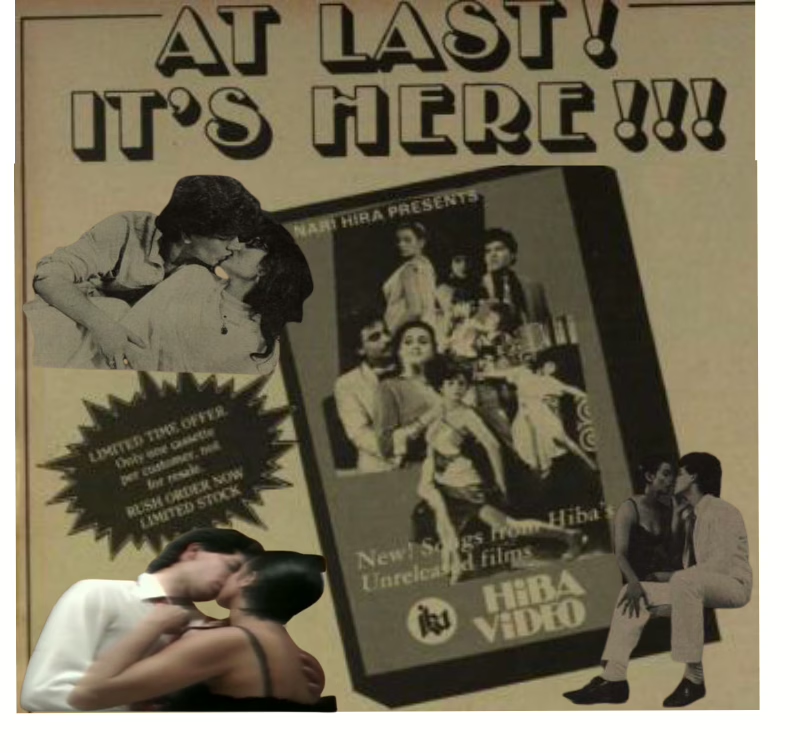
As noted previously, the arrival of video engendered a moral panic in society, particularly with the concern around pornography and its perceived effects on young men. The moral panic discourse seemed to foreground a perception that erotic, sleazy, adult content catered only to a male audience.
The erotic thrillers of Hiba Films defy this perception (and escape censorship) since they are written and performed clearly for women. The arrival of VHS bolstered the creation of bolder transgressive content and Hiba provided the infrastructure for such a form to emerge.
Femme Fatales and Stepsons
I will analyse one erotic thriller, namely Shingora, to demonstrate the aesthetics of the video film.
Shingora was Hiba’s most successful release and included stars like Persis Khambatta, Aditya Pancholi, Marc Zuber and Neeta Puri.

The central character, Roma Sinha (Persis Khambatta), is a successful architect at Sinha Associates by day, and a disco-dancing, sexually active agent by night. She picks up Nainesh (Aditya Pancholi) one night, then rebuffs his romantic advances in the morning. She eventually falls in love with Vikram Lamba (Marc Zuber), who has commissioned her to design the building of a hospital for him. Lamba proposes marriage, but she refuses because of a betrayal by a man she had once loved.
She was a shy, conservative girl when she fell in love with Satish (Ardhendu Bose), the coolest boy in college, but after sleeping with him she learned that he only wanted to win a bet with his friends. Roma had vowed never to fall in love again, and thereafter only engaged with men to fulfill her sexual desires. In a twist, Nainesh is revealed to be Vikram Lamba’s son, and is engaged to Anjali (Neeta Puri), the daughter of the same Satish who had once betrayed Roma. A meeting between these five characters towards the end of the film paves the way for redemption for all.
Director Anil Tejani said strange things were happening in Shingora and that — as a director — his job was “to make it as credible and sympathetic as possible”. The title credits were different from other Hiba Films, which usually began with disco numbers. The credits were simple, with Roma’s eyes and forehead in the foreground. Roma (Persis Khambatta), the central architect-protagonist in the narrative, lives alone with a ‘mausi’ (caretaker) in a contemporary high-rise building in Bombay.
Tejani states, “… my cinematographer B P Singh tried to shoot Persis in the style of Vogue magazine. He wanted it to be extremely bright. Persis was the most important character in the film and it was important to give her movement and a sense of dynamism. The camera tracks Roma’s movements as she sashays like a model to electronic music. Her costumes consist of baggy blazers, scarves, trousers and rimmed sunglasses. The shots convey the appearance of a modern independent woman in control of her own life. In response to her aunt’s anxiety about her lifestyle, Roma asks: ‘What do you want? That I should not go anywhere and just sit at home and watch TV?’
Roma’s character is established through images of her working in the office, driving a car, and supervising a construction site.
This is followed by a shift to scenes at a discotheque. In this sequence, Roma is presented in a black dress with tights, her shoulders exaggerated and her waist and fingers adorned with metallic ornaments. This iconography sets her up as a seductive predator. There is neon lighting and the camera resorts to flash pans and extreme close-ups when Roma spots Nainesh and approaches him. The dance number consists of synthetic beats.
Scholarship on music television cultures and music videos have underscored the role played by technology in transmitting bodily affects,567 and yet it was Elvis Presley’s dancing style that first instilled a desire to see music. This link between body and beat was followed by disco from the 1970s to the 1990s. The visual inscription of music on the body led to disco’s association with acid house, sexual liberation and gay subcultures.8 These elements found their spectacular articulation in music videos where glamorous pop stars swayed to their own music.
In the Indian context, Usha Iyer demonstrates the connection between dance and female stardom, arguing that the item number served primarily to showcase skimpily clad bodies.9 In contrast, Amita Nijhawan suggests that item numbers provide female dancers the space to vent their sexual desires.10 I draw on this scholarship to understand the preponderance of the disco number in Hiba Films.
In Shingora, the scene shifts from the disco to Roma’s apartment where she is having sex with Nainesh. The lovemaking sequence is shot tastefully. The camera moves from her living room to the bedroom, decorated with a double bed, lamps and a mirror. The morning after, when Roma emerges from the shower in a fluffy bathrobe to sit in front of the mirror, Nainesh expresses his admiration for her beauty and his love for her.
This is an interesting sequence and an early example of dramatic role reversal, where a man falls hopelessly in love with a woman and yet his desire to marry is rebuked.
Roma proceeds to casually take a call from another man in front of Nainesh and make plans for the evening. He storms out in anger, accusing her of using him for his body. She summarily dismisses him with a laugh, saying, “One more bites the dust.”
This was the pattern that recurred in the lovemaking sequences of all Hiba Films. To an audience accustomed to watching lovemaking represented through two flowers touching each other, the Hiba sequences appeared extremely bold.
The film then introduces Vikram Lamba shot in the same style as Roma, the camera tracking him swaying to electronic music playing in the background. He has commissioned a hospital construction project but is biased against using a female architect. The plot progresses to Roma winning the contract, as well as a friendly romantic encounter between the two.
Towards the end, the film presents the audience with two flashbacks: one from Vikram’s point of view, the other from Roma’s. The first flashback relates to Vikram Lamba’s first wife who had suffered from mental illness and ultimately died by suicide. This is filmed at a high-rise apartment.
In the second flashback, Roma learns that Nainesh is Vikram’s son. The flashback chronicles Roma’s small-town origins and reveals how a man named Satish took sexual advantage of her in college, causing a scandal that led to the death of her mother. In this flashback, she is shown wearing traditional clothes that cover her entire body. Her hair is styled in two plaits. Roma’s appearance as a traditional, demure girl is in stark contrast to the way she is first introduced to viewers in the present timeline of the film. Both these flashbacks point to the origin of distrust for both genders.
About the content of the films he produced, Nari Hira said: “Our films were made for the family, although our content was adult and not meant for children. Shingora was considered very, very bold at that time.”
Sleaze and Censorship
Only a handful of Hiba Films survive today. The filmmakers and producers themselves did not have any surviving copies of their films, except for Naqli Chehra, which is available for sale on the Magna website. Whatever survives is because of industrious individuals who uploaded these films onto YouTube.
The one thing common to the films is the central position of a femme fatale; an independent, self-assured and intelligent woman with shades of grey.

How can we characterise these films? The reviews seem to suggest ‘sleaziness’ in the Hiba Films. In a review of the song videos of some of Hiba’s upcoming films, TV and Video World wrote: “You can easily see a thread right through the Hiba repertoire which emphasises kinky sex, sado-masochism, midnight cowboys and money”.11 Pawan Kaul referred to his film Scandal as ‘city slick’ and stated, “Just wait for Scandal — it’s on same lines — disco scenes, unnatural sex and middle-class hypocrisy.”
In his work on trash cultures, Jeffery Sconce (2007) proposes that sleaze is not a judgement on taste, but an aesthetic mode of the cine-erotic that is widely recognized as a quality in Hollywood’s genre of exploitation films (with lesser-known stars, low-budget productions and lurid mise-en-scènes).12 The Hiba films deemed inappropriate by reviewers were frequently referred to as sleazy.
The question of sleaziness remains a contested and relative category linked to taste. Judgement is never easy on these questions.
The presence of sexually active female agents may have been disconcerting for the reviewers — enough to make them pass value-based judgements. The filmmakers saw this as a publicity opportunity and a way to differentiate their films from mainstream Hindi cinema.
When it comes to censorship, Nari Hira echoes a hassle-free experience with the censors: “The censors looked at us leniently. With video, parents have a choice. They can tell their children not to see it. We would get an A certificate. The censor attitude towards us was that “theek hai, video-film hai (it’s okay, it’s only video)” and would let it go. I remember that only three or four people in the committee would turn up for the certification process, but when we screened our film, every committee member turned up. They were very nice to me; I did not even have to pay any bribes.”
The lenient attitude of the censors toward these videos was not taken to kindly by the rest of the industry, since they had experienced a very different kind of authoritarian censorship. Director Manmohan Desai, known for Bollywood blockbusters from the 1970s and 1980s, was upset with then-Censor Board chief Vikram Bohra. In an interview with Filmfare, he stated: “I don’t know how Nari Hira’s film (Shingora) got through the censors. I don’t know how they could make such a film.”
In 1969, the Khosla committee report on censorship found that written rules in the Indian censorship code prohibited ‘excessively passionate love scenes’, ‘indelicate sexual situations’ and ‘scenes suggestive of immorality’. Madhav Prasad (1998) has made a strong case for why kissing was ‘prohibited’ by the heavily regulated scopic regimes of the feudal family romance.13 Prasad argues that kissing is informally banned even if the couple is married because — and I paraphrase Prasad here — even marriage is not allowed to open a private space in the feudal order; marriage is socially sanctioned and enacted under the supervision and moral censorship of the communal order. Establishing a logic of if-we-didn’t-see-it-it-didn’t-happen, an ever-present extended family keeps watchful eyes on the lovers till they are joined together in marriage.
Ranjani Mazumdar (2011) offers a slightly different argument, using examples from the global travel films of the 1960s, An Evening in Paris (dir. Shakti Samant, 1967) and Sangam (dir. Raj Kapoor, 1964).14 In these films, Tokyo and Paris are sites of desire, erotic love and mobility, enhanced by a narrative push to mark ‘Indianness’ as different. Kissing scenes featuring foreign couples were shown on screen, while the protagonists of both films were made to hold back to mark out their ‘Indianness’.
In the Hiba video film, the cause of anxiety was not linked to the ‘indelicate sexual situation’, kissing or scenes suggesting immorality, but instead to the sexual agency of the central female protagonist and her escape from punishment. The kiss appears in the film through an elaborate structuring of shots, providing a vivid sense of contact.
Hiba Films were neither interested in holding back to project an image of Indianness, nor in promoting family values.
They were creating alternative maps of desire on an island of Bombay with a sexually active female as a major protagonist.
The biography of Hiba points to the creative possibilities that opened up with analogue video. Although short-lived, the Hiba Films factory was extremely productive, churning out 29 films over the course of three years. Largely forgotten in the annals of media history, the video film remains an important intervention, a prehistory to the B-grade film phenomena of the late 1980s. This essay has tried to recover a fragment of this lost memory of the video film and the intimate encounters it may have engendered.
- Video nasties emerged in the UK during the late 1970s and early 1980s. The term ‘video nasties’ refers to several films distributed on video cassettes that were criticised for their violent content. The advent of the video recorder led to a boom in low-budget horror made available for home rental. In the early 1980s, home video rental in England was essentially unregulated, except for the policing of erotic material under the Obscene Publications Act of 1959 (Martin Rogers, 2011). As VCR sales and home video rentals in Great Britain increased, horror titles flooded the market. These titles were notoriously cheap and quick to produce, and those that fared poorly in theatres found great success in the home-video market.
- Suresh, Mayur and Namitha Malhotra. The Public is Watching: Sex, Laws and Videotape (Delhi: Public Service Broadcasting Trust, 2007).
- Sundaram, Ravi. Pirate Modernity: Delhi’s Media Urbanism (London and New York: Routledge, 2010).
- Dwyer, Rachel. ‘Shooting Stars: The India Film Magazine Stardust’. In Pleasure and the Nation: The History, Politics, and Consumption of Public Cultures in India, eds Rachel Dwyer and Christopher Pinney, pp. 247–285 (New Brunswick, NJ: Rutgers University Press, 2001).
- Frith, Simon, Andrew Goodwin and Larry Grossberg. Sounds and Vision: The Music Video Reader (London: Routledge, 2005).
- Vernalis, Carol. Music Video: Aesthetics and Cultural Context (New York: Columbia University Press, 2004).
- Marks, Craig and Rob Tannenbaum. I Want My MTV: The Uncensored Story of the Music Video Revolution (London: Penguin, 2011).
- Gilbert, Jeremy and Ewan Pearson. Discographies: Dance Music, Culture and the Politics of Sound (London: Routledge, 1999).
- Iyer, Usha. Dancing Women: Choreographing Corporeal Histories of Hindi Cinema (London: Oxford University Press, 2020).
- Nijhawan, Amita. ‘Excusing the Female Dancer: Tradition and Transgression in Bollywood Dancing’. South Asian Popular Culture 7, No. 2 (2010): pp. 99–112.
- TV and Video World, 1 March 1988, Vol. 2, No. 10, pp. 93–94.
- Sconce, Jeffrey (ed.). Sleaze Artists: Cinema at the Margins of Taste, Style and Politics (Durham, NC: Duke University Press, 2007).
- Prasad, M. Madhav. Ideology of the Hindi Film (New Delhi Oxford University Press, 1998).
- Mazumdar, Ranjani. ‘Aviation, Tourism and Dreaming in 1960s Bombay Cinema’. Bioscope: South Asian Screen Studies 2, No. 2 (2011): pp. 129–155.
-
Ishita Tiwary is Assistant Professor and Canada Research Chair at the Mel Hoppenheim School of Cinema. She also directs the Raah lab, a community-facing research space that focuses on migration and media. She is the author of Video Culture in India: The Analog Era, Oxford University Press, 2024. This essay is based on the chapter ‘Video as Intimacy: A Biography of Hiba’, from the same book.