What makes a crime, who is a criminal, and what in the hot white mess is a feminist way of looking at crime anyway? The background work on this edition involved a lot of old school study, and new school interpretations. Together, we believe we have found something not unlike a kaleidoscope, where broken pieces of glass move synchronously to yield a pattern that is both unique and ubiquitous.
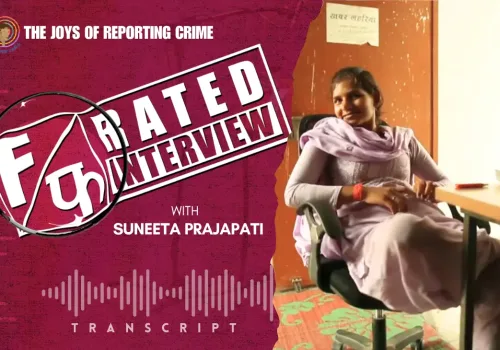
Crime reporting, though long considered a ‘hard’ beat to be covered by serious (read: male) reporters, is a core part of Khabar Lahariya’s grassroots journalism. For one reporter, being put on the crime beat took her back home. Suneeta Prajapati discusses the strategies and compromises that allowed her to carve out a niche in journalism and earn a place in the hearts of many girls from rural India.
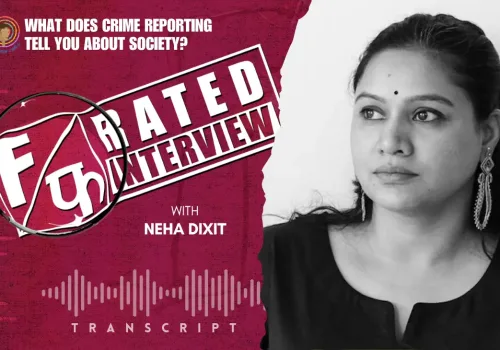
Neha Dixit is a freelance journalist who, in her own words, has investigated topics of social justice, gender and politics for the past 16 years. After Neha’s undercover investigations, audacious encounters, and many formats of work, how does she now understand crime?
Since 2016, Neetu Singh has been engaged in long-form reporting, working with Gaon Connection till 2021 and currently as an independent journalist with her YouTube channel, ‘Shades of Rural India’.
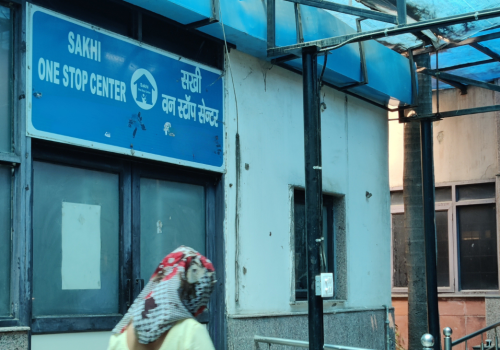
The wave of the massive Nirbhaya protests prompted the government to set up 36 One Stop Centres (OSCs), one for every state and UT, on a pilot basis in 2015. Today, there are 819 operational OSCs across the country. A One Stop Centre is meant to integrate victim-survivor’s access to different mechanisms of justice such as police, hospitals and courts, while also providing emergency shelter and psycho-social counselling.
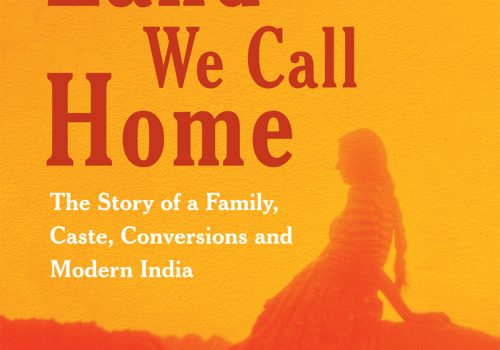
we share excerpts from Nusrat F. Jafri’s The Land We Call Home. In this haunting and intimate memoir, Jafri interrogates the colonial and casteist invention of hereditary criminality—through the prism of her own family’s history.
Through her recent work on a public interest litigation, Maitreyi’s understanding of mental health in prisons saw a shift. What happens when care turns paternalistic? Can the promise of freedom be used as a tool to negotiate/manipulate? Are our imagined alternatives to this system any better? This interview is an attempt to make sense of some of these questions.