
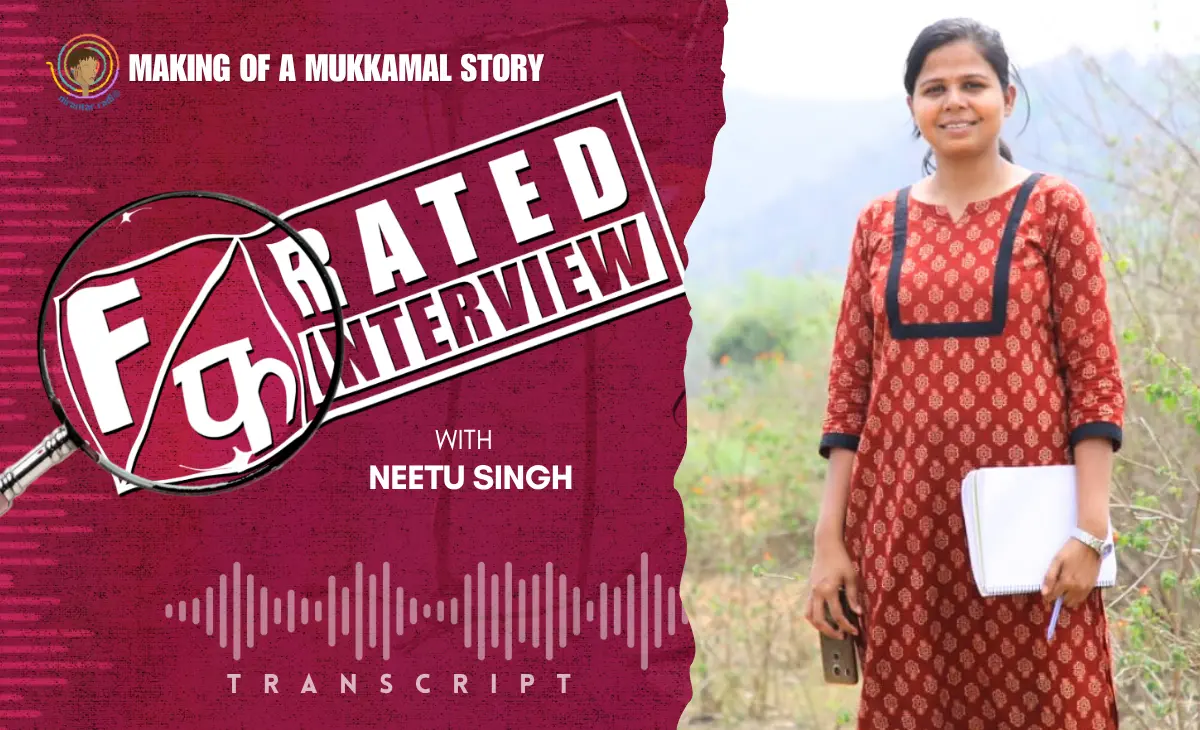
Since 2016, Neetu Singh has been engaged in long-form reporting, working with Gaon Connection till 2021 and currently as an independent journalist with her YouTube channel, ‘Shades of Rural India’. For Neetu, the crime beat isn’t ‘breaking news’ but rather something that requires care and patience to understand. With tremendous insight into how to work with local systems to get the job done, she reminds us that the devil is in the details.
This is a translated and abridged transcript of the second instalment in our podcast F-Rated Interviews, titled ‘Making of a Mukammal Story’. Listen to the full episode in Hindi. Translation to English by Astha Sharma.
TTE: A lot of us didn’t see many journalists around while growing up, especially crime reporters. How did it occur to you that you wanted to become a reporter?
Neetu: First of all, thank you so much for giving me this chance to share my experiences.
Honestly, I don’t know how to explain it. I used to work in radio initially and had heard of many incidents of crime in my town. But I must tell you honestly that I didn’t know what ‘rape’ really meant, who the people involved were, and how one speaks to them. When I joined Gaon Connection in 2016, I met a rape survivor for the first time.
I always say that Gaon Connection’s founder, Neelesh Misra, offered me immense support to do this kind of reportage. He thought of me as a sensitive person, though I don’t know why he thought so, and he assigned me to the crime and justice beat. Once, when I was starting out, he even accompanied me to cover a story.
When you work in an organisation of this kind, on stories of this nature, even a small push and some support from editors makes it easier to report on difficult matters.
I don’t just report; I’ve also always worked on workshops pertaining to gender. I have a nuanced understanding of such issues. I have undergone training on matters like choosing the right words, how much anonymity or identity needs to be maintained, and whether we call the person a ‘survivor’ or a ‘victim’. I pass on these learnings [to others], too. I conduct training on journalism but also attend such trainings as a participant because I feel like there is so much more to learn.
Neelesh sir always gave me the freedom to write without inhibition, to write whatever ran through my mind while on the field. He taught me the technique of visualising a story, which you’ll often find in my writing now. If he edited a story of mine, he might move some paragraphs around, but would never interfere with my style of storytelling. That gave me confidence, which enabled me to dive into stories as a reporter. I was a fresher in the media industry then; this was the first organisation where I learnt [how to do] reportage, in 2016. I was there till 2021. You learn all of this only by doing.
TTE: What goes into the making of a mukammal (complete) story? What are the things that absolutely cannot be left behind?
Neetu: A mukammal story is one where you respond to every aspect of the story. On reading it, you shouldn’t be left with any questions, or feel like something has been left unexplored. For example, while speaking to rape survivors we sometimes require counsellors, so we involve them too. Or we speak to folks from Rajya Mahila Aayog [State Women Commission]. We leave no aspect of the story untouched.
Whenever I cover a story now, my first task is to look out for a copy of the FIR [first information report]. Once I have read the FIR, I pay attention to the language used by all parties — the family, the police and the survivor. After all, in our legal system, everything is about words. If a survivor says, “Something wrong happened to me,” [it will be read as] ‘harassment’ and the allegation [will be of harassment]. Later, if she uses different words, it weakens her case. These nuances matter, and it is crucial to know and understand them.
The lack of correct information, incorrect terminology and careless use of words — all these weaken the law, which weakens the case, and all of this ultimately benefits the criminal.
These cases require a high level of alertness. A report is not just about writing headlines. It should ask questions of the government and stir people’s hearts — that’s what a headline should be.
I get very disheartened when newspapers or websites write, “The girl had an affair with the boy, and that’s why she was gang-raped.” I worry for the reporter and their organisation too. Why did they write that? Does our story become less impactful if we don’t write those words? Why should we weaken the case by using the word ‘affair’? One must be mindful of this vocabulary. Why are these words used? Is it because it’s all ingrained in us now? [We tend to think:] “Is it about a girl? Must have been an affair.” “[The complainant is a] Dalit? Must be about money.” When our mindset itself is prejudiced…
If we carry our biases with us, we won’t be able to overcome them. We need to show why it is essential for us to do that story. What new angle are we giving it, such that even if someone reads it three years from now, it holds the same importance and gravity as it did on the day when a thousand reporters arrived to cover the incident? Our responsibility increases manifold.
TTE: You spoke about nuance and the swapping of words, and about giving the same words a visual imagination. You’ve done a visual essay [as well]. What for you is the photograph of a crime?
Neetu: Personally, I feel that a rape report can never be ‘breaking news’. Crime is not a sensational beat, but one that demands a lot of pausing. You cannot rush it. As a woman, there are also certain advantages when it comes to taking pictures of a crime scene, one being that we can go inside the house and take pictures there. Oftentimes when reporters go to the field, they stay in the vicinity of the victim’s body, where the crowd has gathered. But there are a lot of pictures beyond that too. However, I’m always mindful of not taking any pictures that could potentially harm someone or reveal the survivor’s identity in any way.
You were referring to the Unnao case.
Photographs demand the same rigour as a written story.
I had taken some 15 photographs that portrayed the state of the household. There was a stove burning in the girl’s house, and a roti was on it. She had made that roti before she went to the field. Her slippers, bags, books, the things she’d written, the condition of her house — you must have seen; there were torn sarees and broken things. These were important images, and raised a lot of questions.
If you see those torn sarees, you may get a sense of their poverty and also see evidence of the fact that the family didn’t have access to a washroom. If there are broken slippers in the house and very few things, then you can infer [their socio-economic condition]. A picture is worth a thousand words.
In the Unnao story, for example, the photographs also revealed how easily poisonous substances are available in our country without any regulation. The poison that was fed to the two girls to kill them — there are no regulatory laws for it.
An investigative report takes a lot of time. This is why a story like rape can never be ‘breaking news’.
You need to know what it is that you’re writing that is different [from how others are expressing the same information]. Your vision needs to be that sharp. These things happen over time. I am not doing something extraordinary. When you write stories of this kind, when you live them, it comes to you. It will become a part of your practice.
TTE: After all these years, what have you discovered about crime through your work? Has there been a change in your attitude?
Neetu: There are many things. I am able to see the entire police system up close. I used to trust the police a lot. But when I started reporting on crime, I found that the whole system is faulty. I’m not saying all officials are at fault, but I was able to see gaps in the system, in things like the carelessness of the police, people’s perception, and the [broader] understanding of crime. The biggest lacuna I saw in the entire system was that there is a lack of awareness about gender. The police do not receive any training and don’t have any information about the law [as it pertains to gender]. If I speak to an official about the compensation fund [that survivors of sexual violence are entitled to], they ask me, “Oh, is there a law like that?” The official in charge is himself unaware that there is such a thing. If this is the case, what can you expect from them?
After the Nirbhaya case, the Nirbhaya Fund was created, and it was promised that the fund would be increased every year. There has been no significant increase since it began, because states are unable to spend the existing funds. We have dozens of girls who should have received compensation from the fund, and yet they haven’t because officials are simply unaware of its existence. Then they say that the state government is unable to spend that fund. How much training have the state officials received in order to be able to distribute that budget? Have they received any training at all? Do they have statistics on how many young girls were raped, how many are entitled to the Nirbhaya Fund and how many have not received it? If they have not received it, then why? There is no accountability in the entire system.
Crime is on the rise, but no one is held accountable. If a reporter writes something incorrectly, then the police can start an investigation on them, their editor can question them, and they could even be fired. My accountability is pre-decided because I am a journalist. But a responsible officer’s accountability is completely undecided.
As a journalist, I constantly feel the need for training, and I receive it, but our officials who are connected to the field also need training. They shouldn’t repeatedly be asking a young girl, “So how were you raped that day?”
“They took your clothes?” “Where did they keep those clothes?” “How did it happen?” The things that young survivors have told me about the things officials ask… I become enraged.
TTE: Through your style of reporting and questions, it is clear that one facet is prominent — that of the field. You have stayed in the field, and you’ve spoken to people there. Could you unpack this word, the ‘field’, for us?
Neetu: The ease with which I’m telling you that I speak to families, neighbours, and officers — in reality, it’s not easy. People often say, “Oh, you have spoken to everyone, but no one was talking to us. How come?” It is not possible immediately; it takes time.
Many times, when we go to cover such stories, we begin by talking about things other than the issue at hand. We make a place for ourselves in the neighbours’ homes. If nothing else, I’ll ask them, “Is there a washroom?” “Can I have a glass of water?” “Which class are your kids in?” “How are you?” “What does your husband do?” “How long has it been since you went to your natal home?” These questions aren’t directly connected to the story, but asking them allows me to introduce myself, where I am from and why talking to them is important to me. Until you’re able to do that, you won’t be able to talk in the field, because no one is willing to talk [unprompted], especially in matters like rape cases.
TTE: How do you report such news when no one is willing to talk, if the victim is not willing to talk to you?
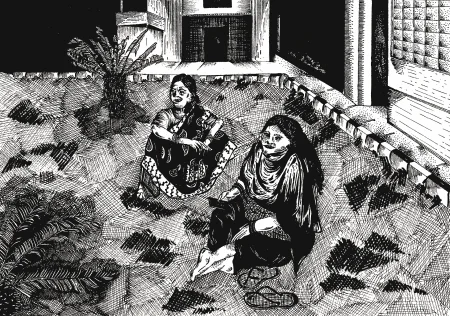
Neetu: I once reported such a story in Kanpur Dehat [district]. The survivor was a minor Dalit girl; most of my stories have been similar. I think it is a coincidence that most stories that came my way were about this demographic. The girl in question had been gang-raped, and the culprits were her neighbours, some four or five people. It had been three or four months since the incident, but the culprits had not been arrested since the police didn’t have proof. The girl kept speaking up, but her testimony was not considered valid evidence. She had been sent to her relatives’ house by her family. She was so distressed that she died by suicide. Only after her death were the culprits arrested — the very same day. I went to do a ground report on this story.
Why was it that as soon as the girl died, the police could carry out the arrest? In this entire case, where does the irresponsibility of the police sit? I found that the Kanpur Dehat police had kept the girl in the police station for some 13 or 17 days. There is no law that allows them to detain a victim in the station.
I emailed and WhatsApp’d all of those police officers. I called them several times for my record, so that when I published the story, they couldn’t say, “Why didn’t you try to contact us?”
Not a single person spoke to me. Out of compulsion, I ran that story a week later and was immediately called by the Superintendent of Police. I got that call within half an hour of publishing.
He asked, “Am I speaking to Neetu Singh?” I said yes. He went on to speak to me in a very rude manner, saying things like, “How dare you? Why didn’t you talk to me? You could go to their house from Lucknow, but you couldn’t come to our office? Why couldn’t you meet me? How could you publish the story?” He even said, “I will fight against you in court. I’ll file a case against you because you’ve run a false story — the girl was not in the police station for that many days.”
I was truly scared. He told me that if I didn’t take down the story, things could go south. I don’t know why, but I also had quite a bit of confidence — and anger — within me. I had emailed and WhatsApp’d him many times; he had ‘seen’ those messages. I asked him whether I could speak if he was done. He responded, “Yes, yes, let’s hear you out as well.”
I told him, “First thing, I am not going to delete the news article. Second, if you’re saying that she was not kept at the station for so many days, then please tell me how many days it was. I will quote and write this: ‘After the news was published, the SP called me to tell me that the number is incorrect. As per our knowledge, the victim was in the station for 13, not 17, days.’ And I will tag you for sure.” We argued for an hour and a half.
After this incident, he was transferred to Hardoi district. When a story has such effects, a fear also sits in the heart — which is why, for many days, I didn’t cover a story in Hardoi.
TTE: You were confident, but also a little afraid. When have you felt this fear in the field, and what role does your being a female crime reporter play in this fear?
Neetu: I have felt it many times. When a woman reporter calls an officer, we’re taken very lightly. When the news starts travelling and having many effects, only then do they take you seriously. There was an incident with a minor girl in Lucknow who was kidnapped by her neighbour. She must have been 10–11 years old and was forced to do sex work. I found the girl, I wrote the report, and to understand the error of the police, I called up officials. I called them multiple times, but no one was willing to speak to me. They were very busy. They would say they were in meetings, but I needed their version. I asked them to speak to me for just a minute and tell me what was happening in the case. They would say, “What should I tell you? The culprits have been arrested, and the girl is in Asha Jyoti Kendra. What else do you want to hear?”
The [Lucknow] story got published. There was a lot of pressure on me. They called my organisation and said, “Your reporter didn’t even talk to us; she called me only for 30 seconds, and I couldn’t say anything at that time. I worked very hard to arrest the culprit within 24 hours, but your reporter simply wasn’t willing to listen to anything.” They had taken me very lightly. But when the story gathers traction or becomes viral on Twitter, when their jobs are at risk, then they say the reporter is insensitive. It’s happened many times. Female reporters aren’t taken seriously by officials; they think we are doing this in vain. That is why I feel that compared to male reporters, we have to work a great deal more when covering issues like rape. We need to put in a lot of effort and strategise while speaking to officers — only then can we publish a complete story.
TTE: You said things like ‘the impact of the news’ and ‘went viral’ a few times. What is the meaning of this ‘impact’?
Neetu: There was an incident in Hardoi where a child was gang-raped, who then became pregnant and gave birth. The family was extremely poor. It was 12 days after the child was born, and the mother was feeding dal water to the baby. There had been no sweets for her; no arrangement had been made to fetch her milk, since they had no money. The [survivor’s] mother said to me, “I’ll go out tomorrow to mortgage my anklet and get some things for them.” I could not bear to see it, so I helped them out a little.
When I asked them if they had received monetary compensation, she said no. I went to speak to the woman officer-in-charge. The benefit of the officer being a woman was that she took the matter very seriously. I told her that I was a reporter working for a certain media house, and this child had not yet received these funds; the family was very poor, and they were in dire need. I told her the entire situation. She asked me not to publish the story for two days, so that she could check what had been overlooked. I waited. Then she called me after two days and said that the file was there, with only the signature pending, and the money had reached the [family] now; I could call them and check. I called to check, and the Rs. 6–7 lakh that the survivor was entitled to had reached her.
The point I want to make is that whatever had to be done, we did with a lot of composure and patience — and the job was done.
We often need to work beyond ‘the field’, and we do that. But many times, we also get stressed, hoping that if two or four stories have an impact, then all stories will. And that does not happen.
People ask, “Madam, you had come to do this, and nothing came of it,” which leads to a lot of guilt. A lot of times I personally call the officers to figure out what the issue is, or I tell [survivors] that I will speak to a lawyer and figure it out. That’s the extra effort behind my stories.
TTE: What did you learn about yourself through this work?
Neetu: I understand things better now. Earlier, I used to react very quickly; I used to snap back. My mindset came from being brought up in a particular kind of environment. I was raised to think that if a guy and girl were talking to each other, they must be having an affair, and if something bad happened, that the girl herself was responsible for it. But as I worked, I learnt — and I continue to learn — about how wrong I was. Not having the best environment around me, however, is not the fault of the people around me; they were also raised the same way. Now when I speak to young girls, I tell them not to be judgemental about any story.
TTE: What other advice do you have for young women who want to become crime reporters or journalists?
Neetu: If you go to the field in a cursory manner, your story will turn out very superficial. One wrong word can turn a case around. And stories of this kind require a lot of patience. Even more than patience, there is the need to read. So, whenever you write a story of this kind, read a lot. When I worked with Gaon Connection, I convinced my editor that I needed time for these kinds of stories, and I got that time. Crime reporting is time-taking; it is crucial to pay attention to details in order to cover the story. If you run an incorrect story, then the relationship with officers also turns sour. The same officers keep getting posted in one district or another, so it’s a matter of building relationships, and it takes time.
I am telling you all this with ease now, but this is not the work of one or two years. I started reporting in 2016; now it’s 2023. If you go into the field with judgement, you won’t be able to work. Right now, there is a big lack of crime reporters in the country — a lack of sensitive reporters, for sure. To whoever wishes to join the field, I would say definitely come, because there is a lack of women reporters. But don’t come with judgement. You need to have the hunger to learn and cultivate patience. You need the ability to go to the field and talk to people, and you will have to develop these skills.
Neetu Singh is an independent journalist and the founder of Shades of Rural India. Her consistent reporting on gender-based violence in rural India has led to effective police action and justice for survivors. Neetu has over 13 years of experience in rural journalism, and has won the Laadli Media Award eight times for gender sensitive reporting. She also won Chameli Devi Jain Award for outstanding women mediapersons and the Priyanka Dahele Award for promising young journalists in 2020.
-
Madhuri Adwani produces, records and edits narratives and sound pieces on Nirantar Radio. She also mentors and facilitates workshops as part of The Learning Lab where her core enquiry is ‘how do we write and tell our narratives’.
Juhi is a writer and a researcher who writes long form pieces, provides editorial support, and produces podcast episodes and audio pieces for The Third Eye’s podcast channel Nirantar Radio.