
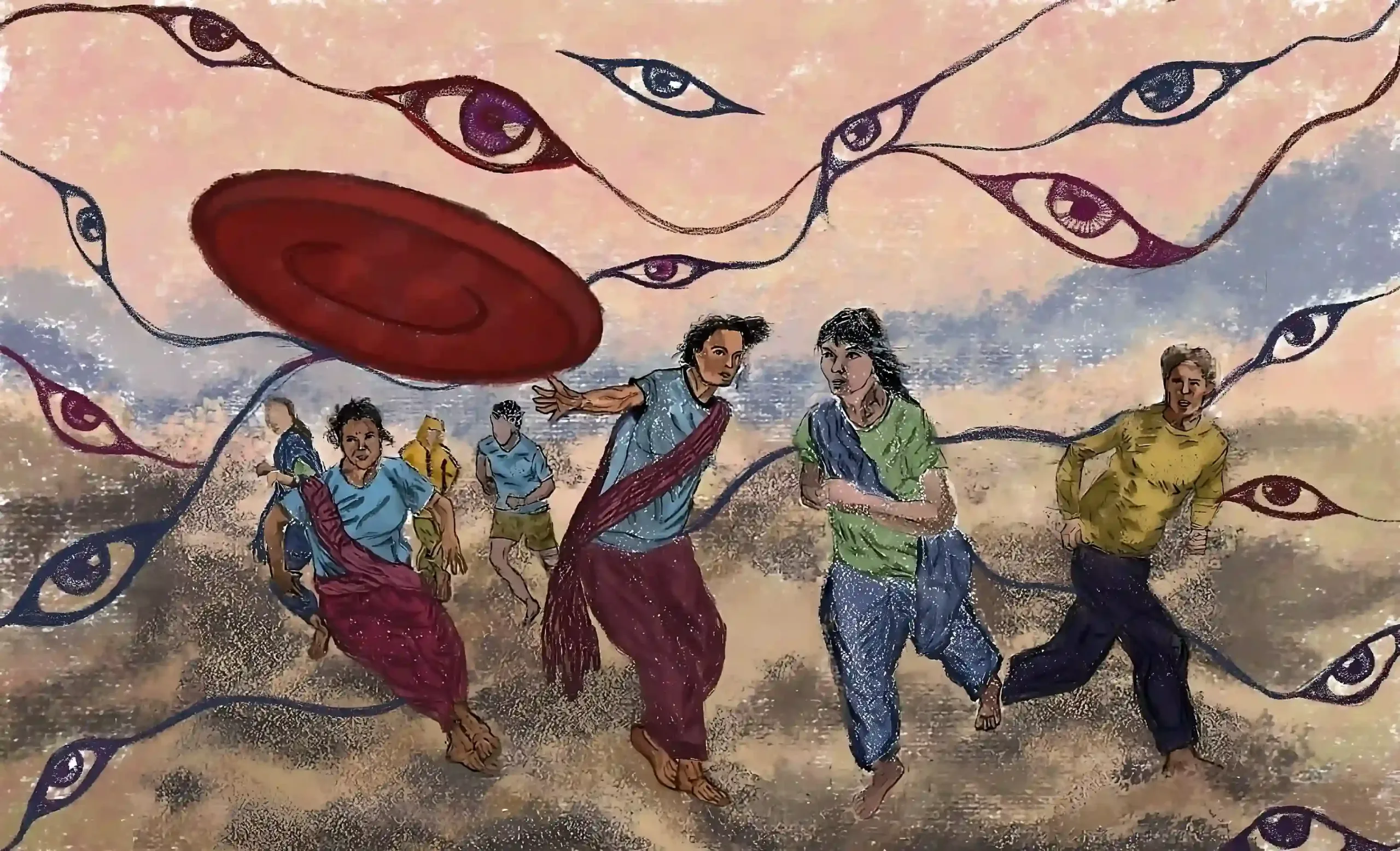
The first time I heard about the incident, it was over the phone — fragments of urgency in Sapna’s voice, the unmistakable sharpness of anger and fear cutting through her words. By the time I could piece together what had happened, the sun had long set over Panserwa. The frisbee had been abandoned on the dusty ground, a fallen witness to the confrontation.
A village in Dandkhora block of Katihar district, Panserwa is not unfamiliar terrain to me. For over 15 years, Jan Jagran Shakti Sangathan (JJSS) — a trade union organising landless workers and marginal farmers in struggles for land, work, wages, food security and dignity — has been active in and around the village and I have been part of this work for the last decade.
The village has OBC (Kurmi) households, as well as some Muslim and Adivasi ones. In recent years, caste and communal boundaries — always present, but negotiated in everyday ways — have begun to harden. As in much of Katihar, the district’s sizeable Muslim population has been used to stoke quiet but persistent communal suspicion, pulling even small, mixed villages like Panserwa into a hyper-watchful climate.
Many of the girls playing frisbee that night had grown up in the union — they had accompanied their mothers or older siblings to local meetings, statewide actions and national protests. They sat through strategy discussions and celebration songs, spent hours jostled in crowded general compartments on long train rides to Delhi or Patna.
Our relationships were built in these shared spaces. Not only in moments of struggle, but in the ordinary rhythms around them: conversations under trees, verandas crowded after meetings, cups of chai passed around at dusk, songs that dissolved into laughter and silences shared without discomfort.
So when the phone calls began — first Sapna’s, then others in twos and threes, some excited, some afraid — I understood what it meant. I knew better than to demand clarity on command. In our work at JJSS, stories unravel slowly — shaped by fear, shame and quiet reckoning. I waited.
Sapna was the first to break. Her words tumbled out, as if saying them quickly might keep them from cutting too deeply.
“We were just playing, Tanmay bhaiya. Racing, catching the frisbee, throwing it back… and then they arrived.”
Elder men from the village. Self-appointed gatekeepers of virtue, carrying a lifetime of unquestioned authority.
Priyanka continued the story, her voice smaller, fraying at the edges.
“Aren’t you ashamed of yourselves?” they had shouted. “Itni badi ho kar kood-phaand kar rahi ho (Running amok like this, at your age)!”
“They said we were shameless… that everyone could see us… our bodies… that we should remember we’re girls.”
The words had a familiar echo: women activists told they talked too much; queer friends told their lipstick was too bright; girls told their laughter was too loud. These were the usual ways people were reminded to stay in their place. The girls had found a way to carve joy out of their routine-laden lives and that itself had become a threat.
And what a joy it had been. I could see it clearly from the way they spoke: the thrill of a frisbee soaring, the rush of air against skin as they chased after it, the breathless laughter that followed every dive, every near-miss. They jumped, they ran, they dove, they grazed knees, ripped their clothes and got up again grinning. For those fleeting moments, in heady pursuit of the frisbee, they were more than daughters, more than girls waiting to be married off. They were athletes, comrades, defiant in joy.
Their laughter must have carried farther than they realised — far enough to summon the guardians of morality.
One of the men’s voices rang out, dripping with scorn. “Have you no shame about your bodies? These antics of yours will bring our entire village to ruin.”
The message behind his words was clear: their bodies belonged to the village, to its eyes, to its judgment.
Sapna, still catching her breath from the last dive, felt her blood boil. How dare they? How dare these men, watching from a distance, dictate what they could or couldn’t do? Fists clenched, for a moment she imagined shouting back at them. Before she could, Neha and Pushpa spoke up, voices steady despite their thudding hearts. “We’re playing frisbee. What’s your problem?”
The men laughed and stepped closer.
“Is this appropriate behaviour for girls? Should daughters of respectable families be running around in a field this way?
Another player, Arti, snapped back, “If you don’t like it, maybe you shouldn’t look.”
The men’s faces darkened. One of them spat on the ground and growled, “Bahut zubaan chal rahi hai. Chup na rahi toh haath chalana aata hai humein (Now you’re talking too much. Shut up or we will shut you up).” He shifted forward, a looming warning.
But the girls did not shrink back. They stood shoulder to shoulder, their voices rising in a chorus:
“Don’t you dare touch us.”
“Maybe it’s your gaze that’s vulgar, not our game.”
Something new was crackling between them, their fear turning into solidarity.
The two older men stood there, caste authority settling around them like a well-worn garment, the air around them contracting. The frisbee lay abandoned at their feet. Neither side moved and neither side yielded.
Later, when Sapna recounted it to me, her voice was softer but unwavering. “Tanmay bhaiya, they act like we are the problem. But the real problem is their own gaze.”
As she spoke, I felt a familiar sting, of being seen as improper for existing in one’s own body. At the same time, my caste gives me a kind of safety my saathis are denied.
In the moment, Sapna had wanted to say more, but the words had caught in her throat. Now, recounting it to me, she finally let them out: “You’re so concerned about how other men will look at us. But you know what? It’s your gaze you’re really afraid of.”
“What happened next?” I asked.
Priyanka sighed. “The game ended,” she said. “And we fell silent. The cows and oxen were returning, raising clouds of dust. Dusk was setting in. So we turned around and started towards home. That man kept hurling threats at us, even as we walked away.”
It was Sunil’s account that revealed the true extent of the confrontation.
A young Dalit JJSS activist from Araria, placed in Katihar to mobilise youth and children, Sunil had been playing frisbee with them that evening. He had dealt with the first confrontation.
“Get lost! Making a scene for no reason, girls and boys playing together!” one of the men had barked at him.
Sunil had held his ground for a moment, his voice calm but firm. “Theek hai, main hatt jaata hoon… par hum kuch galat nahi kar rahe hain. Hum bas khel rahe hain (Okay, I’ll step aside. But we’re not doing anything wrong. We’re just playing a game).”
He even tried to explain, almost pleading in his appeal: “It’s called frisbee, and people play it all over the world. It’s part of the rules that you’re not allowed to touch each other, even by accident. So you don’t need to worry.”
But he had seen enough confrontations to know how quickly these moments could escalate, how easily violence could follow. In that moment he was outraged, but not surprised. Maybe if he stepped away, he had thought, maybe, the girls could still continue to play.
The same evening, the dominant caste elders gathered in a house next to Priyanka’s. From the street, their voices carried — loud, bitter, venomous. They hurled casteist and sexist slurs at the girls, at Sunil.
They called frisbee a ‘bad influence’, a sign of ‘pollution’. They promised to make the girls’ lives hell if they dared to step out like this again.
“They were shouting about ‘control’,” one of the women told me later in hushed tones. “About how things are getting out of hand.” Many women had been in that meeting — silent, staring at the floor. None dared to say a word. Not then. Not yet.
Later, Priyanka mused, weighing her words carefully, “They claim the problem is that we’re playing with boys from elsewhere. But we’re not idiots… we know they were really talking about Sunil. The real issue is that he is Dalit. But he is our friend, our comrade. We learned to play frisbee together… and honestly, we feel safer in this friendship than we ever do with the older men of our own caste.”
A few days later, JJSS called for a panchayati in the village. It was the first time I would step foot there since the incident had happened.
In our experience, allowing this kind of intimidation to go unchallenged would only embolden the oppressors.
The meeting was held in Panserwa, close to the very field where the game had been stopped, close to the houses of the men who had hurled abuse. It was called for five in the evening, but in true village fashion it did not begin until after dark, nearly 8 pm.
The girls came — every single one of them who had played frisbee that evening. Most brought their mothers along; those without parents nearby arrived with older siblings. Overall, the absence of men was striking.
Many fathers were away, working as migrant labourers in far-off cities. Only one showed up that night. The mothers’ quiet presence said a lot about who still carried the everyday weight of these battles.
When it became clear that the two main perpetrators would not deign to grace the meeting with their presence, the girls decided to speak anyway. They stood before their community, steady and clear, and said their piece: that they had done nothing wrong, that they loved playing frisbee, that they cherished their identity as khiladis, as athletes.
Some of the other men in the village, disappointed that there would be no fight with the union that evening, decided to get in on the action. They scoffed: “You call yourselves khiladis? You don’t have a coach, you don’t have equipment, you don’t even have a proper kit. To be a khiladi, you need proper training — this is not how you become a player. Play at the national or international level, then you can call yourselves khiladis. Do you have even a shred of regard for the village’s honour?”
It was then that Sapna and Arti snapped. Their voices rose sharp against the mockery: “You need to practice on your own field before you get to the national or international level! You people play entire matches in your half-pants, but you won’t allow us to play at all?”
Gasps rippled through the crowd. The men turned towards the parents, demanding that the girls be reined in. A much younger man, his words slurred from drink but venom sharp, muttered crude things about the girls’ bodies, called them badchalan.
Chaos followed. The women, who had been silent until then, rose to their feet, voices shaking with fury.
They charged at the man, pushing, shoving, pulling at whatever part of him they could reach. For a few minutes the panchayati was nothing but noise, rage colliding with rage. Then, as suddenly as it had begun, it broke apart. People dispersed. It was already past nine, and life demanded its routines: food to be cooked, animals to be fed, families waiting at home.
The man was young and drunk; it was as if the women’s reaction was seen as proportionate. The matter was closed without blame — on him, or on them.
The next day, Sapna was thrown out of her science coaching class by her 20-something teacher. “Aisi kharaab ladkiyon ke liye is coaching mein jagah nahi hai (There’s no place for such bad girls in this coaching class),” he sneered. Bad girls, who raise their voice at an older man in public.
Sapna’s mother and aunt, along with Priyanka and a few of the other players, marched to the class and gave him a stinging dressing-down. He never apologised, but the next day Sapna was back at her desk, unbothered, her presence a quiet victory.
The two men from the confrontation went about their lives with little consequence. They were lawyers, respected in the village, their authority unquestioned. Women in Panserwa kept a distance from them, wary of their gaze. The girls stopped playing in Panserwa.
But one kilometre away, in Phulwaria, a new panchayat bhavan had been constructed with huge open grounds. The terrace was partially covered — perfect for picnics in the rain or basking in the warm winter sun. And since it was new, it was hardly used.
The best part: tall boundary walls that sheltered anyone who may be playing or hanging out in the grounds.
Here, the girls continued to meet and play frisbee every Sunday. For the first few weekends of this, a couple of older women stayed nearby, keeping watch to make sure no one interfered.
Sunil carried scars from the earlier confrontation. A Dalit youth activist mobilising in an OBC village, he had friends, but also knew his place in the hierarchy. The girls vowed to shield him from any casteist attacks, their solidarity fierce and genuine. He believed them — they would stand by him if trouble came. Yet deep inside, he knew that the weight of caste could crush him in ways their courage could not block.
After the incident, the men of the village had turned their attention to him through subtle gestures, pointed silences and occasional offhand remarks that stung sharper than direct abuse. His presence spiked anxieties about caste purity. He had long suspected that his energy, his work, his solidarity might be better placed elsewhere.
After months of reflection, Sunil understood what Ambedkar had long taught: caste is not sentiment, it is structure. He shifted his work to Araria, his home district, where he now organises primarily with Dalit working-class communities. Leaving Panserwa was not a retreat; it was a return to a terrain where his voice and body would not be perpetually under suspicion.
Panserwa did not transform. The girls carved out a fleeting freedom in Phulwaria.
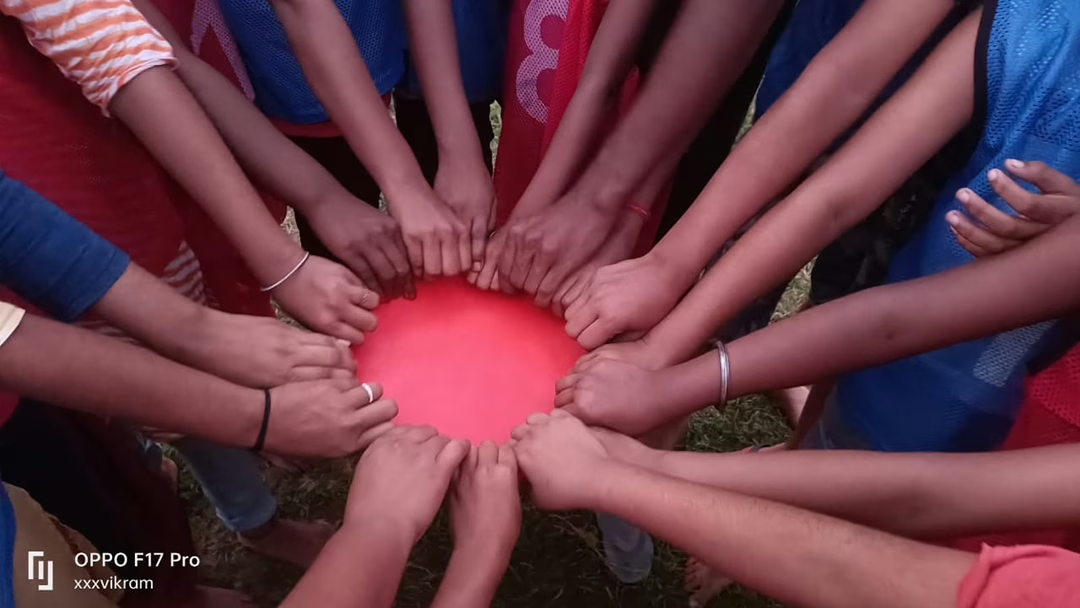
Yet, caste shadows lingered: they remained under watchful eyes, women were weighed down by the daily drudgery of housework and union work pressed, urgent and uneven. Yet in these moments, frisbees soared, laughter spilled across the fields and hands were held in solidarity.
Fragments of joy and defiance persisted. Perhaps this is the real map of caste India — not a single liberated village, but scattered pockets of freedom claimed, held and shared in defiance of its moral geography.
***
Neha flung the disk high. Meena sprinted, dupatta slipping, fingers grazing the frisbee just as her body hit the ground. For a heartbeat, she was weightless — then the earth slammed into her chest, elbow scraping dirt, skin stinging — but she had it. For a moment, she was more than a body being watched. They were all more than just their bodies under scrutiny — they were a warning. Joy, in the wrong hands, is political. Khabardar!
-
Tanmay Nivedita is trans feminist (pronouns: he/him/they) who has worked with Jan Jagaran Shakti Sangathan, a trade union organising landless rural workers, marginalised communities and young people based in rural Bihar for the last decade.