
Pastoral livelihoods are considered anomalous to the development agenda: they’re wholly invisible in the urban imagination. Though many are content to continue along the nomadic lines of their occupation, in recent years some have considered ‘settling’ in the city to formally educate the next generation. Neither of the city nor the forest, with rules curtailing their movement imposed, how and to where do they belong? In the city, where opportunity lies, how do pastoral families negotiate what to change and what to hold onto? As communities attuned to nature’s rhythms, how do they look at the relatively fixed life of urbanity?
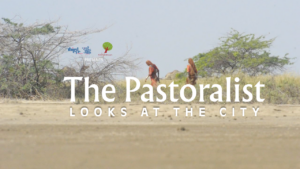
As part of our City edition, we collaborated with Sahjeevan Trust and the Centre for Pastoralism to produce The Pastoralist Looks at the City, a film that centres the gaze of the itinerant rather than that of the city-dweller.
We usually see pastoralists in our rear-view mirrors; many of us don’t even notice. A man and his herd at the edge of a highway, a woman walking her sheep along a road on the outskirts of a metropolis. Looking at them, one can perhaps imagine a world that used to be. This film asks the pastoralist for their idea of the city — as one group of the many kinds of citizens for whom these concrete jungles have not been planned.
Pastoralists are mobile herders who move with their livestock: camels, sheep, goats, cattle, buffalo and even yak. Their invisibility isn’t a metaphor — it’s the official record. Since we never planned for pastoralists, our idea of developing societies has never explicitly included them.
Up until recently, there were no official figures for how many pastoralists lived and worked across the country, though some suggested it could be between 10 and 12 million people. In late 2024, for the first time since 1919, India finally began counting its pastoral communities.
And yet, pastoralism is part of our everyday lives, part of our cities. A sizable portion (10%) of our dairy economy and more than 70% of our meat economy are supported by pastoralism. Along with the economic value of the manure and wool from the livestock and the breeding and upkeep of 40% of the recognised livestock breeds in the country, this is an INR 1.3 lakh crore livelihood based on generations of ecological knowledge.
Globally too, pastoralism has a significant role to play in food and ecological security. So crucial is this role that 2026 has been declared the United Nations’ International Year of Rangelands and Pastoralists, towards overdue recognition of the landscapes and the people who hold them together.
For The Third Eye’s City edition, we partnered with Sahjeevan — a non-profit that has worked in India’s pastoral landscapes for over three decades — to produce this film. Women and men from the Rabari, Bharwad, and Fakirani Jatt communities spoke about their maal (livestock) and their identity. “We look after our animals the way we look after our children,” one said.
Running through every conversation is a choice their work forces on them: the city, or not. The pastoralist’s way of life is built on movement from one place to the next, for grass and water, across the seasons. The city is built for a different kind of movement entirely. It boasts education and healthcare, but no one who can look after the camels. Pastoralists who continue to walk do not reject education, so much as ask why it must cost them their way of life. They question the city itself, which makes room via four- and six-lane highways for the movement of vehicles, but spares not a thought for the movement of the pastoralists that support it.
Film produced by The Third Eye
Text by Aniruddh Sheth (Centre for Pastoralism)
-
The Third Eye is being written and developed by a team of educators, documentary filmmakers, storytellers; people with extensive experience of gathering narratives, oral histories and developing contextual pedagogies for the rural and the marginalised.