
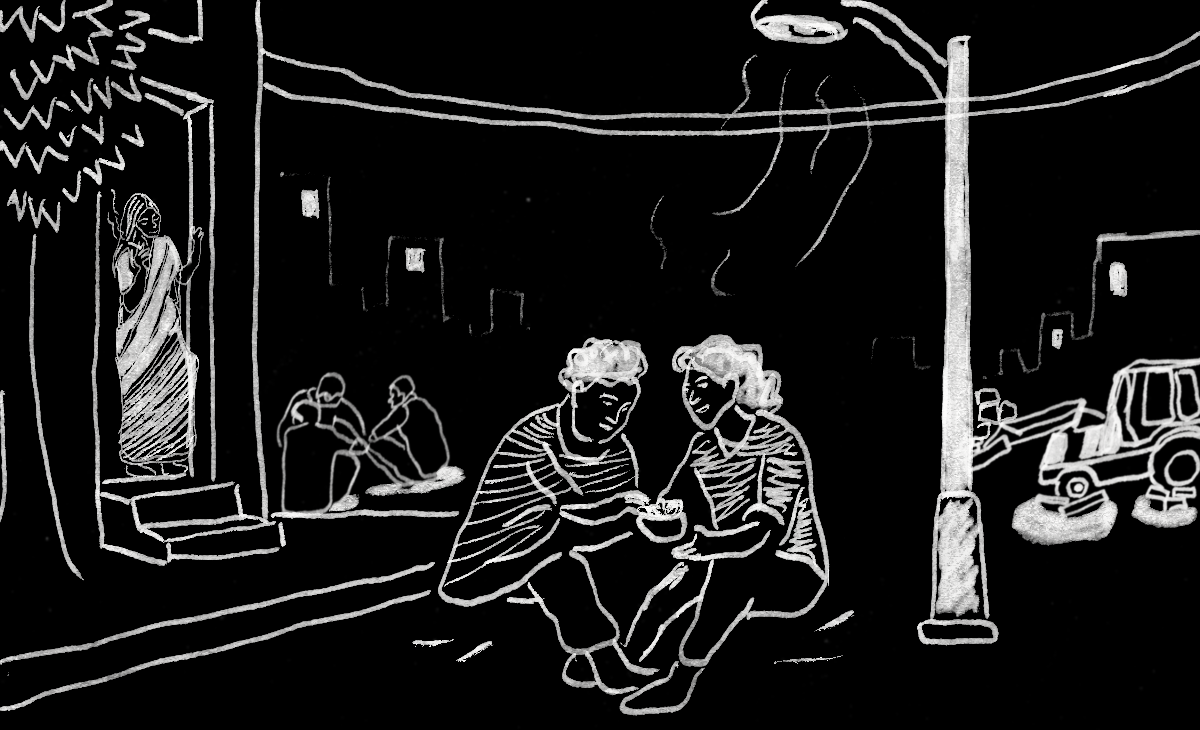
On some nights, M tells me, at the Sabarmati riverfront in Ahmedabad, couples cluster along the parapet, lit dimly against the water’s edge. The river glimmers faintly under the moonlight; heads bend close in whispered conversations. Police patrols move along the sea face discreetly, rarely intervening. “There is a kind of understanding,” M says. “They let you sit together, but there are limits. You are seen, but not addressed.”
This permission is delicate: tolerated today, but not necessarily tomorrow. The riverfront is both public and private. Darkness here performs an impossible task — it shelters love while also risking exposure.
In June 2018, Asha and Bhavna Thakor, a lesbian couple, drowned in the Sabarmati after having lost both their jobs and faced isolation from friends and family. They tied themselves together and leapt into the same river that has long offered other lovers the tenuous safety of the dark. Before their deaths, they left behind a message: “We are leaving this world to live with each other. The world did not allow us to stay together.”
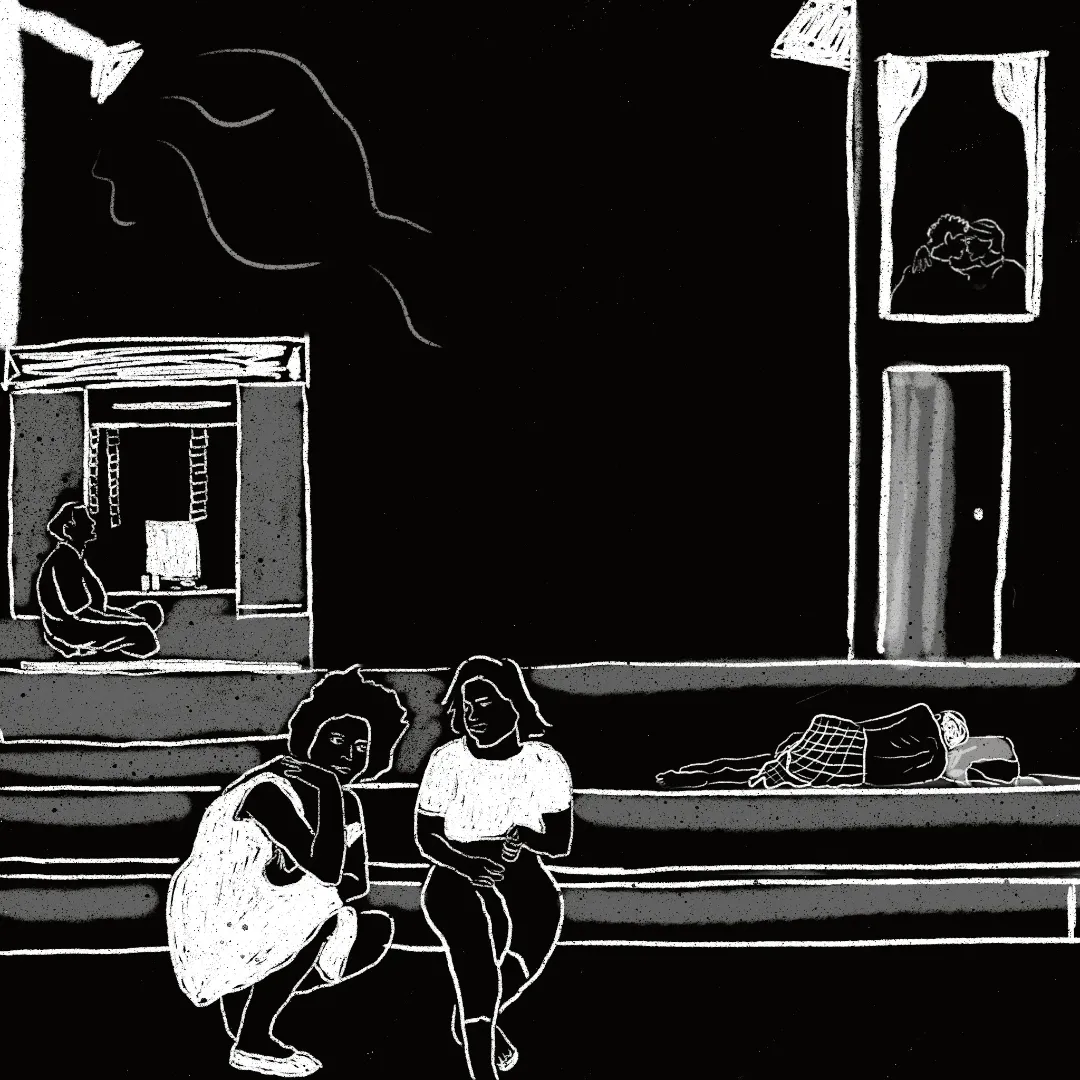
The act sits at the uneasy edge of what darkness promises — privacy without safety, permission without acceptance. In a city where public affection between queer lovers survives only by blending into the dark, Asha and Bhavna’s deaths echo the limits of that permission. Darkness may enable, but it cannot guarantee belonging.
It is not merely the absence of light, but the social condition of urbanism that determines whose intimacy can exist. Darkness grants cover to desire, yet carries the risk of punishment — sometimes with fatal consequences.
Darkness as permission

In Shaunak Sen’s documentary Cities of Sleep (2015), darkness falls over Delhi like a curtain, both sheltering and suffocating. Sen follows Shakeel and Ranjeet, two men navigating what he calls the city’s “sleep economy”. As the night deepens, pavements, underpasses and half-built constructions turn into provisional beds for the city’s working class. A spot in one of the city’s night shelters costs 20 or 40 rupees; a missed payment or the wrong police encounter can mean another night spent awake.
Ranjeet builds a makeshift cinema-and-sleep space under Loha Pul, the railway bridge beside the Yamuna river. “Sleep is not stillness,” he says. “It moves away from the binaries of the world — like in and out, light and darkness, existing and not-existing.” Above the bridge, the city blazes fluorescent white. Below, in the half-light, hundreds rest in the grey area between legitimacy and exclusion.
Shakeel moves through similar thresholds. He searches for food in the day and sleep at night, navigating pavements, shelters, police instructions and the unpredictable generosity of strangers. Like this, the city gives and withdraws permission from one moment to another, from one place to the next.
Cities of Sleep opens the path to seeing darkness itself as a condition of existence — one that decides who is allowed to rest, love or dream while the city sleeps. In a country where visibility often translates into vulnerability, the night becomes both a refuge and a frontier: a landscape of temporary permissions, negotiated silences and unseen intimacies.
Bare life, visible and invisible
Italian philosopher Giorgio Agamben, in his book Homo Sacer: Sovereign Power and Bare Life (1995), introduced the idea of ‘bare life’ to describe people who are present within a political system but denied its protections.
The concept has been taken up by contemporary scholars studying migration, policing and displacement through urbanism: Anthropologist Michel Agier uses it to describe refugee camps, where people are kept alive but remain outside political recognition. Urban theorist Nicholas De Genova writes about undocumented workers whose lives unfold in “zones of deportability”, where they labour in the city but cannot claim safety in it.
Research on homelessness in cities like Delhi and Los Angeles echoes this characteristic of urbanism; the unhoused are permitted to sleep under flyovers and on pavements only until the State decides otherwise. Across these contexts, ‘bare life’ names the experience of living at the threshold — present, but never secure.
A similar precariousness shapes the lives of those who rely on darkness in Indian cities. The people who sleep under Loha Pul in Cities of Sleep; the women who wait for night to relieve themselves in rural Bihar and queer lovers who find privacy only at the Sabarmati riverfront, all inhabit this threshold.
Darkness becomes a kind of exceptional equipment that makes survival and intimacy possible when formal structures of safety are absent.
The lovers and the light
In the 2016 film Aligarh, based on the true story of Professor Ramchandra Siras, light is a violent intruder. Siras, a Marathi professor at Aligarh Muslim University, is filmed at night by journalists conducting a ‘sting operation’, outing his relationship with a rickshaw driver. In the film, the sudden burst of light into his room symbolises revelation as violation.
The dark of the room had been his only privacy — a fragile space in which his desires could exist without scrutiny. Light arrives and does not illuminate, but litigates his right to be unseen; transforming intimacy into evidence.

In an interview for this piece, Shripad Sinnakaar, a Dalit poet from Dharavi, asks: “If you take away the dark, where do the lovers go?” Across cities, lovers find themselves transiting through toilets, underpasses and corners where light does not reach: these are not neutral geographies.
A researcher of urbanism, Dhiren Borisa, maps how working-class queer and trans people in Delhi rely on fleeting and semi-public zones — cruising lanes, subways, underused waiting areas and the shadowed edges of parks — as private rooms are often unaffordable or inaccessible. These spaces become what he terms “geographies of survival… ephemeral, imagined and performative”, existing under conditions of invisibility and risk.
Urban erasures
City planners and practitioners of urbanism increasingly frame darkness as dangerous. Under India’s Safe City Project, municipal authorities have identified “dark spots” to be eliminated through floodlights, LED streetlamps and CCTV networks.
Uttar Pradesh identified over 4,150 such dark spots and installed tens of thousands of cameras under the scheme. In New Delhi, civic agencies announced plans to light up more than 1,000 dark spots, allocating funds and technology to monitor the changes.
When floodlit promenades replace informal corners, or when underpasses and lanes are redesigned to maximise visibility, the result is the re-engineering of who may linger, touch or rest unseen. A lit walkway is coded as safe and respectable. A shadowed corner, once a venue for young lovers, now becomes a site of exclusion: bright lighting invites surveillance and any remaining dim areas are treated as suspicious by police, residents’ groups or security guards.
What was once tolerated as a quiet pocket of privacy is recast as a problem to be managed. The rhetoric of safety and beautification hides a deeper moral project: disciplining whose bodies belong in public, under what terms.

Shripad Sinnakaar observes how in Mumbai’s slums, light becomes a measure of worth. “Darkness is seen as dirty, as immoral,” he says. He points to resettlement buildings in places like Govandi, where the lack of lighting in the lanes are thought of as uninhabitable. The shift is subtle but powerful: light no longer only reveals danger — it signifies legitimacy. In his words: “[J]ust the absence of light decided whether people could live there.”
A 2024 survey counted over 1,50,000 people spending the night on India’s streets, while shelters cover less than 10% of that need. To survive, many exist within the grey light of the city — not fully seen, not fully hidden. The night gathers those the city does not claim — a shadow archive of people who live beyond the promise of belonging to it.
Removed by redevelopment, remodelled as public space, and regimented by lighting, the lightless edge-spaces shrink and the exceptional equipment of darkness breaks down. As they dissolve, so do the possibilities for unsanctioned togetherness and spontaneous connection for lives lived in the margins.
The geography of desire is redrawn by brightness and surveillance: spaces once shadowed enough for intimacy are now managed, sanitised and policed.
Marine Drive, with its romantic reputation, is often celebrated as a safe space for public affection. Shripad is quick to point out the limits of that visibility. “Not everybody goes there,” he says. “What about the others? Where do they go?”
The lovers who gather under the streetlights along Marine Drive are, in some ways, the exception — those who can afford to be illuminated. For the working class, for queer people, for migrants without private rooms, the dark remains the only architecture of urbanism that allows them to exist together, however briefly.
Lovers adapt. “People find their own corners,” Shripad says. “The subways, the public toilets, the backs of buses — to talk, to argue, to be together.”
The dark, in being lit out of existence, becomes more precarious — and more necessary. The anonymity of a crowd or a dimly-lit lane makes possible what cramped homes do not. In many working-class families, young people grow up in one-room tenements, surrounded by parents and siblings, without the “luxury of privacy,” as Shripad says. So relationships are improvised in the shadows — through whispered arguments, brief touches or silences that speak their own language.
The risk and the gender of the dark
For women, darkness carries a different calculus of fear and freedom. In rural Bihar, a 2014 Guardian report noted that women often wait until after dusk to relieve themselves, since social norms forbid them from doing so in daylight. The practice offers privacy but brings risks such as snake bites and harassment.
The dangerous night grants the only moments of privacy in a life of constant visibility. Darkness, for these women, is necessity masquerading as choice.

Another kind of night
Not all darkness is earthly. Thousands of kilometres away, over Chile’s Atacama Desert, lies one of the darkest night skies on Earth. Here, the European Southern Observatory’s Very Large Telescope (VLT) studies distant galaxies, exoplanets and faint celestial phenomena. But a proposed green-hydrogen project called INNA threatens to flood the desert with industrial lighting. Astronomers warn that night-sky brightness could rise by up to 35 per cent, crippling and obstructing long-exposure observation.
“Darkness is extremely fragile,” says astronomer Eduardo Unda-Sanzana, an astronomer quoted in The New York Times. For him, darkness is clarity —- a precondition for seeing the farthest corners of the universe.
For Indigenous Atacameño communities, darkness is part of cosmology itself. The night sky is read not only through its stars but through the dark constellations formed by shadows in the Milky Way, which guide agricultural cycles, mark ceremonial time and hold ancestral narratives.
When artificial light erases the night, these systems of knowledge lose their horizon. “To keep observing the universe, we need atmospheric stability and for darkness to prevail —- without this, we won’t be able to further our understanding,” says Itziar de Gregorio, ESO’s director of the Observatory in Chile.
The battle to preserve the night sky in Chile echoes the struggle for intimacy in India’s cities. In both — the right to preserve the night sky in Chile and to dwell unseen, perceive or love without glare in Delhi — becomes a fight for the right to darkness, for existence itself.
Personal relationships with the dark
For Asad, a yoga instructor in Karachi, darkness is neither metaphor nor menace, but rather a companion. Their bedroom, passed down through generations, has become a refuge from the noise of family life and social scrutiny. “I met darkness as enforced on certain bodies,” they write by email. “Now I return to her because I need her. She is unconcerned with the business of looks and looking.”
Asad’s writing recalls Rumi’s The Guest House and Ocean Vuong’s Someday I’ll Love, in which darkness is personified — loyal rather than lonely, asking for no performance. For them, darkness witnessed a childhood marked by solitude and difference. They describe growing up queer, neurodivergent and often misunderstood, finding in the night a stillness that neither home nor daylight allowed. It was in the quiet, unseen hours that they began to imagine a self that could exist without explanation or defence. “[Darkness] is the only one who stays,” Asad says, a space that holds rather than hides.
This tenderness towards the dark does not erase danger, but rather accepts it as part of intimacy — the risk of being with oneself and with others.
Desire and its disappearing spaces
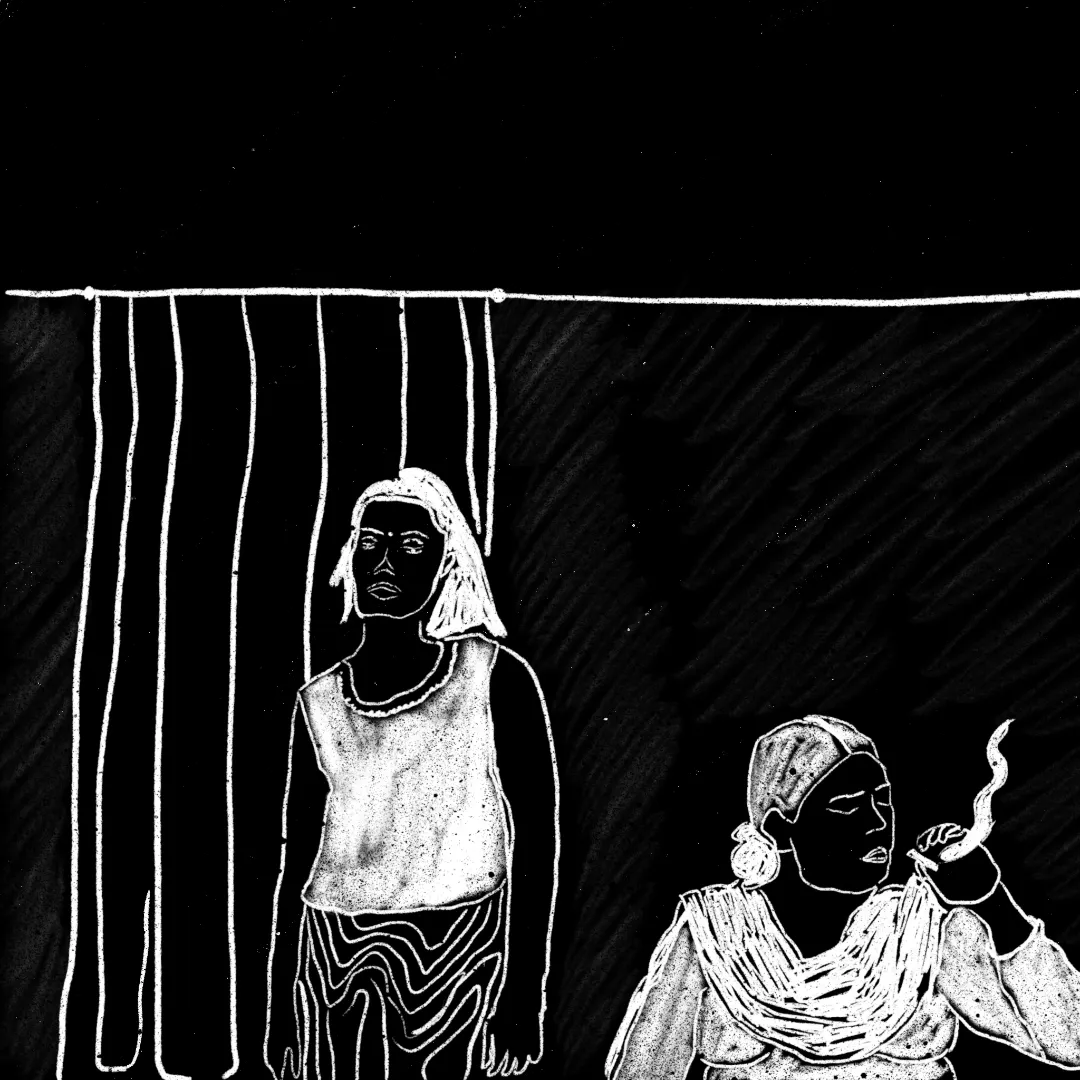
The 2021 police raid on a Delhi massage parlour illustrates again how the dark can turn from sanctuary to spectacle. This time a YouTuber, accompanied by police, stormed into a dimly lit spa where gay men met discreetly. Cameras caught naked men scrambling for clothes; the footage was uploaded online with shouts of “Sex!” — a private refuge turned public humiliation.
The fragility of desire
To exist in darkness then, is to live in what Agamben calls “the threshold” — where one’s humanity is suspended between recognition and erasure. The dark shelters desire not because it is safe, but because it is the only space left ungoverned.
If you take away the dark, where do the lovers go?
For M, at the Sabarmati Riverfront, the answer is uncertain. “People will find new spaces,” they say. “They always do. But it will never feel the same. Darkness hides you just enough — but not so much that you feel alone.”
Darkness is not freedom; it is the prism through which freedom flickers. It is the pause between surveillance and safety, between what is seen and what is allowed to exist. In Agamben’s terms, it is the terrain of the bare life — where people remain visible yet unprotected, existing within sight but outside recognition.
In India’s cities, those who gather in the dark — the undocumented, the poor, the queer, the weary and the dreaming — inhabit this threshold. Their presence unsettles the order of urbanism that equates visibility with legitimacy. In darkness, they negotiate not only love, but the right to remain human.
Perhaps that is the point. Darkness, for all its risk and instability, continues to shelter those who refuse to stop reaching for one another — those who still believe that love, rest and wonder might need the dark to survive.
-
Saachi D’Souza is a writer and editor working across reportage, essays, fiction, and scripts on culture, identity, and politics.